
- What is OKR (Objectives and Key Results)?
- What are KPIs (Key Performance Indicators)?
- Key Differences Between OKRs and KPIs
- Benefits of OKRs
- Benefits of KPIs
- When to Use OKRs vs. KPIs
- Real-World Examples of OKRs
- Real-World Examples of KPIs
- What Your Business Needs: OKRs vs. KPIs?
- How to Use OKR and KPIs Together
- Best Practices to Use OKRs and KPIs
- Common Mistakes While Using OKR and KPIs
- Tools to Measure OKRs and KPIs
- Conclusion
- FAQs
Have you also been using the terms OKR (Objectives and Key Results) and KPI (Key Performance Indicators) interchangeably? You are not alone, as most business professionals make the same mistake. But, in reality, these two structures are far more different than you can imagine.
They impact two different horizons of performance and progress. OKRs provide ambitious, future-oriented goal-setting, while KPIs provide measurable metrics to track ongoing progress.
For sustainable success, using the two in synergy is essential.
But knowing how they differ and how they complement each other despite those differences is even more crucial.
Here is an OKR vs KPI comparison guide that explains the differences between these two popular frameworks, how to use them together, and best practices for making the most of both.
What is OKR (Objectives and Key Results)?
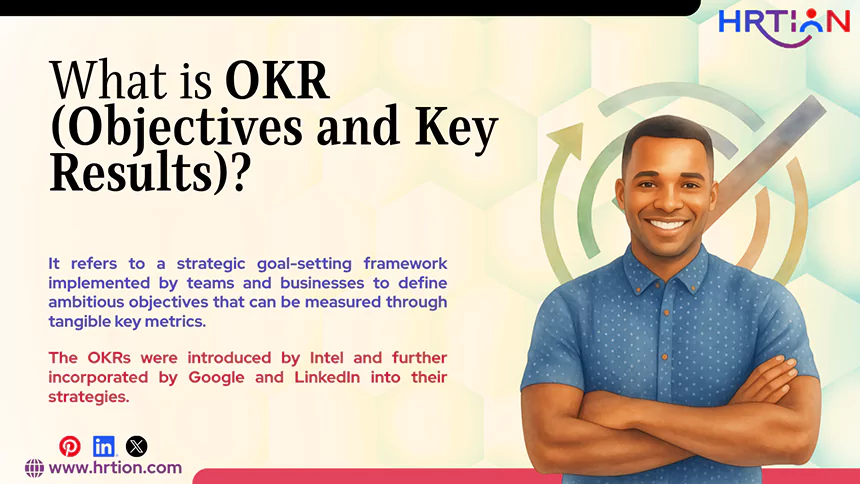
OKR, aka Objectives and Key Results, refers to a strategic goal-setting framework implemented by teams and businesses to define ambitious objectives that can be measured through tangible key metrics.
This framework is divided into two parts: one is qualitative and the other quantitative.
- Objective: A clear and inspiring goal (qualitative)
- Key Results: Measurable results that define the progress and success (quantitative)
OKRs look like: “What are we aiming to achieve, and how will we measure the success?”
The key characteristics of OKRs:
- Time bound
- Ambitious and aspirational
- Transparent
- Result-oriented, instead of task-based.
The OKRs were introduced by Intel and further incorporated by Google and LinkedIn into their strategies. Google then adopted it in the early stages and witnessed significant growth.
What are KPIs (Key Performance Indicators)?
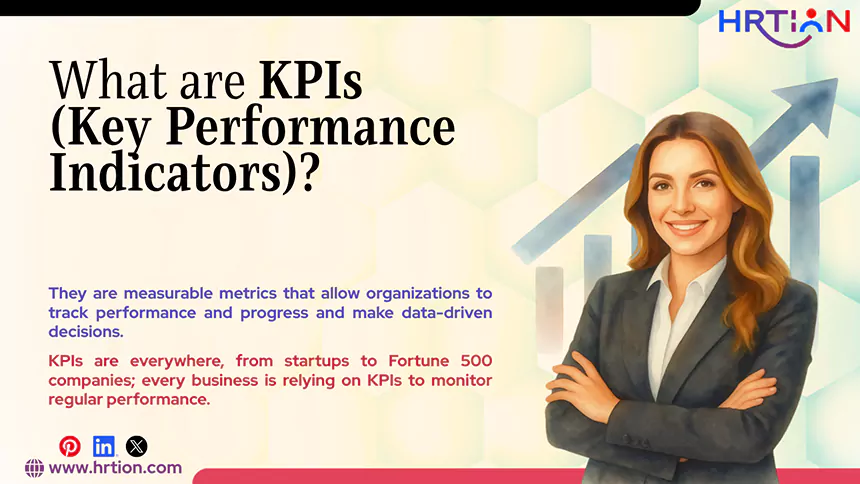
KPIs, or Key Performance Indicators, are measurable metrics that allow organizations to track performance and progress and make data-driven decisions.
Instead of setting ambitious outcomes, KPI focuses on monitoring current performance by setting achievable benchmarks.
In contrast to OKRs, KPIs are just metrics and not a complete framework.
KPIs look like: “How are we performing right now?”
The key characteristics of KPIs:
- Quantitative and measurable.
- Track ongoing progress
- Monitor continuous performance
- Dependable on business operations
KPIs are everywhere, from startups to Fortune 500 companies; every business is relying on KPIs to monitor regular performance and ensure that operations are on track.
Key Differences Between OKRs and KPIs
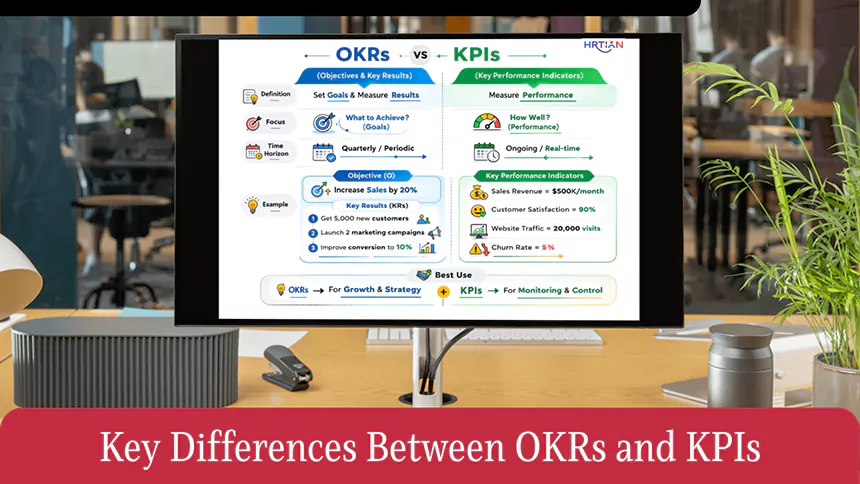
| Aspect | OKRs (Objectives and Key Results) | KPIs (Key Performance Indicators) |
| Definition | It is a strategic goal-setting framework for defining ambitious objectives and measurable outcomes. | It is not a framework but metrics that help a business to work toward its goal. |
| Primary Purpose | Setting directions, driving growth, and achieving desired transformation. | Measure ongoing performance to ensure that business operations are on track. |
| Nature | Framework with qualitative and quantitative facets. | A metric or a measurable value. |
| Focus Area | Futuristic achievements and improvements. | Current and past performance tracking. |
| Structure | Two components:
| Single measurable metric, for example, revenue, conversion rate, and churn rate |
| Timeframe | Short-term and cyclical (usually quarterly and monthly) | Long-term and continuous |
| Flexibility | Highly flexible and can be changed according to priorities | Stable, and it only changes when there is a shift in business strategy. |
| Goal Type | Aspirational and ambitious | Realistic and performance-based. |
| Usage | Best for strategy execution, innovation, and growth | Used for monitoring operations, efficiency, and stability. |
| Measurement | Measures progress towards achieving a specific goal. | Measures performance based on a predefined standard. |
| Outcome vs outputs | Focused on outcomes | Focused on outputs |
| Reviews | Reviewed frequently | Reviewed periodically |
| Transparency | Highly transparent | Restricted to teams or dashboard. |
| Complexity | Slightly complex | Simple and straightforward |
| Best use case | Best for startups, scaling businesses, and innovation. | Best for already established processes, operations, and performance tracking. |
Benefits of OKRs
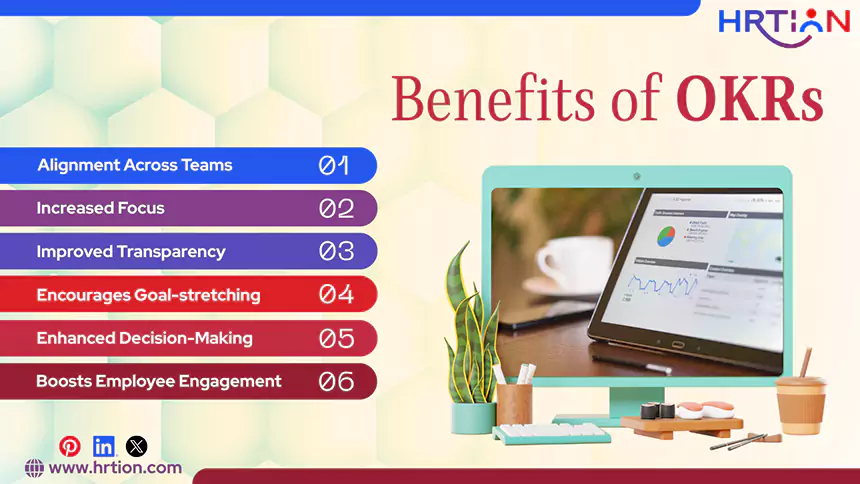
- Alignment Across Teams
OKRs help teams and individuals align with the company goals. It ensures that everyone is moving in the same direction.
- Increased Focus
OKRs narrow down the number of priorities, helping the team focus on what’s actually required. Instead of juggling 20 different jobs, teams can concentrate on major meaningful objectives.
- Improved Transparency
OKRs offer complete transparency as the process is quite visible to every team member. This fosters accountability and collaboration.
- Encourages Goal-stretching
OKRs are designed to stretch goals and push teams and professionals out of their comfort zones. This feature is said to stretch goals’ performance by 20-25%.
- Enhanced Decision-Making
With clear data, objectives, and measurable results, managers and authorities can make data-driven decisions without investing much time and effort.
- Boosts Employee Engagement
Employees feel more connected and motivated to meet company goals. They can track their contributions towards the work.
Benefits of KPIs
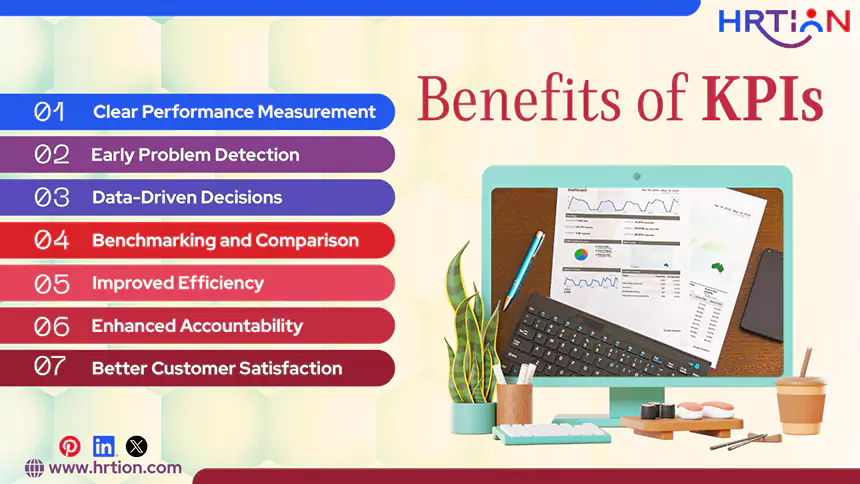
- Clear Performance Measurement
KPIs provide measurable and objective data for clear goal management. It helps to comprehend how well an employee, team, or group is performing.
This clarity helps in setting realistic goals and planning strategies that actually work.
- Early Problem Detection
Regular KPI tracking allows the company to find the limitations in the early stages before they turn into blunders. For example, a sudden drop in conversion rate can help spot the issues with marketing strategies, website performance, and user experience.
- Data-Driven Decisions
By providing comprehensive data insights, KPIs eliminate the guesswork and intuition-based decisions. Leaders and managers can make informed decisions, leading to profitable outcomes.
- Benchmarking and Comparison
KPIs allow businesses to compare the current performance with the past results, industry standards, and competitors. The comparison enables businesses to identify areas of improvement.
- Improved Efficiency
KPIs aid organizations in identifying challenges and bottlenecks, helping maintain a streamlined workflow and optimized resource management. Teams can focus on high-impact and profitable activities, reducing wasted efforts, and improving overall productivity.
- Enhanced Accountability and Transparency
With clear KPIs and metrics, teams can set real-time and achievable expectations. And, with performance becoming transparent, companies can evaluate contribution and hold a specific individual accountable.
- Better Customer Satisfaction
Customer-based KPIs enable tracking metrics like response time, retention rate, and satisfaction rate. This helps companies form a structure that enhances customer experience, resulting in stronger relationships, loyalty, and sounder revenue.
Manage the payroll, attendance, shift roles, and more in an all-encompassing HR suite. Your ultimate HR toolkit is just a click away.
When to Use OKRs vs. KPIs
OKRs and KPIs cannot be used interchangeably but are complementing factors. Although they both serve different purposes, their goal is precisely the same. But here is when to use OKRs and when to focus on KPIs.
| OKRs | KPIs |
| While setting ambitious goals. | For day-to-day operations and routine performance tracking. |
| When The team needs little push | To measure efficiency, quality, and productivity. |
| During new initiatives of projects. | Tracking business health metrics, such as revenue or customer satisfaction. |
| In fast-growing environments. | When ensuring stability and consistency across the team. |
| To encourage innovation and better performance | During reporting and reviews |
| Aligning team efforts around shared objectives. | For benchmarking against the previous achievements. |
Real-World Examples of OKRs
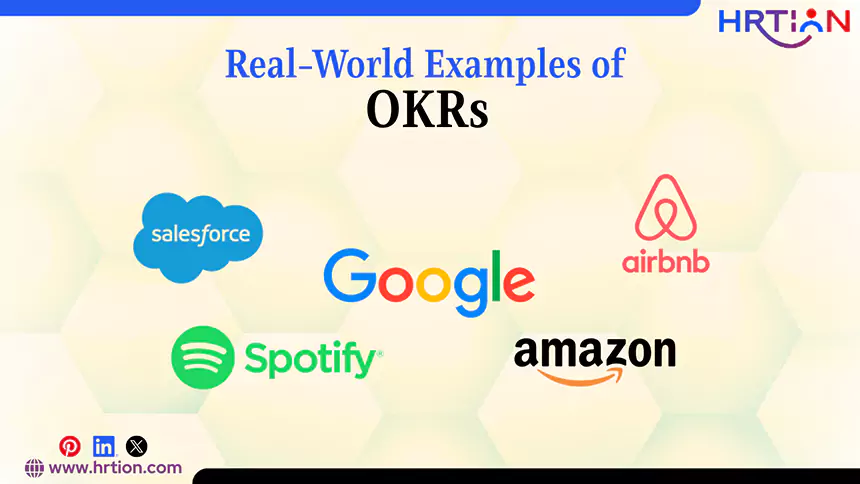
OKRs can be better understood when tied to real-time examples. Here are the OKRs examples that various industry giants have integrated for better goal-setting.
1. Marketing OKR Examples:
Airbnb
Airbnb mainly focuses on brand storytelling and global reach; their OKRs prioritize real-time marketing across the world.
Objective: Increase global brand awareness and user acquisition
- Key Result 1: Increase website traffic by 50% through organic channels.
- Key Result 2: Grow app downloads by 30% in emerging trends.
- Key Results 3: Improve conversion rate from 4% to 7%.
- Key Results 4: Launch 5 high-performing global campaigns.
2. Sales OKR Examples
Salesforce
Salesforce uses structured sales processes to scale business; thus, their OKRs usually look like this:
Objective: Increase enterprise sales growth
- Key Result 1: Accelerate enterprise revenue by 25%.
- Key Result 2: Close more than 100 deals to generate revenue of $5000 and above.
- Key Results 3: Reduce the sales cycle from 60 days to 40 days.
- Key Results 4: Increase the win rate from 22% to 30%.
3. HR OKR Examples
Google is known for its employee-centric and data-driven HR practices; these are some of the realistic OKRs for the company.
Objective: Increase employee engagement and workplace culture.
- Key Results 1: Improve employee engagement score to 90%.
- Key Results 2: Reduce voluntary attrition by 15%.
- Key Results 3: Achieve 95% participation in internal feedback surveys
- Key Results 4: Increase diversity hiring ratio by 20%.
4. Product Engineering OKR Examples
Spotify
Objective: Improve user experience and platform performance.
- Key Results 1: Reduce app load time by 50%.
- Key Results 2: Increase daily active users by 20%.
- Key Results 3: Improve feature/adoption rate for playlists by 35%.
- Key Results 4: Reduce app crashes by 40%.
5. Customer Support OKR Examples
Amazon
Objective: Enhance user experience and platform performance.
- Key Results 1: Reduce average response time to 1 hour.
- Key Results 2: Increase daily customer satisfaction score (CSAT) to 1 hour.
- Key Results 3: Resolve 92% of issues within the first interaction.
- Key Results 4: Improve NPS (Net Promoter Score) by 20 points.
Real-World Examples of KPIs

KPIs depict real-time and trackable metrics to ensure performance stability. Here are examples of how KPIs have been used in some of the most successful business strategies.
1. Marketing KPI Examples
Netflix
Netflix mainly relies on engagement and user retention metrics.
- Monthly active users (MAU)
- Customer acquisition cost (CAC)
- Conversion rate from free trial to paid.
- Content engagement rate.
- Subscriber growth rate.
2. Sales KPI Examples
HubSpot
SaaS companies, including HubSpot, usually track KPIs that focus on recurring revenue and pipeline health.
- Monthly recurring revenue (MRR).
- Sales conversion rate.
- Average deal size.
- Customer acquisition rate.
- Pipeline value.
3. HR KPI Examples
Microsoft
Microsoft uses HR KPIs to build a high-performing workforce, resulting in accelerating growth.
- Employee retention rate
- Time to hire
- Employee satisfaction score
- Diversity ratio
- Training completion rate
4. Product Engineering KPI Examples
Meta
Meta tracks user engagement and platform performance quite closely.
- Daily active users
- App crash time
- Feature usage rate
- System uptime
- Page load time
5. Customer Support KPI Examples
Zappos
Zappos is known for providing exceptional customer service; it ensures that it evaluates related KPIs strictly.
- Customer satisfaction score (CSAT)
- First-time response
- Resolution time
- Customer retention rate
- Net Promoter Score (NPS)
What Your Business Needs: OKRs vs. KPIs?
Neither OKRs nor KPIs are better, as both are equally essential for scalability and growth of the business. They serve as complementary tools; choosing between them only depends upon your specific goals at a given time.
OKRs are ideal in situations where businesses want to grow, innovate, or change. They help in setting ambitious goals and define a direction for business to move.
Whereas KPIs are primarily used to measure the ongoing performance of processes and ensure that business stays on the right track.
Thus, combining them both will lead to a business that stays in the right direction and grows in both qualitative and quantitative aspects.
How to Use OKR and KPIs Together
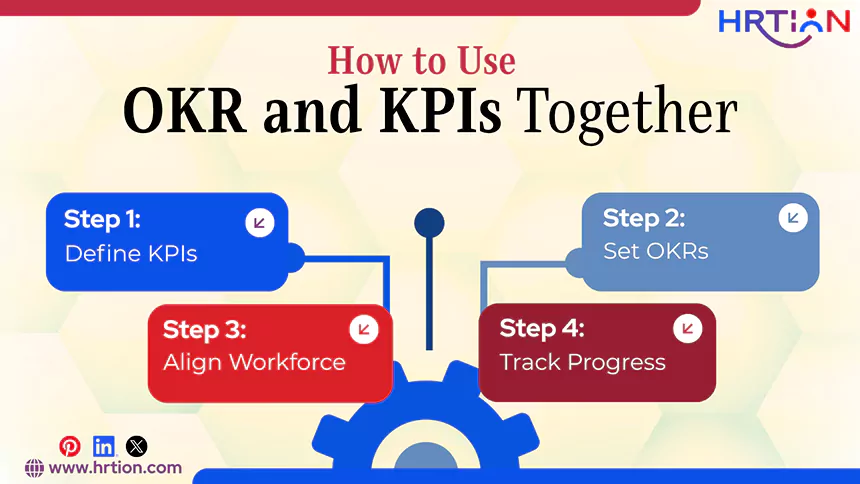
For a flourishing and profitable business, it is essential to use both together. It creates a balanced approach to achieve long-term success.
Here are the steps to follow for setting OKRs and KPIs together:
Step 1: Define KPIs
First determine the key metrics that describe the overall business health. KPIs are indicators that help measure factors like revenue, customer retention, conversion rates, and more. They work as a scorecard for the current performance.
Step 2: Set OKRs
Form clear and attainable objectives that aim at improving KPIs. Each objective must be supported through measurable key results so that the focus can remain on growth, change, and achieving certain results within a set time span.
Step 3: Align Workforce
The next important thing is to align team-level OKRs with company goals, and each team must work to improve key KPIs for the objective. This alignment is helpful in keeping everyone focused and directed towards the same objectives.
Step 4: Track Progress
Monitor KPIs regularly to check the progress and performance against OKRS. For this, use dashboards, reviews, and check-ins, and adjust the strategies if KPIs are not improving as planned.
Best Practices to Use OKRs and KPIs
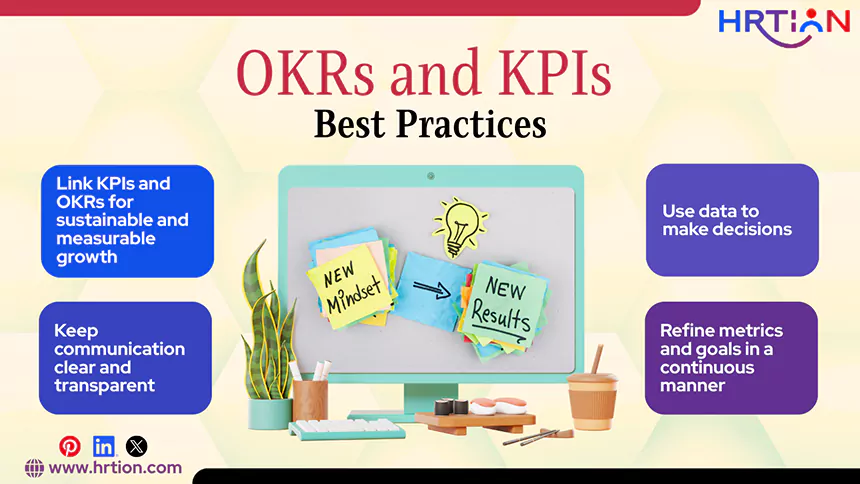
Before getting to the specific ones, let’s walk through the common best practices when using OKRs and KPIs together:
- Link KPIs and OKRs for sustainable and measurable growth.
- Use data to make decisions.
- Keep communication clear and transparent.
- Refine metrics and goals in a continuous manner.
Now, it’s time to comprehend the best practices to follow while focusing on OKRs and KPIs separately.
| OKRs Best Practices | KPIs Best Practices |
| Set 3-5 objectives per quarter. | Focus on crucial metrics only. |
| Make key results attainable. | Avoid superficial metrics, such as impression without conversion. |
| Keep goals ambitious and realistic. | Use real-time dashboards. |
| Ensure transparency across the company. | Align KPIs with the business goals. |
Common Mistakes While Using OKR and KPIs
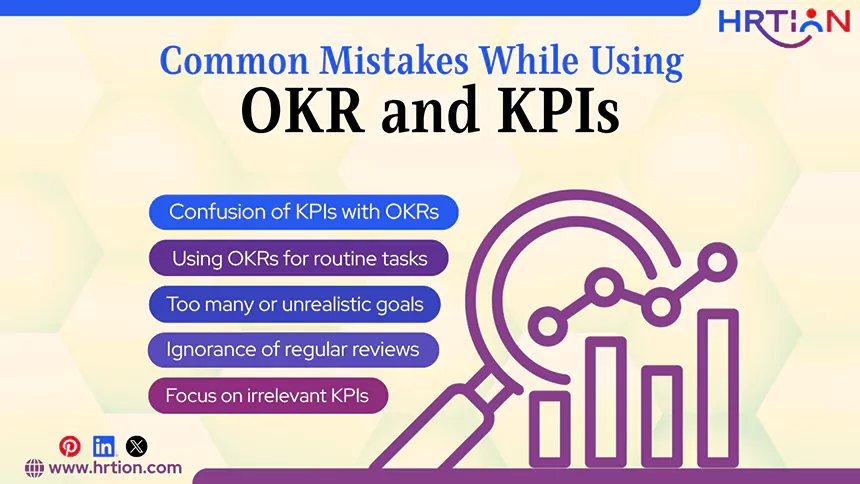
Here are a few common mistakes that can derail the company from meeting goals and achieving success:
- Many businesses often confuse KPIs with OKRs. They keep using KPIs for forming objectives, reducing clarity and measurability.
- Establishing too many goals diverts attention and focus. Teams with fewer goals are twice as likely to achieve them as they are dealing with what’s feasible.
- Setting unrealistic goals causes disruption. Overly ambitious OKRs can cause demotivation and failures.
- Ignoring regular reviews is risky, because without checking in progress at regular intervals, goals and KPIs become irrelevant.
- Businesses often use OKRs for routine tasks, which can be unhealthy. The OKRs are mainly focused on overall transformation and not daily routines.
- Focusing on irrelevant KPIs is another mistake. Vanity metrics can lead to misguided decision-making.
Tools to Measure OKRs and KPIs
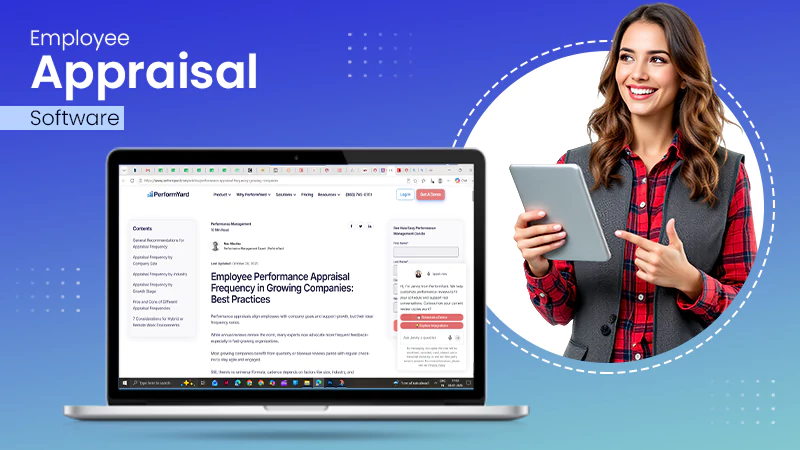
Many organizations also use Performance Management Software to track OKRs and KPIs in a centralized platform. These solutions help managers monitor employee goals, measure performance metrics, automate reporting, and maintain alignment between individual, team, and organizational objectives.
Choosing the right tools to track OKRs and KPIs can simplify implementation.
These tools can help in tracking progress, refining data, automating reporting, and keeping teams focused and aligned.
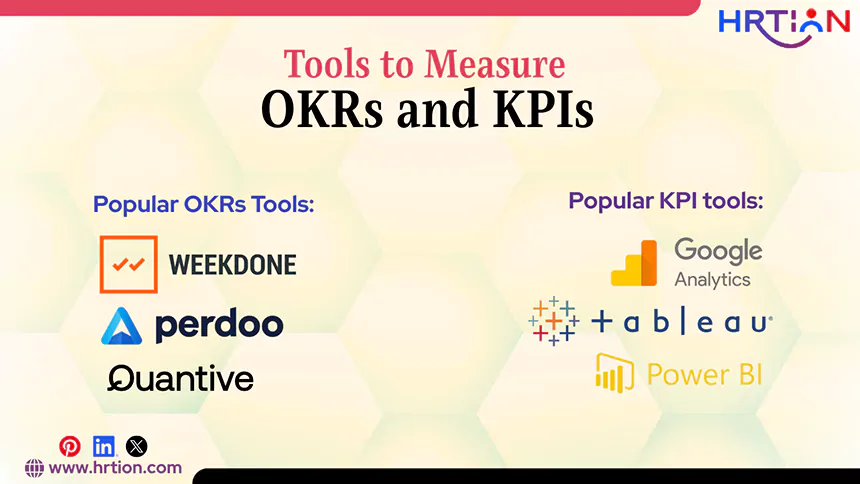
Popular OKRs Tools:
- Weekdone: It offers weekly progress reports, dashboards, and easy OKR tracking. The tool is best suited for mid-sized teams and businesses.
- Perdoo: It combines OKRs and KPIs in one platform, making it easier to track progress and measure results.
- Quantive (Gtmhub): It helps organizations to align strategy with execution by offering real-time dashboards, automating tracking, and integrating with other business tools.
Popular KPI tools:
- Google Analytics: It helps track website traffic, user behavior, conversions, and marketing performance.
- Tableau: It converts raw data into interactive dashboards and visual insights for data-driven decision-making.
- Microsoft Power BI: It helps businesses create detailed reports and break down KPIs for better understanding.
Conclusion
OKRs and KPIs are not competing frameworks but are actually meant to complement each other. They both help in creating a powerful system for growth and performance.
There are a few unified solutions available in the market to provide robust employee management through OKRs and KPIs; one such option is HRtion. With real-time analytics and user-friendly dashboards, it helps in aligning teams to meet goals efficiently.
FAQs
What is the difference between OKRs and KPIs?
OKRs are a goal-setting framework, whereas KPIs are performance metrics used to measure current progress.
How many OKRs are good enough for a business?
A company should have 3-5 objectives per quarter for attainable and realistic progress. Too many objectives can cause demotivation among employees.
Are OKRs suitable for small businesses?
Yes, OKRs suit all sizes of businesses well. They can even help startups grow better and faster.
What are the examples of KPIs?
Revenue, conversion rate, website traffic, churn rate, and customer satisfaction scores are some common KPIs used in all kinds of operations.
Do OKRs replace KPIs?
No, in reality, they both work together to form a strategic approach towards achieving goals and desired outcomes. One (OKR) sets goals while the other (KPI) helps measure them.

Bhavesh is a Guest Writer at HRTion with an academic background in HR. He did an HR management course in 2025. Before transitioning to HR content writer, he worked as an Academic Content Writer at Trident Management for over 6 years. His expertise in recruitment processes & strategies helps him write detailed and clear content that is not only informative but also accessible for everyone.