
- What is HR strategy?
- Why HR Strategy is Important for Small and Medium-Sized Enterprises (SMEs)
- Key Components of an Effective HR Strategy
- Popular HR Strategy Frameworks Used by Organizations
- How to Develop an HR Strategy for SMEs
- How to Use Automation in HR Strategy Development
- Real-World HR Strategy Examples for Businesses
- HR Strategy for Small vs. Large Businesses: Key Differences
- Conclusion
- Frequently Asked Questions (FAQs)
Small and medium-sized enterprises (SMEs) need an HR strategy that is simple, effective, and cost-efficient. For these businesses, employees are the backbone of success. Therefore, they must be properly trained, motivated, and rewarded, which is why SMEs’ human resource strategy must be people-centric.
However, with limited resources, time, and money, small companies often struggle to plan a strategy that can support the business’s success.
So, here is a complete HR strategy guide especially developed for SMEs. It consists of practical approaches to build a stronger workforce, improve productivity, reduce turnover rate, and create a positive and welcoming work culture.
So let’s dig in!
What is HR strategy?
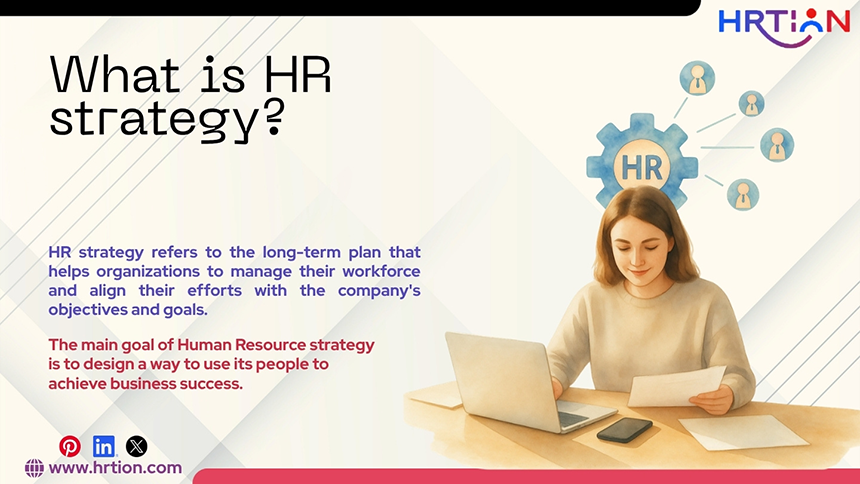
HR strategy refers to the long-term plan that helps organizations to manage their workforce and align their efforts with the company’s objectives and goals.
The main goal of Human Resource strategy is to design a way to use its people to achieve business success. Instead of just focusing on regular administrative tasks, strategic human resource management allows focus on attracting the right talent, enhancing employee engagement, developing skills, and directing endeavors towards business growth.
A well-designed HR strategy addresses major concerns like
- What are the skills and talents required for the company to achieve the determined goals?
- In what ways can an organization retain the talent that is high-performing and can bring growth?
- What sort of training and development initiatives are needed?
- How to align employee performance with the business objectives?
For SMEs, HR strategy is quite vital, as they are already looking for ways to scale their business. Even with smaller teams and limited resources, a strong Human resource strategy can help build productive teams. It acts as a roadmap to success by managing people effectively.
Why HR Strategy is Important for Small and Medium-Sized Enterprises (SMEs)
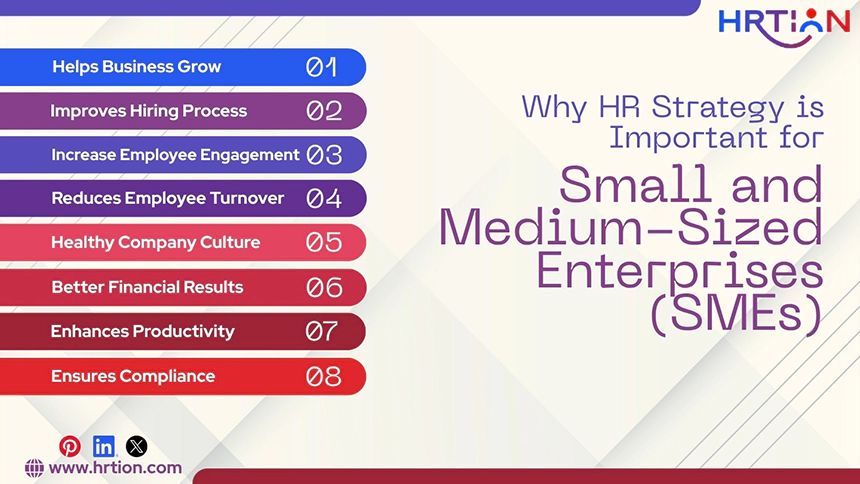
Small and medium-sized businesses usually come across more challenges when compared to
- Helps Business Grow
An HR strategy supports business growth by ensuring better team structures. It empowers companies to plan future workforce needs so they can grow smoothly.
- Improves Hiring Process
Instead of random or inefficient hiring, proper strategic human resource management can help define the skills and qualities required for different roles. This makes recruitment more effective and streamlined.
- Increase Employee Engagement
Engagement is the key to a happy and successful workforce, and HR strategies ensure that employees feel appreciated and supported. It focuses on communication, feedback, and recognition.
- Reduces Employee Turnover
A higher employee turnover rate can negatively affect a company’s success and development. HR strategy includes career development plans and fair compensation, helping retain the right talent.
- Builds a Healthy Company Culture
A positive work culture encourages teamwork, productivity, and innovation. HR strategies help define better company values and improved policies.
- Gives Better Financial Results
HR strategy drives financial growth by transforming employees into value-adding assets, boosting the profitability of the business.
- Enhances Productivity
Productivity depends on certain factors like employee skills, a motivated environment, and better goal setting, and a good strategy focuses on all these aspects to make the best out of people working in the organization.
- Ensures Compliance
Businesses thrive when they follow employment laws and workforce regulations, and HR strategies make certain that companies maintain proper documentation and follow labor laws.
For SMEs, HR strategy acts as a strong foundation that builds a workforce that delivers profits.
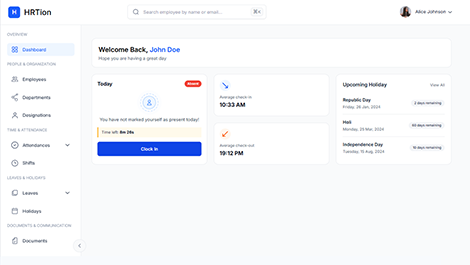
Manage the payroll, attendance, shift roles, and more in an all-encompassing HR suite. Your ultimate HR toolkit is just a click away.
Key Components of an Effective HR Strategy
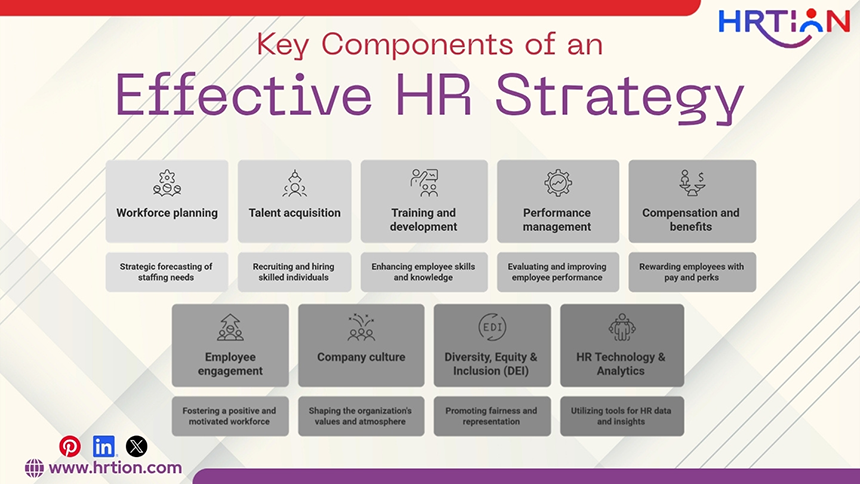
A successful HR strategy includes several important components that aid the organization in managing workforces to reap the most benefit.
The major elements are:
- Workforce/people planning
Workforce planning consists of making close predictions about the number of people required to run the company efficiently.
For example, if the company plans to expand services, it may need to hire additional staff or train the already working employees.
- Talent acquisition
Talent acquisition is mainly about attracting and hiring skilled employees. This process includes creating a job description, advertising jobs online, interviewing the shortlisted candidates, and onboarding the selected candidates.
- Employees’ Training and Development
Employees always look forward to new learning opportunities to develop their skills and become a well-round employee. This is why planning training sessions, workshops, and learning initiatives is quite important for professional growth.
- Performance Management
A well-built performance-boosting scheme lets an organization measure productivity, contribution, and progress of employees. It mainly includes forming and sharing regular feedback and performance reviews to keep employees aligned and motivated.
- Compensation and Benefits
Monetary benefits are the most potent driving factor for employees. HR strategy includes deciding on competitive compensation packages that keep employees motivated. But the company must sustain its financial stability while planning salaries and benefits.
- Employee Engagement
Engaged employees work better! Creating a plan that keeps employees engaged while being committed and productive is essential for the company’s advantage. It includes recognition programs, team-building activities, and an open communication channel.
- Company Culture
Company culture defines the values, beliefs, and behavior of employees. A positive and powerful culture encourages communication, transparency, and respect across the company. HR strategy maintains a thriving culture through policies, leadership, and engagement initiatives.
- Diversity, Equity & Inclusion (DEI)
Diversity, Equity, and Inclusion (DEI) focuses on creating a workspace where employees from different backgrounds feel respected, valued, and supported. DEI ensures fair treatment and inclusion within the company.
- HR Technology & Analytics
HR strategies rely on digital tools and data insights provided by them. HR technology automates the operational processes, such as recruitment, payroll, and attendance tracking, enabling HR to make better strategic decisions.
Popular HR Strategy Frameworks Used by Organizations
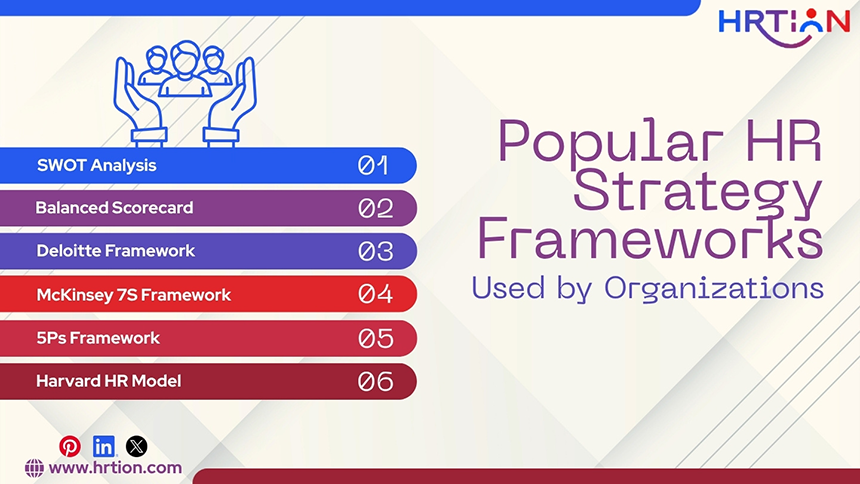
An HR strategy framework is a long-term roadmap that enables HR to act like a strategic partner. There are a few popular HR planning frameworks with predetermined components to help with talent planning, performance monitoring, employee retention, learning & development, and compensation.
Some of the famous and most-used HR strategy frameworks are:
1. SWOT Analysis
SWOT analysis is the simplest yet most powerful HR tool that evaluates an organization’s internal and external factors. It helps identify areas of improvement and weaknesses.
SWOT stands for:
Strength – Internal advantages like skilled employees, strong leadership, or a positive work culture.
Weaknesses – Internal challenges like skill gaps, high turnover rate, and limited resources.
Opportunities: External beneficial factors like a new talent pool or emerging technologies.
Threats: External risks such as strong competitors, economic changes, and talent shortages.
2. Balanced Scorecard
The Balanced Scorecard framework helps the organization to measure and define performance through different perspectives other than financial outcomes.
This helps organizations to keep tabs on the HR initiatives and their overall impact. It evaluates:
Financial performance: Recruitment costs, training investments, and HR efficacy.
Customer Perspective: Employee contribution to customer satisfaction.
Internal Processes: Efficiency of hiring and onboarding processes
Learning and growth: Employee development, skills, and leadership training.
3. Deloitte Framework
The Deloitte framework focuses on creating people-centric organizations. It is mainly designed to improve employee experience, leadership development, and digital transformation.
Key elements of this are the following:
- Building strong leadership.
- Improving employee experience.
- Using HR technology and analytics
- Developing agile workforce strategies
4. McKinsey 7S Framework
The McKinsey 7S Framework is used to align organizational structure with strategy. This framework is great for managing administrative practices.
It focuses on seven interconnected elements:
- Strategy: The organization’s long-term plan
- Structure: The better hierarchy.
- Systems: Processes and workflows.
- Shared values: Core beliefs and company culture.
- Skills: Employee capabilities and expertise.
- Style: Leadership approach.
- Staff: Workforce and talent management.
5. 5Ps Framework
The 5Ps HR strategy framework mainly focuses on five key elements that shape HR practices. It helps businesses create a balanced HR strategy that connects employees with goals.
Purposes: The organization’s mission and long-term goals.
Principles: Core values and ethical standards guiding employee behavior.
Processes: HR policies and procedures, such as recruitment and performance reviews.
People Performance: Measuring employee productivity and organizational results.
6. Harvard HR Model
The Harvard HR Model focuses on balancing employee needs with organizational growth. It views employees as important stakeholders and partners of the business.
This model highlights:
- Employee involvement in decision-making.
- Fair and transparent company policies.
- Strong relationship between employees and organization.
- Long-term employee engagement and development.
How to Develop an HR Strategy for SMEs
SMEs need a strategy that focuses on scalability, engagement, productivity, and growth. Here are the steps to follow for building an HR strategy for SMEs.
Step 1: Define Your Goals First:
The first step is to create a strategy by setting goals for organizational growth. Evaluate what the current needs are, whether it’s expansion, productivity, or new ventures. HR initiatives and planning support these objectives. This will help the HR team plan recruitment, training, and employee development schemes.
Step 2: Evaluate Your Strengths and Weaknesses:
Organizations must analyze their internal capabilities to figure out what their strengths and weaknesses are. For example, if your company has a strong leadership team but weaker technical skills, you would know what aspect needs more focus.
Step 3: Check the Gap:
Gap analysis lets a company focus on current workforce capabilities and skills required to achieve future goals. This will allow businesses to figure out whether they need to hire new employees, train existing staff, or restructure teams.
Step 4: Evaluate Employee Skill Sets:
Another important factor of organizational growth is effective workforce planning. HR teams should evaluate employees’ experience, expertise, and performance. This will help identify high-performing employees, leadership qualities, and areas where they are lacking.
Step 5: Assess Talent Strategy:
A strong talent strategy ensures that organizations can find, attract, develop, and retrain employees. This step involves reanalyzing recruitment methods, employer branding, the onboarding process, and career development possibilities.
Step 6: Identify Core HR Priorities:
After deciding on workforce needs, organizations must identify what their key HR priorities are. This includes improving the recruitment process, enhancing employee engagement, strengthening leadership, and adding new HR technologies to the system.
Step 7: Create Strategic HR Policies and Programs:
HR policies and programs offer a clear structure for managing the workforce. They include forming-systems for performance analysis, training programs, workplace policies, and payment structure.
Well-developed HR policies help maintain fairness, transparency, and consistency within the organization.
Step 8: Use HR Technology:
Modern technical advancements can empower HR staff by automating time-consuming tasks.
HR software like HRtion can help manage recruitment, payroll, attendance, performance reviews, and employee record tracking. Inclusion of technology allows the HR team to focus on creating a strategy instead of spending too much time on administrative work.
Step 9: Rely on Analytics:
HR analytics offer key insights into performance, engagement levels, and workforce trends. It also helps in data-driven decision-making, improving hiring strategies, filling skill gaps, and measuring success.
Step 10: Monitor and Improve:
HR strategies need to be reviewed regularly to ensure effectiveness. Organizations must check the performance indicators, gather employee feedback, and analyze HR data to assess progress. Regular monitoring sessions allow businesses to polish HR strategies and meet workforce needs.
How to Use Automation in HR Strategy Development
Automation is necessary for HR teams to simplify routine tasks and focus on development. With HR technology, companies can manage recruitment, payroll, performance, and employee data through a centralized platform. It reduces manual work and enhances accuracy.
Some common ways to use automation for making strategic HR processes are the following:
- Use automated recruitment tools to screen candidates and filter employee applications for different departments.
- Payroll and attendance systems can help manage salaries, leaves, and working hours.
- Performance management software can measure employee goals and evaluate skillset.
- HR analytics tools help with workforce data sorting and support better decision-making.
By integrating automation in HR strategy, SMEs can improve their efficiency, save time, and make informed decisions.
Real-World HR Strategy Examples for Businesses
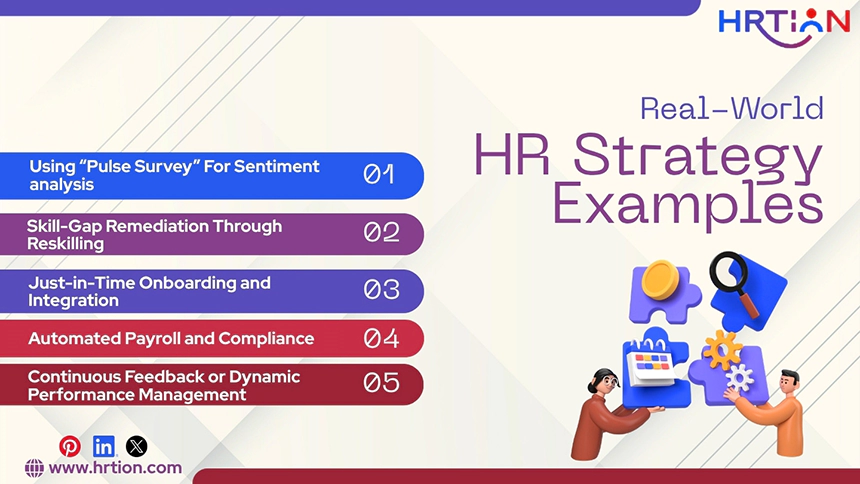
There are different HR strategy examples focusing on different aspects leading to growth and success.
Here are some case studies of how some of the big names incorporated strategic moves into their HR processes to fix complexities affecting the overall work-culture.
- Using “Pulse Survey” For Sentiment analysis
A pulse survey is a short and frequent questionnaire that consists of 5-15 questions, taking under 30 seconds. This helps in analyzing employee satisfaction and engagement along with sentiment analysis.
Instead of annual surveys, HR teams can collect quick feedback without spending much time on it. This will help identify issues early and address them faster. The company Genpact uses the infeedo.ai/pulse-survey to monitor real-time employee sentiments, satisfaction, and engagement.
- Skill-Gap Remediation Through Reskilling
With rapid technical advancements, companies mostly need new skills immediately. But external hiring can be challenging and expensive. To fix this, HR can identify skill gaps using AI and develop fast-track training programs.
One example of this is BT Security, which launched 16-week intensive boot camps to re-skill and retain existing employees in the cybersecurity department.
- Just-in-Time Onboarding and Integration
New hires usually take too long to be productive, causing project delays and dropped deadlines. To solve this, automating the onboard process can do the trick. It provides immediate access to tools, training, and culture, reducing time consumption.
The biggest example of this is Buffer, which used a “3s” system where new hires are assigned a manager, a culture buddy, and a role buddy. This way, an employee gets 3 contact points, and this accelerates the training process.
- Continuous Feedback or Dynamic Performance Management
Annual performance reviews are an outdated concept. Also, they are demoralizing and ineffective because there isn’t enough real-time data to work on.
When Adobe encountered this problem, it replaced the annual review sessions with “check-ins”—a digital-first platform for ongoing reviews with a continuous goal-setting process. The setup used 60-60 check-ins using instant feedback tools and tracked OKRs (objectives and key results) every quarter.
- Automated Payroll and Compliance
Manual compliance is a time-consuming process. To fix this, an automated payroll system that includes time-tracking can be implemented to ensure compliance with the labor laws.
One such step was taken by TimeWellScheduled, which used cloud-based, real-time alerts to notify managers regarding the employee overtime limits and allow them to adjust schedules before the costs exceed the preset bounds.
HR Strategy for Small vs. Large Businesses: Key Differences
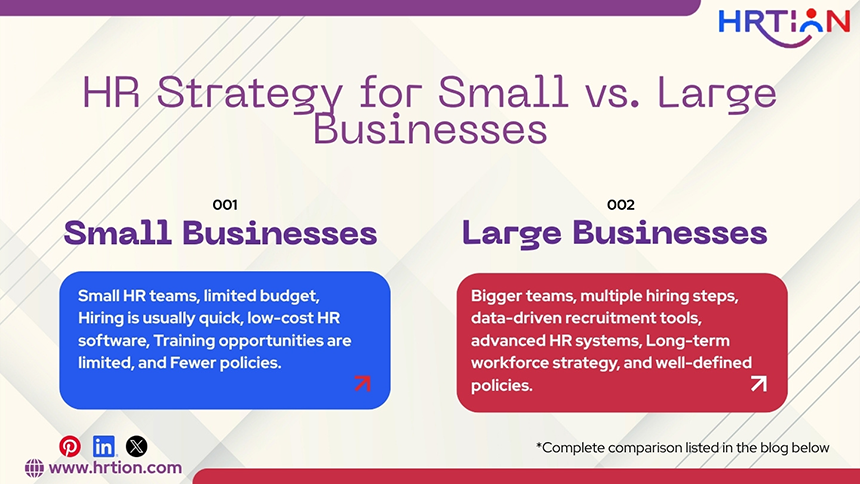
| Aspect | HR Strategy in Small Businesses | HR Strategy in Large Businesses |
| Resources | SMEs have small HR teams and a limited budget. They must use affordable tools and outsource some HR tasks. | Large businesses have bigger teams and budgets, and they can build specialized teams for recruitment, training, and engagement. |
| Hiring Process | Hiring is usually quick, so they can focus on employee referrals and culture-fit hiring. | Have multiple hiring steps. They can implement structured interviews and data-driven recruitment tools. |
| HR Technology | Need low-cost HR software. Thus, using HRMS for payroll, attendance, and recruitment would work. | Require advanced HR systems. For this reason, integrated AI-driven HR platforms and workforce analytics are a great choice. |
| Decision-Making | Decisions are usually quick; thus, maintaining open communication and quick feedback will help. | Decision-making is an elongated process, involving multiple departments. Use a structured decision-making framework. |
| Company Culture | Informal and personal workspace environment, so encourage the team by providing transparency, recognition, and fair treatment. | Formal culture and well-defined policies. Building stronger policies offering values and structured engagement programs. |
| Employee Training | Training opportunities are limited, so introducing online courses, mentoring, and skill-based workshops is great. | Usually have formal training programs. Implementing leadership development and a continuous learning program is workable. |
| Policies and Compliance | Fewer policies and regulations to create HR policies that focus on legal compliance. | Comprehensive policies for larger workforces. Use compliance software and review the policies regularly. |
| Performance Management | Informal feedbacks are quite common. Conduct regular one-on-one sessions. | Structured performance review systems are provided. Use automated performance software. |
| Workforce Planning | Focus on short-term hiring needs. Plan hiring according to scalability and future skill requirements. | Long-term workforce strategy, by using workforce analytics to forecast talent needs. |
| Employee Benefits | Basic benefits with smaller budgets, so try offering flexible work options and recognition programs. | Offer wider benefits, so provide frequent bonuses, career growth opportunities, etc. |
Conclusion
Having a well-designed and effective HR strategy is the road to success. It helps in numerous ways by accelerating the hiring process, encouraging employee development, improving performance, and fostering workforce culture.
For SMEs, a clear and defined HR strategy is essential because it enables building a strong team through limited resources and smaller teams. It enables making the right use of HR practices, technology, and analytical data for long-term business growth.
Frequently Asked Questions (FAQs)
What are the examples of HR strategies?
The common examples of HR strategy are improving the recruitment process, introducing training programs, using a performance management system, implementing flexible work policies, and using HR technology for automating administration tasks.
What are the four main HR strategies?
The most common HR strategies are:
- Talent acquisition
- Employee development
- Performance management
- Employee retention
What is an HR strategy framework?
An HR strategy framework is a model that helps organizations to effectively plan and manage HR activities. Some famous frameworks are SWOT analysis, McKinsey 7S, or the Harvard HR model.
What is the best HR strategy for SMEs or small businesses?
HR strategy for SMEs or small businesses focuses on efficient hiring, employee engagement, skill development, and cost-effective HR tools. Because SMEs have limited resources, the HR strategies must prioritize flexibility, productivity, and employee retention.
What is HR strategy in HRM?
HR strategy in Human Resource Management (HRM) refers to long-trem plan that aligns HR practices with the growth of the organization. It helps with recruitment, performance, training, and work culture strategically.

Sunita Kumari is a Freelance Contributor Writer at HRTion, writing accurate, reliable, and informative content. She completed her Bachelor's from Rajdhani College of the University of Delhi. She has been a Human Resources Recruiter for almost 2 years, including over 1 year with Battersea Web Expert. Drawing on her recruitment and HR processes experience, she writes clear and practical payroll-related guides that help employees and job candidates better understand HR procedures and workplace practices.