
- What is HR Compliance?
- Why are HR Policies and Compliance Frameworks Important for a Business?
- Essential HR Policies Every Company Needs
- Key Elements of HR Policies and Compliance Framework
- How to Create Effective HR Policies and Compliance Framework
- How to Ensure HR compliance
- Best Tips for Creating HR Policies and Compliance Framework
- Challenges to Overcome With HR Policies and Compliance Framework
- HRTion: To Keep Employees Updated with HR Policies
- Conclusion
- FAQs
An HR Policies and Compliance Framework is a structured approach to managing the workforce without any bias while keeping legalities and obligatory regulations in mind.
An organization without clearly established rules creates an unfair, confusing, and rigid environment for employees, resulting in stunted growth and an unsatisfied workforce.
By having a compliance and policy framework, companies can foster smooth operations and long-term growth. Thus, here is how a business can develop an effective framework to avoid risks and build trust.
What is HR Compliance?
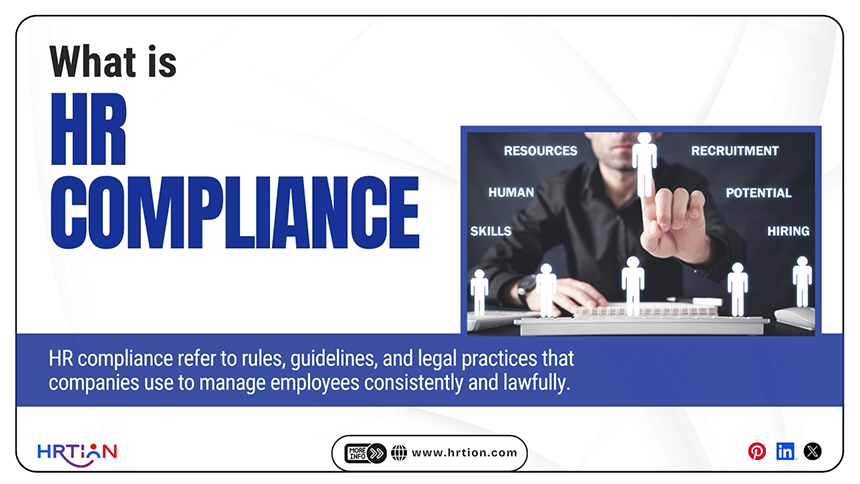
HR policies and compliance refer to rules, guidelines, and legal practices that companies use to manage employees consistently and lawfully.
HR policies define the company’s expectations for its employees, and compliance ensures that those policies are being followed and implemented properly.
HR compliance and policy management covers all major organizational aspects, such as recruitment, leaves, employee behavior, compensation, and retirement.
These practices and obligations are designed to bring clarity, eliminate confusion, and ensure fair treatment to every employee. Similarly, HR compliance focuses on meeting legal requirements under local, state, and national laws.
Key characteristics of HR policies and compliance are the following:
- HR policies offer the workplace rules, expectations, and strategies to follow.
- Compliance ensures that the rules are set according to the legal standards.
- Promote fairness and transparency.
- Help avoid legal risks and penalties.
- Build employee trust and accountability.
Why are HR Policies and Compliance Frameworks Important for a Business?
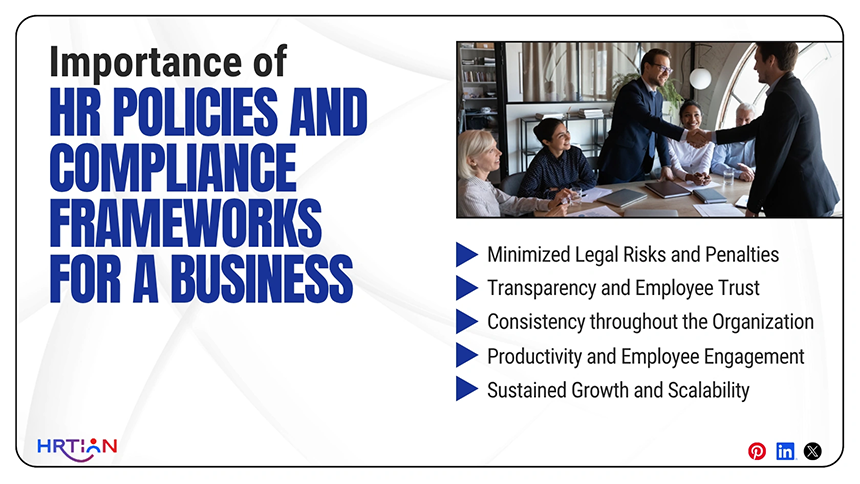
With a strong HR compliance framework, the business can create a risk-free and legally compliant environment. It is quite essential for:
- Minimized Legal Risks and Penalties
The most important facet of the policy and compliance framework is freedom from legal trouble. Employment-related disputes like wrongful termination, discrimination, or wage violations can quickly lead to expensive lawsuits. According to SHRM, even in the best-case scenarios and with the aid of proper defense attorneys, an employment lawsuit can still cost an average of $160,000 or more. A well-structured HR framework helps organizations maintain proper documentation and records, follow federal and state laws, and reduce legal risks.
- Developed Transparency and Employee Trust
Clarity in HR policies allows employees to understand what is expected from their position and tasks and what they are entitled to within the organization. This includes their rights, benefits, workplace behavior standards, and grievance procedures. Treating employees fairly and helping them stay informed not only builds trust in leadership but also strengthens workplace relationships. Transparency also leads to a general decrease in misunderstandings and workplace conflicts.
- Ensured Consistency throughout the Organization
Without a consistent system of HR policies, different managers may handle similar issues in different ways, which can cause conflicts in decisions. This inconsistency can often lead to bias or discrimination. A proper compliance framework ensures that all the rules are applied uniformly and accurately across departments, locations, and teams. This maintains fairness and brings consistency to the system, protecting the organization from discrimination claims.
- Improved Productivity and Employee Engagement
The performance of employees heavily depends on their understanding of their own roles, responsibilities, and workplace expectations. Well-defined HR policies greatly reduce confusion and enable employees to focus on their tasks. A well-defined system also allows the employees to become more efficient, as there is no uncertainty in the regulations. Research by Gallup has shown that highly engaged teams are 21% more productive and this establishes a direct link between structured HR systems and performance.
- Sustained Growth and Supported Scalability
As a business expands across regions and states or even internationally, managing employees becomes much more difficult and complex due to a large variety in labor laws and operational practices. A structured HR compliance framework allows companies to scale easily and smoothly by standardizing processes, ensuring legal alignment, and maintaining organizational control despite the regional differences and locations.
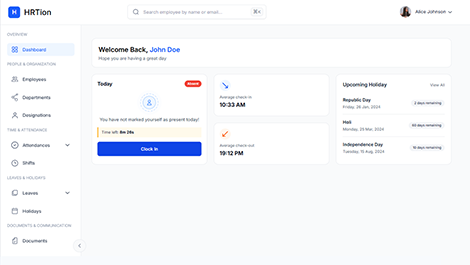
Manage the payroll, attendance, shift roles, and more in an all-encompassing HR suite. Your ultimate HR toolkit is just a click away.
Essential HR Policies Every Company Needs
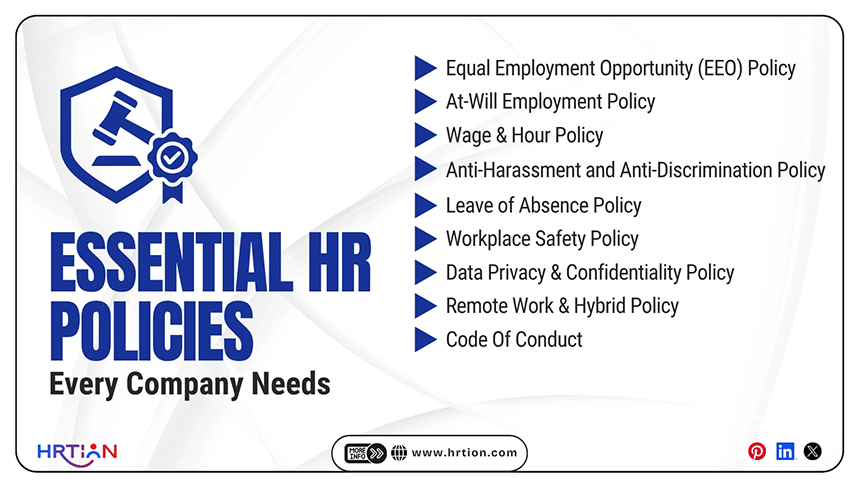
A well-defined set of HR policies is crucial for the development and growth of a business. Without clarity in the system, risks can increase in frequency, regulations may be confusing and inconsistent, and employees would be unable to understand their own tasks and goals within the organization. Some policies that are frequently implemented in well-defined sets of HR policies are provided below:
- Equal Employment Opportunity (EEO) Policy
An EEO policy is necessary for ensuring that all employment decisions like hiring, promotions, compensation, and termination are made without any discrimination based on race, gender, religion, and other protected characteristics. This policy helps to promote the growth of diversity, inclusion, and equal access to opportunities.
- At-Will Employment Policy
This policy explains that either the employee or employer can terminate the employment relationship at any time, with or without cause (wherever legally applicable). It clarifies the expectations from the employee, protects employers from wrongful termination misunderstandings, and allows the employee to know their own fair authority in termination procedures.
- Wage & Hour Policy
This policy ensures that employees are paid correctly and on time, covering minimum wage, overtime eligibility, time tracking, and breaking records in compliance with the Fair Labor Standards Act (FLSA). This policy helps to protect employees and employers in legal disputes regarding wages and ensures that an employee is paid sufficiently for their work in the organization. If properly implemented, it can resolve many compliance issues and legal penalties.
- Anti-Harassment and Anti-Discrimination Policy
This policy clearly defines inappropriate workplace behavior, commonly including harassment, bullying, and discrimination, and details reporting procedures and investigation processes. By implementing zero-tolerance standards, organizations are able to provide a more comfortable, respectful, and safer work environment for employees, which also reduces the chance of legal risks regarding harassment for the organization itself.
- Leave of Absence Policy
Precise detailing of a leave policy allows proper clarification of different types of leaves, which include sick leave, paid time off (PTO), and family or medical leave under the Family and Medical Leave Act (FMLA). It ensures that employees are able to fully understand their entitlements and the processes for requesting time off.
- Workplace Safety Policy
The Workplace Safety Policy highlights the importance of safe and healthy work environments for employees. It aligns with standards set by the Occupational Safety and Health Administration (OSHA) and includes safety guidelines, emergency procedures, training, and reporting mechanisms for hazards or incidents.
- Data Privacy & Confidentiality Policy
Employee data and sensitive company information are protected under this policy, which outlines how data can be accessed, stored, and shared. This prevents data breaches and ensures compliance with privacy regulations.
- Remote Work & Hybrid Policy
With shifting and flexible work models, it is important for there to be a policy that clearly defines the expectations for remote employees. This covers work hours, communication standards, performance tracking, and cybersecurity practices. The policy allows employees to be more productive and efficient while still ensuring their accountability is maintained outside the office.
- Code Of Conduct
A code of conduct includes guidelines on professionalism, integrity, conflict of interest, and workplace interactions and also sets the overall standard for employee behavior and ethics. It acts as a foundation for company culture and decision-making.
Key Elements of HR Policies and Compliance Framework
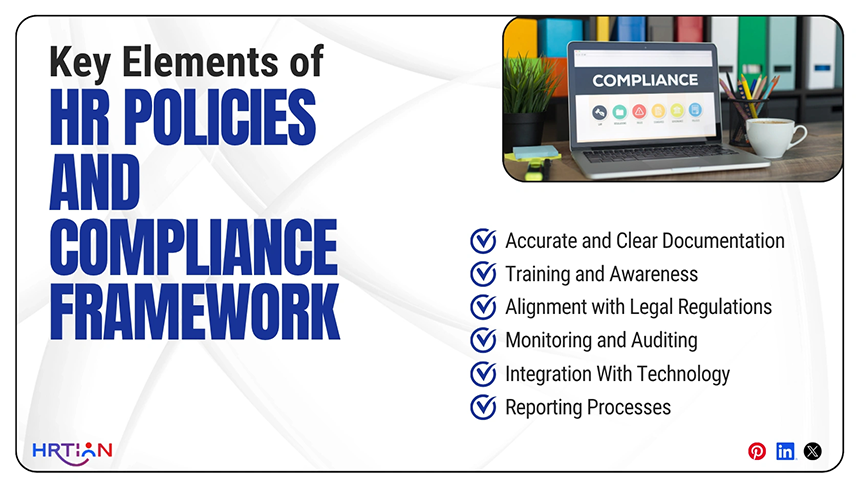
A successful HR policies and compliance framework is designed to be practical, enforceable, and aligned with business goals. Some of the key features of a successful HR compliance framework are given below:
- Accurate and Clear Documentation
The HR policies must be precisely defined, easy to understand, well written, and readily available to all employees. An organization can provide access to these policies via employee handbooks, HR portals, or internal systems, reducing confusion by making these easily accessible.
- Training and Awareness
Providing a structure for policies is an important step, but without proper understanding and implementation, these policies will lack their usefulness. Regular training sessions, workshops, and onboarding programs help to reinforce compliance expectations.
- Alignment with Legal Regulations
A very large component of any HR framework is compliance with applicable laws. Every policy must reflect federal, state, and local regulations to ensure the organization operates within specified legal boundaries. These should align themselves with wage, safety, privacy, and even anti-discrimination laws.
- Monitoring and Auditing
Continuous monitoring ensures that policies are being properly followed, and regularity in internal audits helps in locating gaps, inconsistencies, or risks before they turn into serious issues.
- Integration With Technology
Modern HR frameworks depend upon technology to improve efficiency and accuracy. These HR software systems are able to automate many tasks such as policy updates, employee data management, attendance tracking, and compliance reporting.
- Reporting Processes
Effective HR frameworks are able to include safe and confidential ways for employees to report any concerns or violation of any policies. Anonymity in reporting encourages openness and helps organizations address issues like misconduct or policy breaches early, before any escalation can follow.
How to Create Effective HR Policies and Compliance Framework
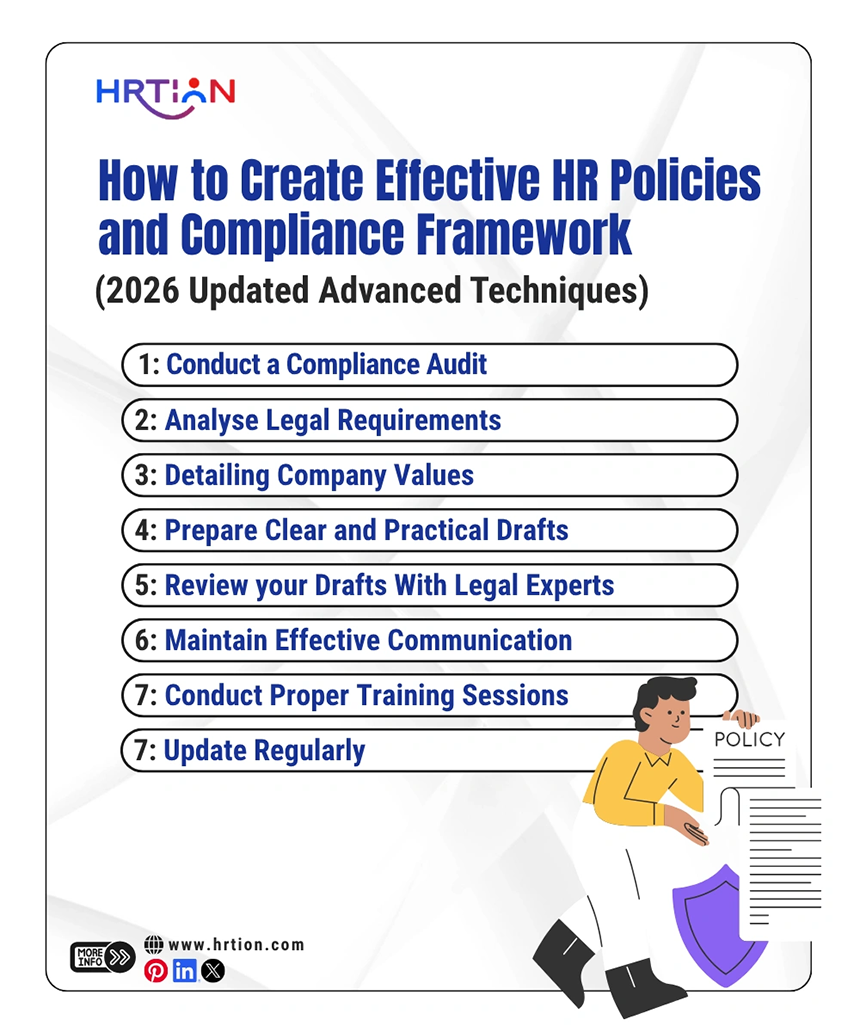
A strong and effective HR policies & compliance framework needs to be legally sound, easy to follow, and well-defined. It must be aligned with the organization’s goals and interests and provide structured approaches to any issues and obstacles. Provided below are some steps that a business can take to create an effective framework:
- Conduct a Compliance Audit
The best way to start is to review your existing HR policies, processes, and practices. Finding out the gaps and areas where your organization may not be fully compliant with current laws allows you to analyze possible solutions and methods of improvement for the structure.
- Analyse Legal Requirements
The next step is to ensure that your policies are aligned and comply with federal and state laws, such as the Fair Labor Standards Act and Family and Medical Leave Act. It is also necessary to stay updated with employment laws that vary with different regions and account for them during this step.
- Detailing Company Values
It is important for HR policies to reflect an organization’s culture, mission, and values. An example of this is if an organization values flexibility or inclusivity, its policies should be able to support these principles in its practices and processes.
- Prepare Clear and Practical Drafts
Write policies in simple, easy-to-understand language, ensuring you avoid complex legal jargon so all employees are able to understand expectations, rules, and procedures effectively and without confusion.
- Review your Drafts With Legal Experts
Before you finalize the policies, it is crucial that you have them reviewed by legal professionals. Not only does this reduce the risk of errors and guarantee compliance, it also protects the organization from potential long-term legal issues.
- Maintain Effective Communication
Policies need to be clearly shared with the employees for successful implementation. This can be done by using onboarding programs, employee handbooks, internal portals, and regular updates about the policies.
- Conduct Proper Training Sessions
Regular training sessions help employees and especially managers to learn and understand how to apply policies correctly and effectively. Well-trained managers play an important role in consistent implementation.
- Update Regularly
Workplace laws and business environments shift constantly. It is, therefore, necessary to regularly review and update your policies to keep them relevant, compliant with the changing laws, and aligned with organizational goals and needs.
How to Ensure HR compliance
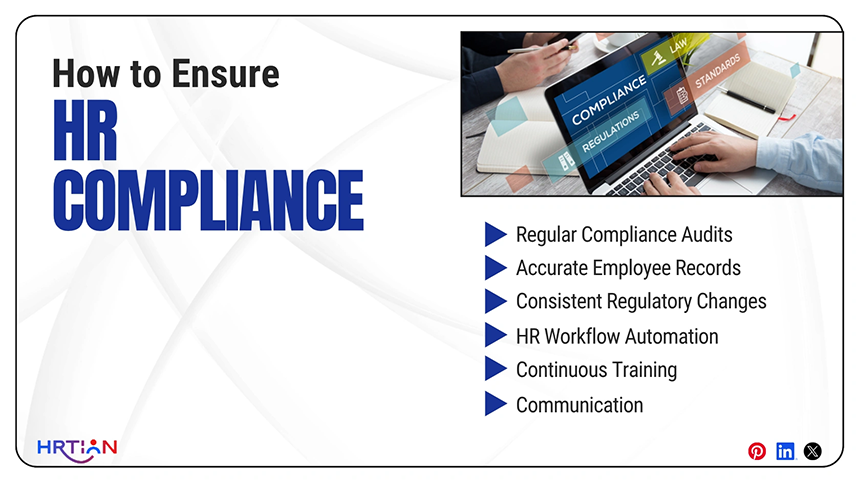
To ensure HR compliance is a long-term process. It requires continuous monitoring, tracking, and active participation. Here is how to do so:
- Conduct regular compliance audits: Perform periodic and regular audits to identify gaps in policies and practices. This ensures that the company is following legal requirements and maintaining compliance standards.
- Maintain Accurate Employee Records: Keeping detailed and up-to-date records is the main element for compliance. It includes contacts, payroll data, attendance, and taxes.
- Update regulatory changes consistently: labor laws and regulations change over time. Therefore, organizations must keep track of updated happenings around the federal and state levels and revise their policies accordingly.
- Use HR Workflow Automation: Modern HR software helps automate tasks such as payroll, record-keeping, policy updates, compliance tracking, and reporting. HR workflow automation improves accuracy, reduces manual errors, and enhances compliance efficiency.
- Provide continuous training: Regular training sessions help employees and managers to stay compliant with legal requirements. workplace policies and responsibilities. This reduces the chances of law violations caused by lack of awareness.
- Encourage communication: fostering a culture that encourages employees to speak and share concerns is crucial. Open communication channels help find and resolve budding issues immediately.
Best Tips for Creating HR Policies and Compliance Framework

- Write policies in a clear and elaborated manner so that employees can grasp the key pointers without any confusion.
- Use simple and everyday language instead of using heavy terms so that every individual working in the company can practice and follow it without extra effort.
- Ensure that policies are available on multiple platforms such as HR portals and mobile devices so that employees can access compliance on the go.
- Add practical scenarios and examples in the policies to help people comprehend how they apply in real-time situations.
- Gather input from employees to identify gaps and incorporate feedback to improve policies and increase implementation rate.
- Involve senior management in the process of policy creation and enforcement to show commitment towards the policies.
- Use tools and systems to automate updates, monitor compliance, and keep accurate management up-to-date.
Challenges to Overcome With HR Policies and Compliance Framework
- Complex and changing laws: Labor laws in every region vary and constantly evolve, and thus keeping policies updated regularly can be challenging.
- Lack of awareness: Even well-designed policies may seem inadequate without proper training and communication. Unaware employees can violate rules, causing compliance troubles.
- Inconsistent enforcement: When managers apply policies differently across teams and situations, it can create a perception of unfair practices. This can lead to conflicts and breach employee trust.
- Remote work compliance issues: The rise of remote and hybrid work culture has made compliance even more complex. Companies need to put extra efforts to ensure proper policy application, data security, and adherence across distributed teams working from different locations.
HRTion: To Keep Employees Updated with HR Policies
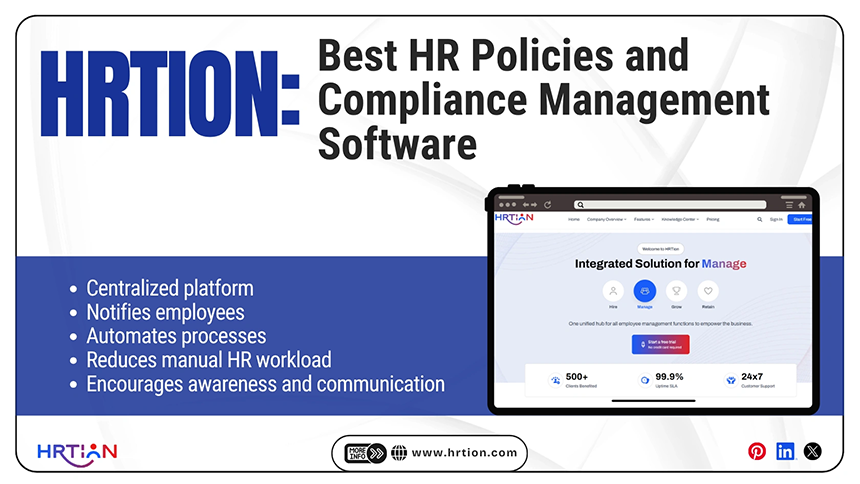
Modern businesses need a smart companion to manage compliance effectively, and HRtion is one such solution that is designed to assist companies in keeping their workforces updated with changes taking place in HR policies and compliance.
- It is a centralized platform to access employee data, company policies, and payroll.
- It notifies employees regarding the policy updates.
- It automates processes that require precision and accuracy, leading to proper record management for audits.
- It encourages awareness, communication, and engagement.
- It reduces manual HR workload, allowing them to focus on policy enforcement.
Conclusion
HR compliance goes beyond just penalties; it’s about creating an ethical and future-compliant organization. Therefore, the HR policy framework must be up-to-date, employees are trained, and compliance is automated.
If there is a communication gap, the first and foremost factor is to fix it. Strengthening HR policies and the compliance framework can save from the costly risks and create a workforce that is informed, protected, and legally aware.
FAQs
What is HR compliance?
HR compliance ensures that businesses follow federal, state, and local labor laws to stay protected and informed.
What are the most important HR policies?
Key HR policies that every organization must have include EEO, anti-harassment, wage & hour, leave, workplace safety, and data privacy policies.
When must the HR policies be updated?
The HR policies are updated annually or whenever a change happens in federal or state laws.
What are the risks associated with non-compliance?
The risks of non-compliance are quite severe, such as fines, lawsuits, reputational damage, and employee dissatisfaction.
How can HR software help in staying compliant?
HR software automates the compliance tracking, policy update, and record management, resulting in reduced manual errors and improved efficiency.

Sunita Kumari is a Freelance Contributor Writer at HRTion, writing accurate, reliable, and informative content. She completed her Bachelor's from Rajdhani College of the University of Delhi. She has been a Human Resources Recruiter for almost 2 years, including over 1 year with Battersea Web Expert. Drawing on her recruitment and HR processes experience, she writes clear and practical payroll-related guides that help employees and job candidates better understand HR procedures and workplace practices.