
- What is the Payroll Process?
- What Are the Stages of Payroll Management?
- What Are the Steps of Payroll Management?
- Key Elements of Payroll Management
- Importance of Payroll Management
- Various Methods to Handle Payroll for Businesses
- Tips for Smoother Payroll Management
- Challenges with Manual Payroll Processing
- Benefits of Using Payroll Software for Better Management
- Top 5 Payroll Software for Payroll Management in 2026
- Conclusion
- Frequently Asked Questions:
Payroll is the compensation that a businesses pay to its employees for their time, work, and responsibilities.
Undoubtedly, payroll management is one of the most essential yet most complex responsibilities for all businesses. Whether you are a startup or a large enterprise, paying the right amount at the right time is crucial. And to achieve this, setting up a complete and effective payroll process is non-negotiable.
Payroll today is not about salaries only; it now involves a wide range of other factors, such as incentives, compliance, and legalities. Fortunately, the rise of automation has made it easier to deal with such payroll complexities by implementing the right tools.
If you are still figuring out the best approach to process payroll, here is a walkthrough guide to the entire payroll process.
What is the Payroll Process?
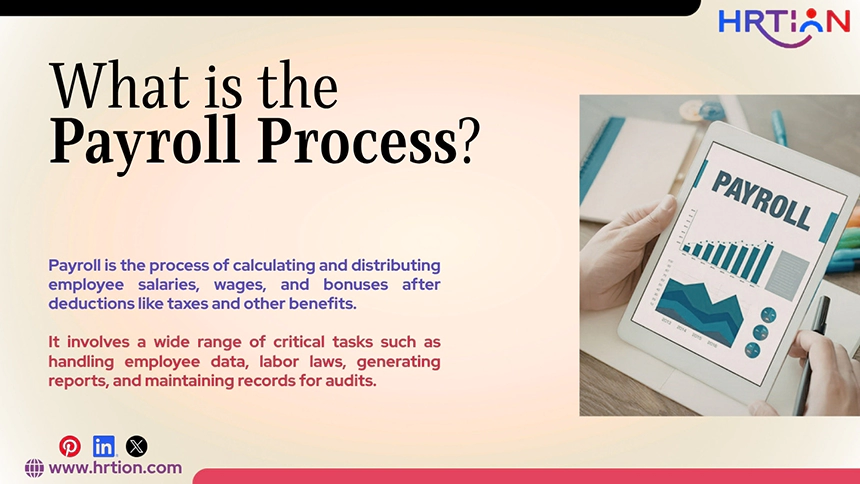
Payroll is the process of calculating and distributing employee salaries, wages, and bonuses after deductions like taxes and other benefits.
When handled right, the payroll system ensures that employees are paid correctly and accurately. Furthermore, it helps in complying with legal and tax requirements.
The Payroll Formula:
Payroll = Salary Calculation + Deductions + Payment + Compliance
It helps in:
- Calculating gross salary
- Applying deductions (taxes, PF, etc.)
- Determining net salary
- Disbursing payments
However, payroll is much more complex than this; it involves a wide range of critical tasks such as handling employee data, labor laws, generating reports, and maintaining records for audits.
What Are the Stages of Payroll Management?
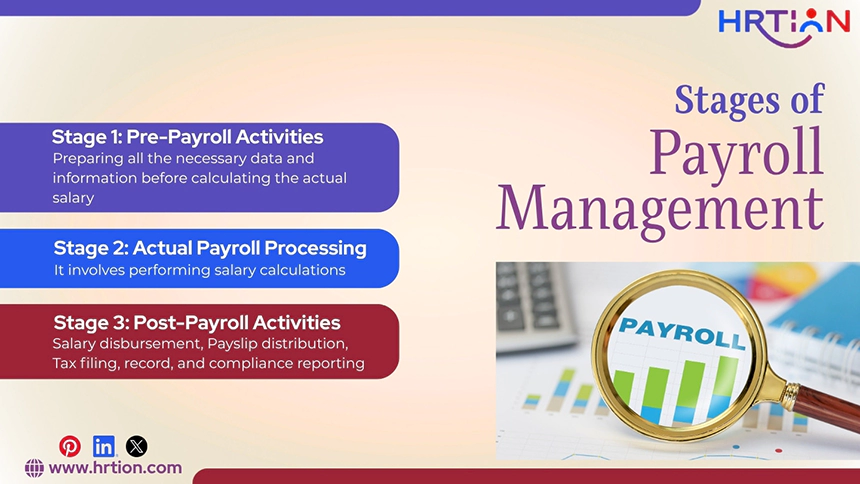
The payroll can be divided into three stages: pre-payroll, payroll processing, and post-payroll activities.
Stage 1: Pre-Payroll Activities
It involves preparing all the necessary data and information before calculating the actual salary. Accuracy is the most critical factor of this stage because any error can impact the entire payroll cycle.
This stage includes:
- Collecting employee attendance and leave data.
- Verifying the details like bank information, tax declarations, and benefits availed.
- Defining the salary structure.
- Counting bonuses, incentives, and reimbursements.
Stage 2: Actual Payroll Processing
The next stage is the core of the payroll system, because it involves performing salary calculations. The businesses nowadays are using modern payroll systems to complete this rapidly and precisely.
This stage involves:
- Calculate gross salary
- Deduct taxes like income tax, PF, ESI, and more.
- Apply bonuses and incentives.
- Calculate net salary
- Generate payslips
Stage 3: Post-Payroll Activities
Once the payroll is processed, the additional tasks are completed. These are the activities that stage 3 handles:
- Salary disbursement.
- Payslip distribution.
- Tax filing and compliance reporting.
- Record maintenance for audits
All these stages can be further divided into specific steps, and the entire payroll cycle can be completed with 9 simple steps.
Manage the payroll, attendance, shift roles, and more in an all-encompassing HR suite. Your ultimate HR toolkit is just a click away.
What Are the Steps of Payroll Management?
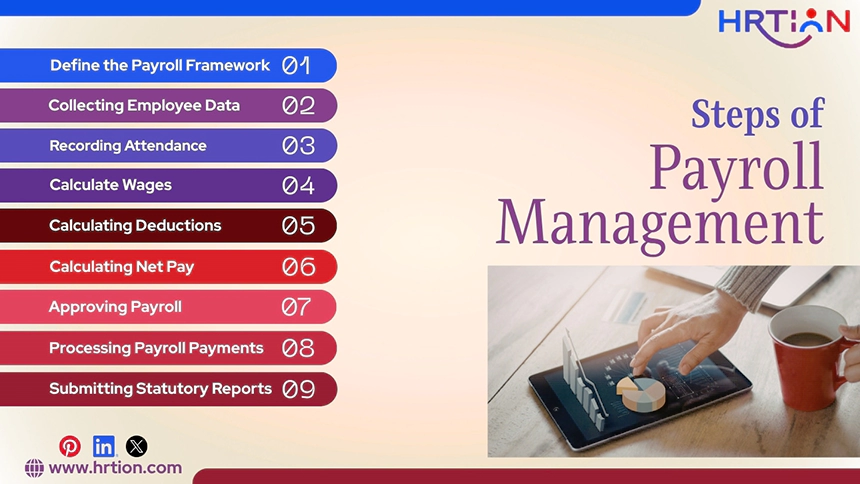
Payroll management in HR is a step-by-step process, and missing even a single step can disrupt the entire cycle, causing errors, discrepancies, and legal issues. So, follow them in the order they are given.
Step 1: Define the Payroll Framework
The first step in the payroll processing is to form a defined payroll structure and payroll policies in the organization. The framework consists of salary components, pay cycles, policies, and compliance requirements.
Organizations need to decide the timelines for when to process the payments; it can be weekly, bi-weekly, or monthly. It usually depends on the labor laws and tax regulations of the region.
Building a strong framework is quite critical because it ensures payroll accuracy, consistency, and a proper system design.
Step 2: Collecting and Maintaining Employee Data
In this step, the company gathers information like personal details, job roles, tax declarations, bank accounts, and compensation structures.
According to recent stats, “50%-52% of payroll errors are caused by outdated or incorrect employee data.” Therefore, collecting and arranging the employee information in a well-organized structure is important.
Continuously updated information is necessary to plan promotions, new hiring, and cost-cutting.
Step 3: Recording Work Hours and Attendance
Tracking attendance, leaves, overtime, and working hours through manual sheets or automated platforms is important to process accurate payments.
This data directly affects payroll calculations and employee satisfaction. Companies that are manually managing the payroll data often create more errors in the data entry, making automation increasingly essential.
Step 4: Calculate Wages and Gross Pay
Gross pay can be defined as basic salary, allowances, bonuses, overtime, and reimbursements without any deductions. This step requires precisely done calculations based on company policies.
The formula is Gross Pay = Regular Pay + Overtime Pay + Bonuses.
Step 5: Calculating Deductions
Calculating deductions includes placing statutory components such as taxes, provident funds, loans, benefits, and insurances. The most important factor in this step is compliance, as inaccuracies can lead to legal penalties.
Step 6: Calculating Net Pay
The net pay or take-home salary determines the final amount that the employee receives after all the deductions are subtracted from gross pay.
Net pay is calculated by:
Net Pay = Gross Salary – (Statutory Deductions + Voluntary Deductions)
The net pay should always try to align with the employment contracts and company policies.
Step 7: Reviewing and Approving Payroll
Before actually releasing the salaries, a thorough verification and approval process is conducted. The administration processes the quality checks to ensure that the calculations and deductions are done accurately.
This involves cross-checking attendance data, salary calculations, deductions, compliance with laws, and previously made payroll reports.
The payment sheets are finalized after obtaining approval from the finance department, HR, and the authorities.
Step 8: Processing Payroll Payments
The next step is to process the payments and proceed with the salary distribution. This ensures that every employee gets the right amount of pay on time.
The payments are then transferred through bank transfers, cheques, and other digital platforms. After this, the payslips are generated and distributed in digital or printed form to give employees the details of what they have received.
Step 9: Submitting Statutory Reports and Ensuring Compliance
The final step involves managing the legal and regulatory obligations related to payroll. Organizations must report employee earnings and deductions to the government and maintain accurate records of them.
It includes filing income tax returns and TDS reports, depositing statutory contributions, maintaining audits and inspection reports, and generating compliance reports.
Key Elements of Payroll Management
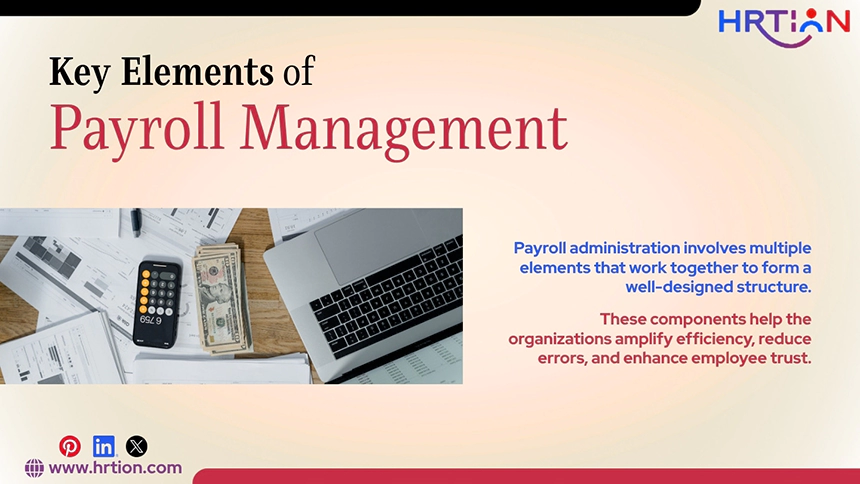
Payroll administration involves multiple elements that work together to form a well-designed structure. These components help the organizations amplify efficiency, reduce errors, and enhance employee trust.
- Employee Information
Employee data includes personal details, job designation, salary, tax information, and bank account information. And the accurate and error-free employee data is crucial for successful payroll processing.
- Attendance and Time Tracking
Payroll heavily depends on attendance and leave records, such as work hours, leaves, overtime, and holidays according to the company calendar. Businesses use methods like timesheets and automated systems to maintain this data.
- Salary Structure
The salary structure describes how an employee is paid in the organization. It includes:
- Basic salary
- Employee allowances such as HRA, DA, and travel allowances.
- Bonuses, reimbursements, and incentives.
- Gross Pay Calculations
Gross pay can be defined as earnings without any deductions. It is mainly the basic pay, allowances, overtime, and bonuses.
- Deductions
Deductions are the amount that is subtracted from the gross pay. They are classified into two categories:
- Statutory deductions: Income tax, PFs, and ESI.
- Voluntary deductions: Loans, advances taken, and retirement contributions.
- Net Pay
Net pay or take-home salary is the final amount that is paid to the employee after making all the deductions. It is the most crucial component for employee trust and satisfaction.
- Payroll Compliance
Payroll compliance ensures that the corporation is following the government regulations related to taxes, labor laws, and statutory contributions. Compliance ensures that the business can steer clear of penalties and legal troubles.
- Payroll Processing Systems
The automated payroll tools are the backbone of the modern organization. They digitally handle the repetitive and critical tasks, reducing errors and saving time.
- Payslips
Payslips provide a detailed breakdown of salary, including gross pay, deductions, net salary, and more. They are highly effective at promoting transparency and understanding between employee and employer.
- Records and Report
Maintaining payroll records is crucial for audits, tax filings, and financial reporting. Therefore, organizations need to build a proper documentation structure.
Importance of Payroll Management
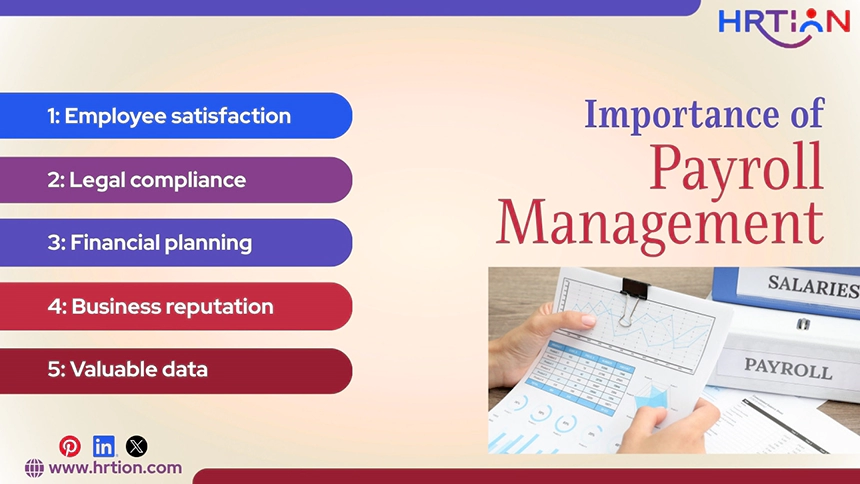
Payroll is the backbone of every enterprise; it can make or break the business. Hence, the right payroll management plays a huge role in driving growth and ensuring sustainability.
- Ensures employee satisfaction: When salary is processed correctly and timely, employees feel motivated. Thus, well-organized payroll management ensures that a working individual is financially stable and satisfied with the workplace.
- Maintains legal compliance: A payroll system is a helpful component when ensuring regulatory compliance. It helps in staying aligned with tax and labor laws, reducing the risk of penalties, fines, and legal issues.
- Supports financial planning: Payroll is the most significant expense of a company. Thus, with efficient payroll management, the business can plan better budgets, forecast expenses, and control labor costs.
- Uplift business reputation: When a company pays its employees well and on time, the employees and stakeholders trust it better, forming a trusting and positive connection.
- Provides valuable data: Payroll information includes data that can help in refined future planning, such as workforce analysis, salary standards, and strategic financial decision-making.
Various Methods to Handle Payroll for Businesses
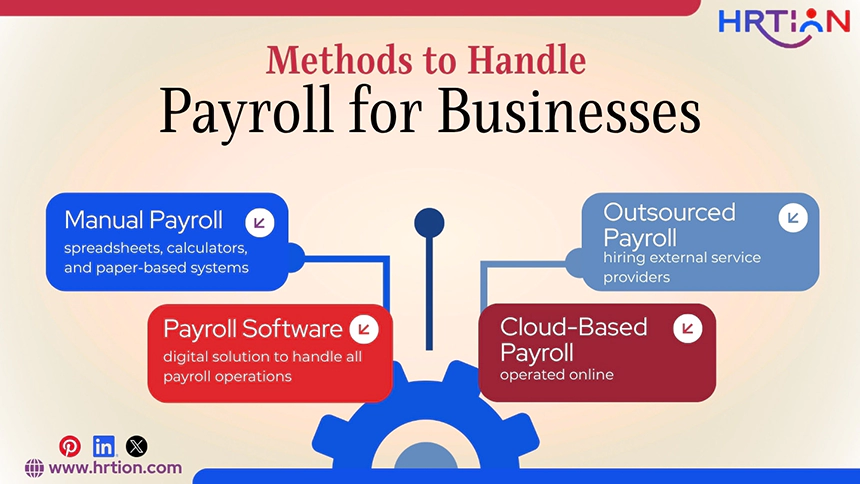
There are different payroll methods available for companies with different budgets, sizes, and operational tendencies. Every method has its own advantages and disadvantages.
1. Manual Payroll
A manual payroll system uses spreadsheets, calculators, and paper-based systems. It is best suited to small businesses with fewer employees and simple payroll systems.
| Advantages | Disadvantages |
| Low cost | High risk of errors |
| Easy to implement | time-consuming |
| No additional software needed | Limited scalability |
| Complete control | Poor compliance tracking |
2. Outsourced Payroll
Outsourced payroll can be defined as hiring external service providers to handle the payroll functions. The third party handles salary calculations, tax filings, and compliance regulations on behalf of the business.
| Advantages | Disadvantages |
| Professional expertise | Additional service cost |
| Reduced HR work | No direct control |
| Better compliance management | High dependency on the service provider |
| Time-saving and highly convenient | Data security issues |
3. Payroll Software
Payroll software is a digital solution to handle all payroll operations. It is widely used by medium and large enterprises. It automates and simplifies calculations, reduces errors, and improves competence.
| Advantages | Disadvantages |
| Automated calculations | Initial investment |
| Digital Payslip | Requires training |
| High accuracy rate | Regular maintenance and updates required |
| Faster processing | Technical support required |
4. Cloud-Based Payroll
Cloud-based payroll software is operated online, allowing businesses to access the payroll data anywhere using a stable internet connection. It is highly popular due to its flexibility and scalability.
| Advantages | Disadvantages |
| Remote accessibility | Internet dependency |
| Real-time updates | Data security concerns |
| Highly scalable | Subscription cost |
| Automatic data backup | Limited offline accessibility |
Tips for Smoother Payroll Management
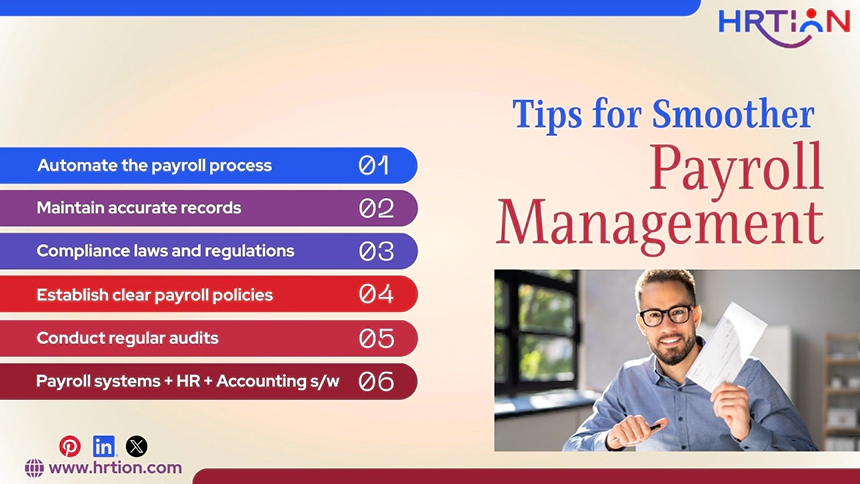
The payroll system requires a systematic approach. By following the practices mentioned below, businesses can streamline payroll processes and boost operational efficiencies.
- Automate the payroll process, as automation can save time and reduce potential errors.
- Maintain accurate records for employee data, as updated data helps avoid pay discrepancies.
- Align your pay policies with the updated compliance laws and regulations to eliminate legal threats.
- Establish clear payroll policies for a consistent and standard process.
- Conduct regular audits, as they can help identify and fix errors before it’s too late.
- Try using payroll systems in interaction with HR and accounting software, as it ensures smooth data flow.
Challenges with Manual Payroll Processing
The manual payroll process can be quite difficult to manage. Most growing businesses face these challenges while handling the payroll manually.
- High error rate: Manual calculations can lead to errors and inaccuracies.
- Time-consuming process: Processing payroll manually can require excessive time and effort.
- Compliance Risks: The manual payroll process can make it difficult to manage with the changing regulations.
- Data security risks: The manual payroll process can cause data sensitivity, putting sensitive data at risk.
- Limited scalability: Payroll can handle business growth efficiently, but a manual system can limit scalability.
The most effective way to overcome these challenges is by implementing automated payroll software that can manage repetitive tasks while maintaining precision and speed.
Benefits of Using Payroll Software for Better Management
Efficient payroll software can help the company grow leaps and bounds. These tools are designed to promote accuracy and compliance. It enhances overall productivity and employee satisfaction. Here are the benefits of incorporating payroll software into the system:
- Improved accuracy: Automation is the best way to minimize errors; it minimizes errors and ensures accurate salary processing.
- Time-saving: Payroll processing tools speed up the payroll operations, saving time, effort, and cost.
- Compliance management: Implementing software in the payroll process helps in automatically updating tax rules and legal regulations.
- Data security: Payroll management software consists of secure systems and controlled access, which ensure that sensitive employee information is end-to-end protected.
- Better Reporting: Automated tools provide in-depth insights and analytical reports, promoting data-driven decision-making.
Top 5 Payroll Software for Payroll Management in 2026
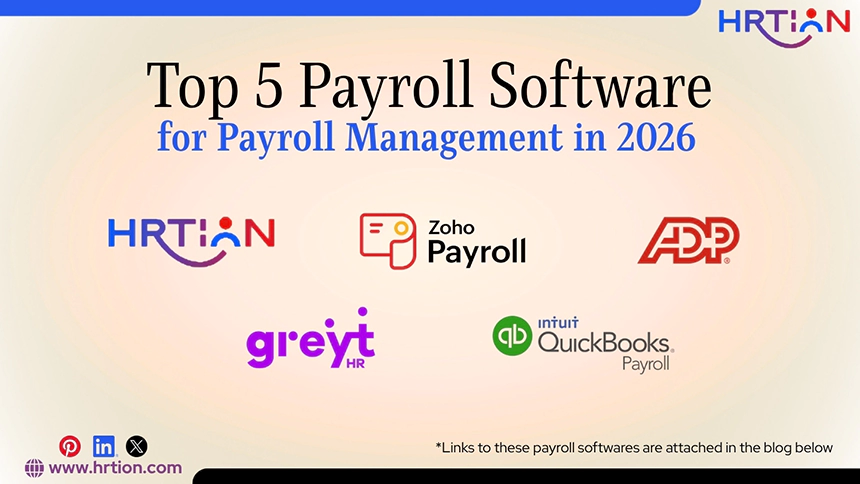
Managing payroll can be much simpler with the right tool. Here are the top 5 payroll management software that are ruling in 2026:
- HRtion: An integrated HRMS solution with built-in payroll tools. It is an ideal option for both SMEs and large enterprises, as it offers complete HR management in one place. HRtion is popular for providing advanced features at pricing and plans.
- Zoho Payroll: It is best suited for small to mid-sized businesses. It offers automated calculations, salary processing, tax compliance, and strong integration capabilities with the Zoho ecosystem.
- ADP: The globally recognized payroll system, ADP, is known for its scalability, advanced automation, and multiple-country support.
- QuickBooks Payroll: QuickBooks Payroll is designed to cater to small businesses with straightforward features such as payroll, accounting, tax filing, and reporting.
- GreytHR: It is known for its robust statutory compliance features. GreytHR offers advanced payroll automation along with employee self-service features.
Conclusion
Payroll management is crucial for a business to run smoothly, profitably, and successfully. It not only impacts the financial performance of the company but also influences employee satisfaction, operational efficiency, and regulatory compliance.
With the right information and best practices in place, businesses can streamline payroll operations and sustain long-term growth.
In the current era of automation, the most promising way to keep payroll managed properly is to adopt powerful payroll management software, as it single-handedly enhances accuracy, productivity, compliance, and scalability.
Frequently Asked Questions:
What is payroll?
Payroll is the process of calculating and managing employee salaries after deductions.
What are the main steps of payroll management?
The entire payroll management can be broken down into 9 simple steps:
- Defining Framework
- Collecting Employee Data
- Recording Work Hours
- Calculating Gross Pay
- Figuring Deductions
- Estimating Net Pay
- Reviewing and Approving
- Processing Payroll
- Submitting Statutory Reports
Why is payroll important?
Payroll is highly crucial because it ensures timely payments and legal compliance.
What is the best payroll software for SMEs?
The best integrated payroll system for SMEs is HRtion as it offers HRMS capabilities combined with payroll management.
What are the types of payroll solutions?
The four major types of payroll solutions are:
- Manual payroll.
- Outsourced payroll
- Payroll software
- Professional Employer Organizations (PEO).
Sources:

Sunita Kumari is a Freelance Contributor Writer at HRTion, writing accurate, reliable, and informative content. She completed her Bachelor's from Rajdhani College of the University of Delhi. She has been a Human Resources Recruiter for almost 2 years, including over 1 year with Battersea Web Expert. Drawing on her recruitment and HR processes experience, she writes clear and practical payroll-related guides that help employees and job candidates better understand HR procedures and workplace practices.