
- What is In House Payroll Management?
- What is Payroll Outsourcing?
- Payroll Software vs Payroll Outsourcing: Key Differences
- Benefits of Using Payroll Software
- Benefits of Using Payroll Outsourcing
- Cost Comparison: Payroll Software vs Outsourcing
- Common Challenges in Payroll Software
- Common Challenges in Payroll Outsourcing
- Hybrid Approach: Combining Software and Outsourcing
- Payroll Software vs. Payroll Outsourcing: Which One Should You Choose?
- Key Factors to Consider When Choosing Between Payroll Software and Payroll Outsourcing
- Conclusion
- FAQs
Payroll may sound simpler, but it is the most critical process that determines the growth of a business. When not done correctly, it can cause major inconvenience to both the employee and the employer.
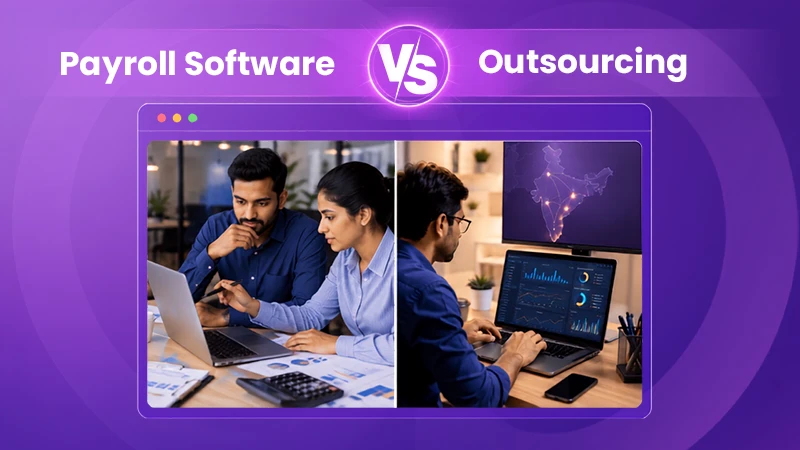
Being the most time-consuming and error-prone process for any business, it requires additional help to be sorted out without complications. There are two ways to deal with it: Payroll Software vs. Outsourcing.
But which one to pick? Here is the complete guide to offer a clear answer on which approach actually works best for your business.
What is In House Payroll Management?
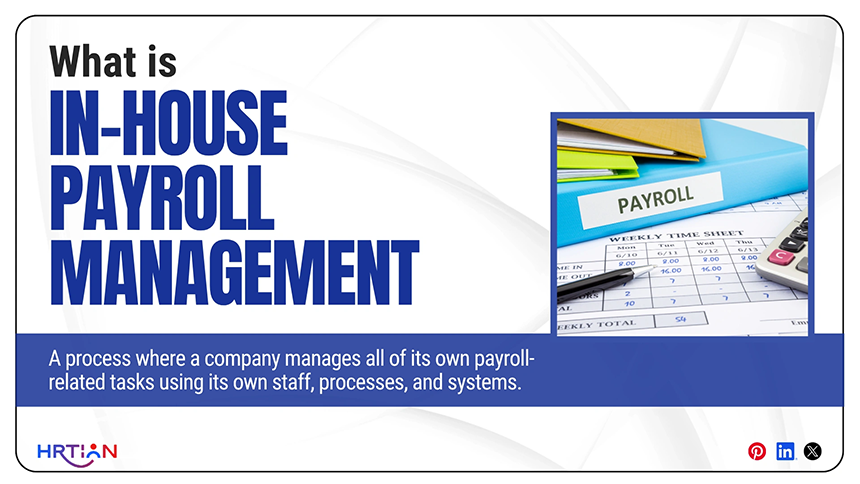
In house payroll management is a process where a company manages all of its own payroll-related tasks using its own staff, processes, and systems. This process is characterized by precise calculation of employee salaries, tax deductions, and bonuses; generation of payslips; and compliance filings.
With digitization taking over, businesses now include payroll software in the in-house management process, as it saves time and effort, minimizes human errors, and helps in compliance.
Most organizations typically depend on their HR or finance teams for sorting payroll operations, with or without a digital tool. While this process enables maximum control over sensitive employee information and data, it requires significant time, expertise, and constant monitoring of changing tax laws to be effective.
Some important features of this process are the following:
- Handled by internal HR and finance teams.
- Significant control over employee data and processes.
- Needs dedicated payroll staff or training.
- All responsibility for compliance lies solely with the company.
What is Payroll Outsourcing?
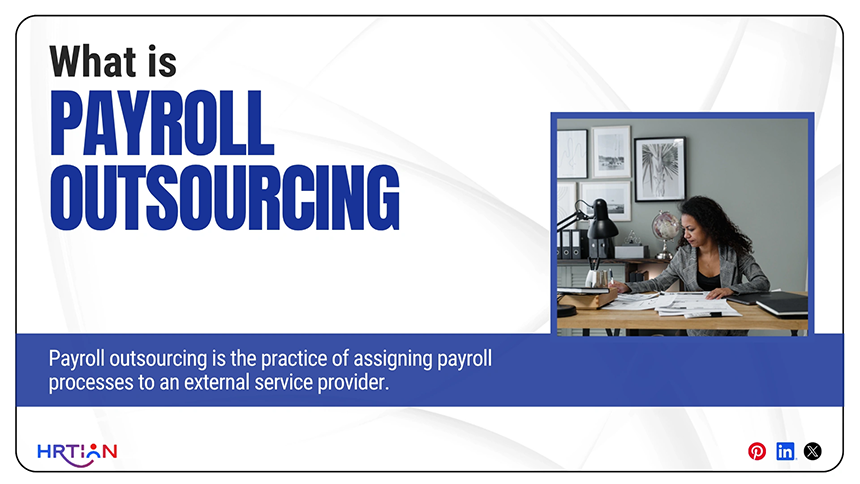
Payroll outsourcing is the practice of assigning payroll processes to an external service provider. These providers specialize in managing the payroll calculations, tax filings, statutory compliance, and reporting for the business.
These outsourcing providers are usually equipped with advanced systems and ensure compliance with shifting labor and tax laws, which is particularly valuable for companies that operate across a wide variety of regions.
According to industry estimates, over 60% of small and medium businesses across the globe outsource part of their payroll to help relieve administrative burden and compliance risks.
Some key features of payroll outsourcing include the following:
- Managed by external payroll experts.
- Internal workload is heavily reduced.
- Compliance with constantly shifting laws is maintained.
- Often includes support, audits, and reporting.
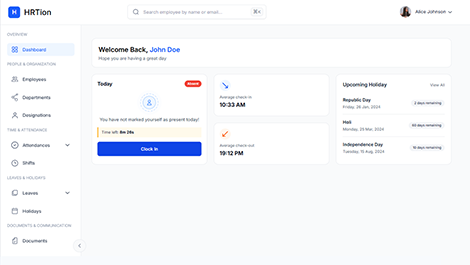
Manage the payroll, attendance, shift roles, and more in an all-encompassing HR suite. Your ultimate HR toolkit is just a click away.
Payroll Software vs Payroll Outsourcing: Key Differences
| Factor | Payroll Software (in-house) | Payroll Outsourcing |
| Definition | A digital tool is used by HR and finance teams for managing payroll internally. | A third-party service provider is hired to handle payroll operations |
| Control | Complete control over data and operations | Limited control as data and processes are managed externally |
| Cost Structure | One-time setup or subscription fees | Monthly/yearly recurring fee. |
| Compliance Management | Managed internally, it requires updated compliance, policy, and regulation management. Some tools automatically update the changes. | Compliance is handled by experts. |
| Accuracy | Depend on the tool chosen and HR efficiency | Usually high-level. Need to be careful while choosing a service provider. |
| Time Investment | Set up and training time required | Instantly, as internal teams are not involved. |
| Scalability | Need to upgrade, or a scalable solution is required. | Easily scalable with business needs. |
| Data Security | Data stays within the organization | Data is shared with third parties. |
| Customization | Highly flexible, based on company policies | Limited customization |
| Technology Dependence | Requires system maintenance and updates | Managed externally by a service provider |
| Best For | Businesses with highly efficient HR teams. | Businesses requiring to save time and reduce admin burden |
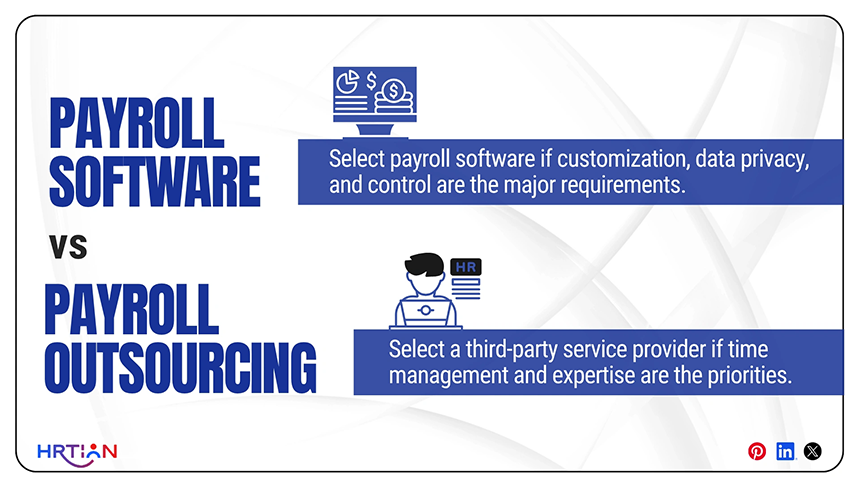
Summary:
- Select payroll software if customization, data privacy, and control are the major requirements.
- Select a third-party service provider if time management and expertise are the priorities.
Benefits of Using Payroll Software
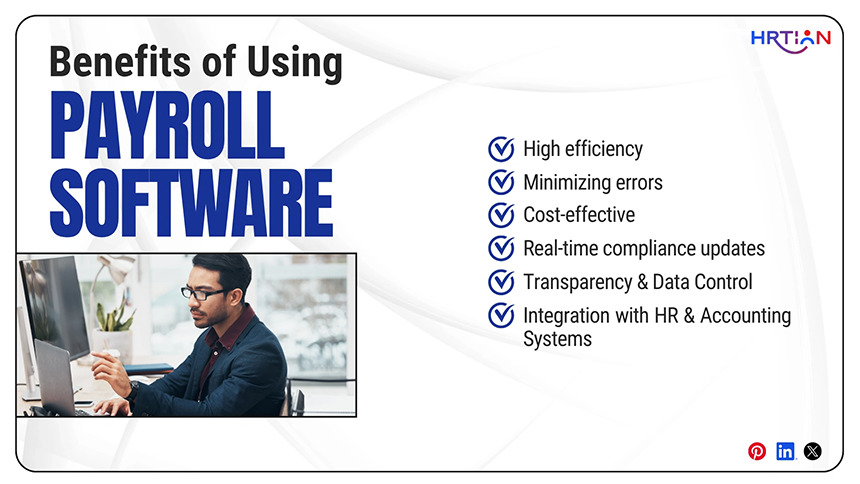
Payroll software allows an organization to organize, maintain, and accurately calculate payroll processes internally. Some benefits of such software are provided below:
- High efficiency: Payroll software significantly reduces the processing time by automating difficult and repetitive tasks like salary calculations, tax deductions, and payslip generation. This software has been shown to cut the processing time by up to a massive 80%, saving anywhere from 5 to 10 hours per pay cycle. This allows teams to direct their attention towards higher-value objectives.
- Minimizing errors: Payroll software allows an organization to reduce errors in payroll processes, which can become very expensive quickly. It has been observed that payroll software lowers error rates in payroll processes from 1-8% in manual systems to less than 1%. The cost of mistakes can vary, and the average cost of mistakes has been found to be $231 per employee annually.
- Cost-effective: Manual payroll or outsourcing tends to be more costly than payroll software. The software can reduce payroll processing costs by 30-50%, allowing many small businesses to automate their payroll processes with affordable rates that range between $20 and $200.
- Real-time compliance updates: Modern payroll software automatically updates according to the shifting regulations, including tax laws and statutory requirements. This is a crucial obstacle for many organizations, as nearly 40% of small businesses get penalized every year due to payroll errors or non-compliance.
- Transparency & Data Control: Payroll software allows full control over sensitive details and payroll data. It also offers real-time insights into employee compensation, tax liabilities, and financial reports.
- Integration with HR & Accounting Systems: Most modern payroll software integrates seamlessly with HRMS and accounting platforms. This helps in avoiding excess duplication of work, reduces the workload, and also improves operational efficiency by 25-40%.
Benefits of Using Payroll Outsourcing
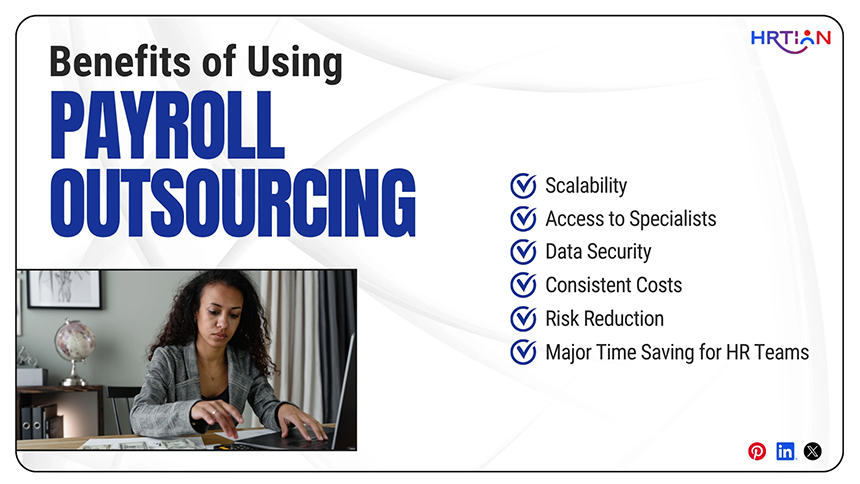
Payroll outsourcing makes use of external providers and allows the organization to utilize its internal resources and teams to focus more on internal goals and organizational objectives. Some benefits of payroll outsourcing are given below:
- Scalability: Outsourcing helps organizations scale their operations easily, which becomes valuable during expansion into new markets. Companies are able to reduce setup times by 50-70% without needing to build internal payroll infrastructure.
- Access to Specialists: External payroll specialists are usually well-versed in their knowledge of tax laws, labor regulations, and compliance requirements. This allows organizations to modify their payroll processes easily and detect the regulatory changes across various regions.
- Data Security: Established payroll providers invest heavily in advanced security systems and protocols, leading to a clear decrease in risks like internal fraud, which has been found to account for nearly 5% of annual business losses.
- Consistent Costs: Payroll outsourcing offers very consistent pricing, usually ranging from $50 to $150 per employee per month, and also ensures up to 99.9% payroll continuity. This also accounts for employee turnover or unexpected disruptions.
- Risk Reduction: Payroll outsourcing providers ensure a high degree of accuracy, usually from 95 to 99%, and drastically decrease the risk of penalties due to tax laws by up to 80%, while also complying with changing regulations.
- Major Time Saving for HR Teams: Since outsourcing makes use of external providers to maintain and manage payroll processes, it frees up internal resources by decreasing up to 70% of the time spent on payroll administration. This allows HR teams to focus 15-20% more time on strategic functions such as talent management and employee engagement.
Cost Comparison: Payroll Software vs Outsourcing
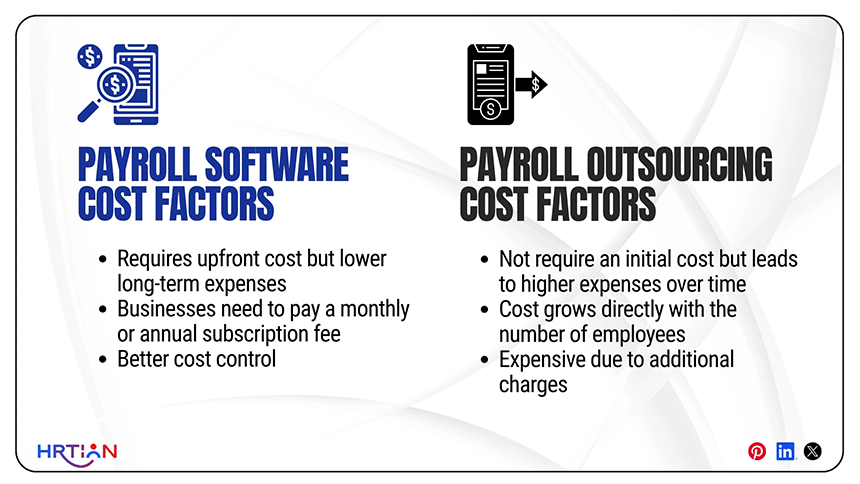
When making a comparison, cost is a crucial factor, as it directly impacts the business. Here is a complete cost breakdown for software vs outsourcing.
A) Payroll Software Cost Factors
- Upfront Investment
Payroll software requires an initial investment, including setup fees, system configuration, and training costs. These costs may seem higher initially, but they are a one-time expense that offers long-term benefits.
- Recurring Expenses
Apart from the initial setup, businesses need to pay a monthly or annual subscription fee. These recurring costs include software updates, maintenance costs, and customer support.
- Long-term Efficiency
Payroll software provides more cost-effectiveness as expenses remain quite stable and predictable. The cost does not rise quickly or significantly as the company grows.
B) Payroll Outsourcing Cost Factors
- Low Initial Cost
Payroll outsourcing generally involves minimal or zero initial cost. This makes it a perfect choice for startups and mid-sized businesses.
- Ongoing Pricing
The cost structure is typically based on per employee or per payroll cycle. But this cost may increase significantly as the company expands.
- Additional Charges
Many outsourcing companies charge extra for additional services like compliance management, tax filings, audits, and reporting.
Key Cost Differences:
- Payroll software involves a higher upfront cost but offers lower long-term expenses.
- Payroll outsourcing may not require an initial cost but leads to higher expenses over time.
- With internal payroll software, the cost remains stable and does not increase significantly.
- With outsourcing, the cost grows directly with the number of employees and payroll frequency.
- Payroll software supports better cost control, while outsourcing can become expensive due to additional charges.
Common Challenges in Payroll Software
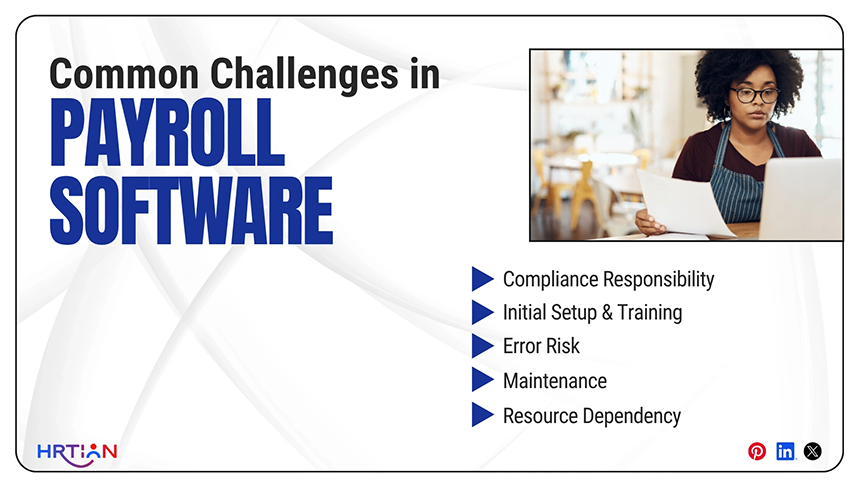
- Compliance Responsibility: Labor regulations and tax laws change constantly, and businesses must do their best to stay updated with the changes to maintain compliance.
- Initial Setup & Training: Proper staff training is required, and implementation may be time-consuming.
- Error Risk: Automation reduces errors in the payroll process, but invalid or incomplete data inputs can still lead to mistakes.
- Maintenance: Regular system updates and technical maintenance are necessary to ensure the software works properly.
- Resource Dependency: Effectiveness depends on the expertise and dedication of HR and finance teams for the management of payroll processes.
Common Challenges in Payroll Outsourcing
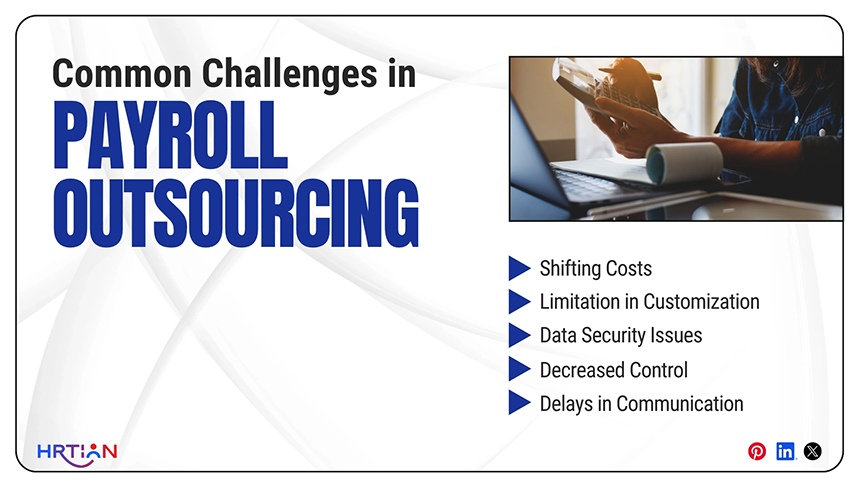
- Shifting Costs: Recurring service fees can increase over time, especially with company growth.
- Limitation in Customization: Standardized processes may or may not fully align with specific business requirements.
- Data Security Issues: Sensitive information regarding employees must be shared with third-party providers, which raises privacy concerns.
- Decreased Control: Businesses have very limited direct oversight over external payroll operatives and payroll operations.
- Delays in Communication: Resolving problems tends to take longer due to reliance on external teams.
Hybrid Approach: Combining Software and Outsourcing
A combination of payroll software and outsourcing helps in the formation of a balanced payroll management system. In this model, businesses utilize outsourcing for complex tasks, which can involve compliance, tax filing, and audits to external experts, and more repetitive tasks, like salary processing and employee data management, are automated through the use of payroll software.
This enables companies to not only maintain control over daily operations but also helps in reducing the burden of technical and regulatory responsibilities.
Benefits of Hybrid Approach:
- Flexibility and Scalability: The hybrid model adapts quickly and easily to business growth, enabling companies to scale their operations without having to significantly increase usage of internal resources.
- Heavily Reduced Workload & Better Efficiency: Due to a clear-cut division of tasks and responsibilities, internal teams are able to focus on core activities, while external providers manage complex tasks, and this allows for improved efficiency.
- Control Over Internal Payroll Processes: Businesses are able to retain full visibility and control over their payroll operations, which allows for easy management of data and implementation of changes.
- Specialized Support for Compliance: Outsourcing crucial compliance tasks ensures accuracy and allows businesses to stay aligned with shifting laws, which leads to an overall decrease in penalties.
Payroll Software vs. Payroll Outsourcing: Which One Should You Choose?
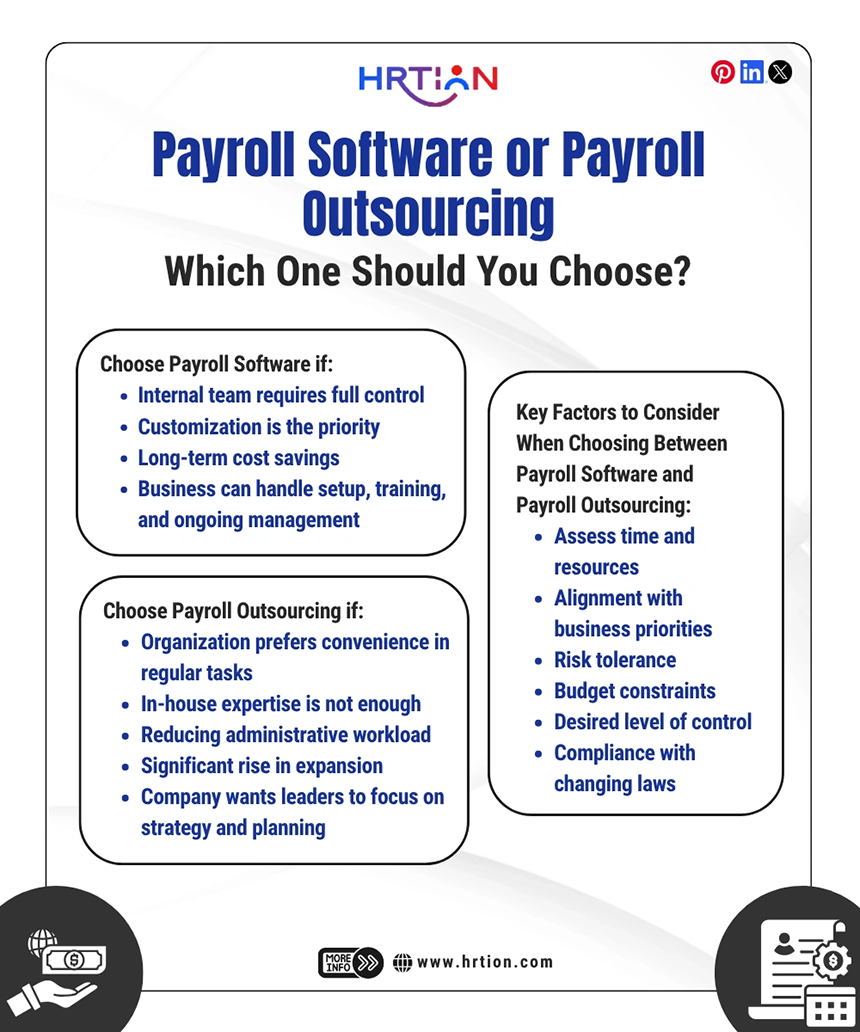
Choosing between payroll software and payroll outsourcing is more complex than one can think. It depends on several factors, such as budget, convenience, and operational process. Both approaches differ in terms of responsibility and internal capabilities.
Choose payroll software if:
- The company requires full control over the process.
- The internal team is capable of handling compliance, tax updates, and calculations.
- Customization is the priority for handling bonuses, shifts, and complex pay structures.
- Long-term cost savings are preferred and required.
- Business can handle setup, training, and ongoing management.
Choose payroll outsourcing if:
- The organization prefers convenience and no involvement in regular tasks.
- In-house expertise is not enough to handle compliance, tax regulations, and filings.
- Reducing administrative workload is a major concern.
- The company requires an expert to handle accuracy and adherence.
- Businesses can invest in ongoing costs that can rise significantly with expansion.
- The company wants leaders to focus on strategy and planning, instead of payroll management.
Key Factors to Consider When Choosing Between Payroll Software and Payroll Outsourcing
Selecting the right payroll solution requires evaluating several business factors, including cost, control, compliance requirements, scalability, and available resources. Assessing these considerations can help organizations choose the option that best aligns with their operational and growth objectives.
Factors to Consider:
- Assess time and resources: Focus on considering if the internal team has enough time and resources to properly manage payroll processes regularly, without negatively affecting core operations.
- Focus on alignment with business priorities: Decide between different options by evaluating which of them best supports the organization’s focus by enhancing efficiency, cost savings, or operational simplicity.
- Understanding risk tolerance: Evaluate the risk of errors and penalties when managed internally versus when managed by external professional providers.
- Awareness of budget constraints: Compare and differentiate carefully between the long-term savings of payroll software and the recurring expenses of outsourcing.
- Factor in scalability requirements: Consider choosing an option that supports the company’s growth without using excessive resources, costs, or complexity.
- Estimate the desired level of control: Identify whether the organization prefers direct control over payroll processes or can afford to entrust them to external providers.
- Consider compliance with changing laws: Figure out if the company is able to manage the shifting tax laws and regulations internally or needs external assistance through outsourcing.
Conclusion
Choosing between payroll software vs payroll outsourcing is complex due to involvement of a wide array of benefits and limitations associated with both.
Where payroll software offers flexibility, control, and cost-effectiveness, payroll outsourcing provides convenience, time savings, and expertise. However, the right solutions depend upon the company’s needs, budget, and growth plans, as there is no one-size-fits-all.
The most effective way to make the best out of both worlds is to include a hybrid approach in the process, which ensures error-free and efficient payroll management.
FAQs
What is the main difference between payroll software and outsourcing?
Payroll software allows payroll processes to be automated internally, while outsourcing is a process where the payroll processes are handled by external service providers.
Is payroll outsourcing more expensive than payroll software?
It usually depends on the size of the company. Outsourcing may have lower costs upfront, but higher recurring expenses when compared to payroll software.
Which is better for smaller businesses: payroll software or outsourcing?
Smaller businesses benefit more from outsourcing because of limited resources and requirements for compliance support, both of which can be handled by external providers better.
Can I use both payroll software and outsourcing together?
Yes, and it is generally advised to use a hybrid approach for combining control over data with specialized assistance.
How do I decide between payroll software and outsourcing?
Try to figure out various factors like budget, team expertise, compliance needs, and scalability to decide whether payroll software works better or if outsourcing is preferred.

Sunita Kumari is a Freelance Contributor Writer at HRTion, writing accurate, reliable, and informative content. She completed her Bachelor's from Rajdhani College of the University of Delhi. She has been a Human Resources Recruiter for almost 2 years, including over 1 year with Battersea Web Expert. Drawing on her recruitment and HR processes experience, she writes clear and practical payroll-related guides that help employees and job candidates better understand HR procedures and workplace practices.