
- What are Payroll and Statutory Compliance?
- Why Payroll Compliance is Important for Businesses
- Key Components of Payroll Compliance
- Types of Statutory Compliance in Payroll
- Payroll Compliance Process: Step-by-Step Guide
- Who is Responsible for Maintaining Payroll Compliance?
- How to Ensure Payroll Compliance?
- Best Practices for Payroll Compliance in 2026
- Common Payroll Compliance Mistakes to Avoid
- Simplify Payroll Compliance Management with HRtion
- Frequently Asked Questions (FAQs)
Payroll is not about distributing salaries to people working in the company; it also includes taxes, deductions, legal obligations, and more. Similarly, statutory compliance requires businesses to follow certain laws related to employee welfare, benefits, taxes, and labor regulations.
With new laws and codes rolling out every other day, payroll compliance has become much trickier than it was in the past. Therefore, companies often face challenges while managing payroll.
Hence, to help out businesses across the world, here is a data-driven guide that helps ensure timely filings, ensuring accuracy, and maintaining transparency to steer clear of legal troubles.
What are Payroll and Statutory Compliance?
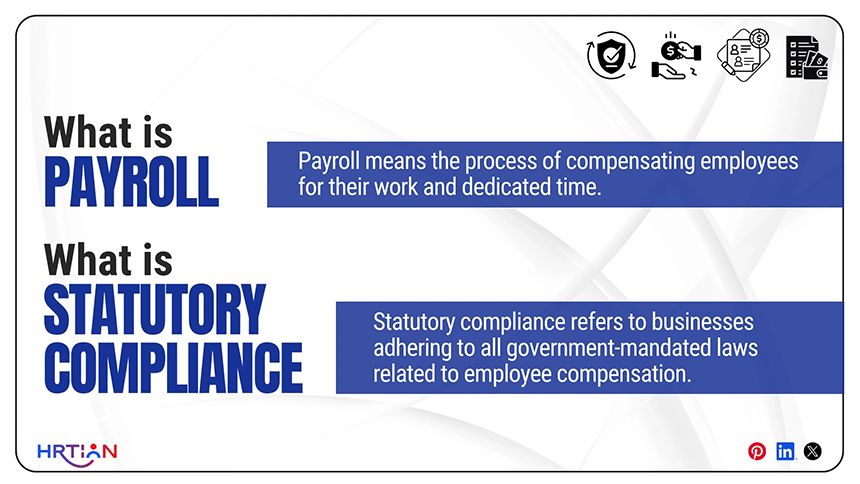
Payroll means the process of compensating employees for their work and dedicated time. This includes calculating wages, managing overtime, processing bonuses, withholding taxes, and ensuring timely payments to the workers. However, payroll works hand in hand with statutory compliance.
Statutory compliance refers to businesses adhering to all government-mandated laws related to employee compensation.
This system makes the overall payroll process more complex because there are multiple taxes involved, which need to be considered whenever payments are made. Even a single mistake can lead to miscalculations, overlooked rules, and legal complications.
Why Payroll Compliance is Important for Businesses
Payroll compliance is crucial for businesses to process correct salaries, timely tax filings, and build employee trust. It plays a major role in the growth and reputation of the company.
- Avoid Financial Risks and Penalties: Payroll compliance helps businesses comply with tax and labor laws, reducing the risk of audits, penalties, and legal issues. It is estimated that the payroll non-compliance cost is $845 per employee annually, which can grow as the company scales, leading to significant loss.
- Bypass Legal Troubles: Payroll and statutory compliance help businesses to follow laws meant for employee welfare, reducing the risk of audits, penalties, or legal actions.
- Build Employee Trust: Paying employees timely and correctly can lead to increased confidence, dedication, and job satisfaction.
- Protects Company’s Reputation: Compliance is the best method to showcase that the business is responsible and professional towards its workforce. This builds credibility among employees, partners, and related authorities.
- Keeps Data Organized: With regular reporting and audits, it requires proper documentation, which keeps data updated and organized, leading to better financial planning.
- Adapt to Changing Laws: Regular monitoring keeps the business updated with the evolving tax laws and rules.
- Reduces Disputes: Correct payments and right deductions help in minimizing the conflicts and misunderstandings between employees and the company.
- Improves overall efficiency: A compliant payroll system forms a structured and reliable payment process for improved and stable operations.
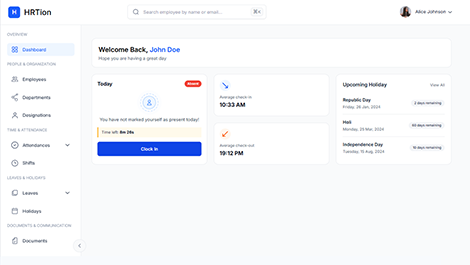
Manage the payroll, attendance, shift roles, and more in an all-encompassing HR suite. Your ultimate HR toolkit is just a click away.
Key Components of Payroll Compliance
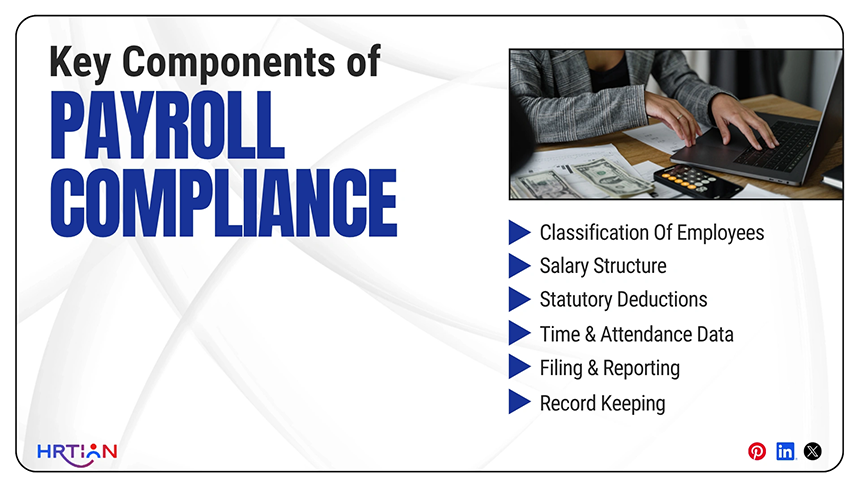
Payroll compliance is an amalgamation of several components that work in collaboration to maintain compliance with state and national laws.
1. Classification Of Employees
Employee classification is a very important component of payroll compliance. A business must be able to correctly decide and define whether a worker is full-time, a contract employee, or a part of the gig workforce.
Every different category has vastly different tax rules, benefits, and legal obligations. Misclassification of an employee can lead the company to face legal trouble, including penalties, legal actions, and additional tax liabilities.
2. Salary Structure
Defining the salary structure accurately includes precise detailing of various parts such as basic salary, allowances, and bonuses. The salary is taxed differently in various categories and must comply with proper wage laws and regulations.
Improper structuring can result in non-compliance, higher tax burdens, or clashes with employees. A transparent and compliant salary structure aids businesses in managing payroll efficiently and ensures clarity in employee compensation.
3. Statutory Deductions
Statutory deductions are defined as compulsory contributions that employers must deduct from employee salaries. These usually include Provident Fund (PF), Employee State Insurance (ESI), and Tax Deducted at Source (TDS).
The responsibility of calculating and analysing these deductions, as well as the submission of the deductions to the relevant authorities, is taken by the employers. Errors in the calculation of deductions can lead to fines and legal problems for the business.
4. Time & Attendance Data
Payroll calculations are heavily dependent on definite time and attendance records. Tracking work hours and leaves taken by the employees, as well as overtime worked by employees, all play a necessary role in these records.
Missing or inaccurate data can result in wrong salary payments and issues with compliance. Maintaining reliable systems for attendance and records ensures that employees are paid fairly and accurately.
5. Filing & Reporting
Payroll compliance requires regular and proper filing and reporting to government authorities. These comprise monthly filings, quarterly returns, and annual reports relating to taxes and employee benefits. Prompt and precise submissions are necessary for avoiding penalties and maintaining compliance with regulations. This also, in turn, leads to transparency and accountability.
6. Record Keeping
Maintenance of documents such as payslips, tax records, and employee details for specified periods is a key step for guaranteeing payroll compliance. These records are highly valuable for audits, legal verification, and internal reviews. Good record-keeping allows businesses to stay organized and prepared for compliance checks.
Types of Statutory Compliance in Payroll
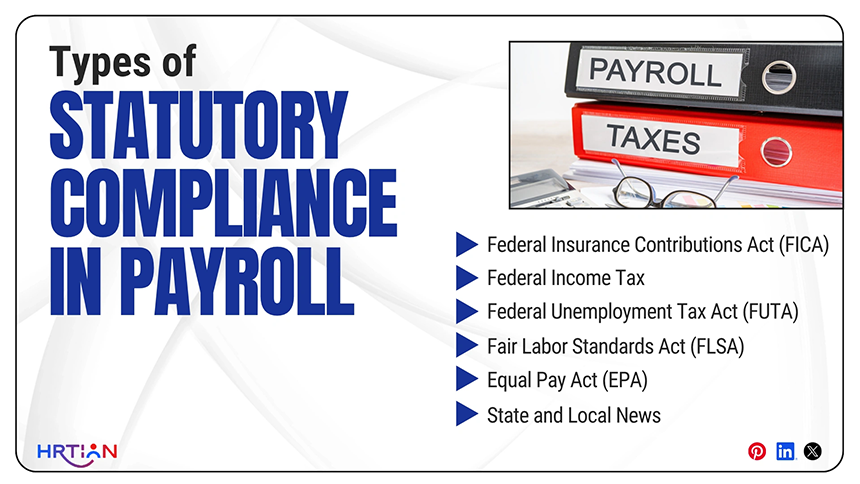
“Statutory compliance” refers to the obligations that employers must follow while processing compensation. These are the types of payroll compliance that help in lawful salary and payroll operations.
1. Federal Insurance Contributions Act (FICA)
The Federal Insurance Contributions Act (FICA) is a post-employment or retirement scheme that is mandatory for every organization. It mandates payroll taxes to fund Social Security and Medicare programs.
Both the employer and the employee contributed a fixed amount or a percentage of salary, which can be withdrawn after the tenure is over. It is regularly managed through deposits and accurate reporting.
2. Federal Income Tax
Federal income tax is a type of compliance that provides medical and cash benefits to employees based on income levels, filing status, and allowances. FIT ensures the social security of the workers, and employers are responsible for calculating tax and deducting it from the salary based on slabs and declarations (e.g., W-4 form).
3. Federal Unemployment Tax Act (FUTA)
The Federal Unemployment Tax Act (FUTA) is designed by the government to provide financial support to unemployed workers. According to this law, employers are required to pay the unemployment tax to the federal government.
The collected tax is then distributed to the state’s unemployment insurance program. However, FUTA is not deducted from the wages of working employees.
4. Fair Labor Standards Act (FLSA)
The Fair Labor Standards Act (FLSA) establishes key labor standards to protect workers, such as minimum wage, overtime pay eligibility, recordkeeping requirements, and restrictions on child labor.
FLSA ensures that employees are being paid fairly for their work and eliminates exploitation in the workplace. The employer must maintain accurate records of working hours according to employee classification standards to remain compliant.
5. Equal Pay Act (EPA)
The Equal Pay Act (EPA) is meant to eradicate wage inequality based on gender; it ensures that both men and women are paid equally while performing an equal amount of work under similar conditions.
This act applied to all sorts of compensations such as salary, bonuses, and benefits. For this, employers need to carefully evaluate job roles and maintain a fair pay structure within the organization.
6. State and Local News
State and local laws are important in determining payroll compliance by imposing required regulations as per the regions. These may consist of minimum wage rates, state income taxes, paid leave policies, and employee benefits.
Employers must stay updated with the compliance requirements depending on the federal standards. It varies by state, city, or municipality.
Payroll Compliance Process: Step-by-Step Guide
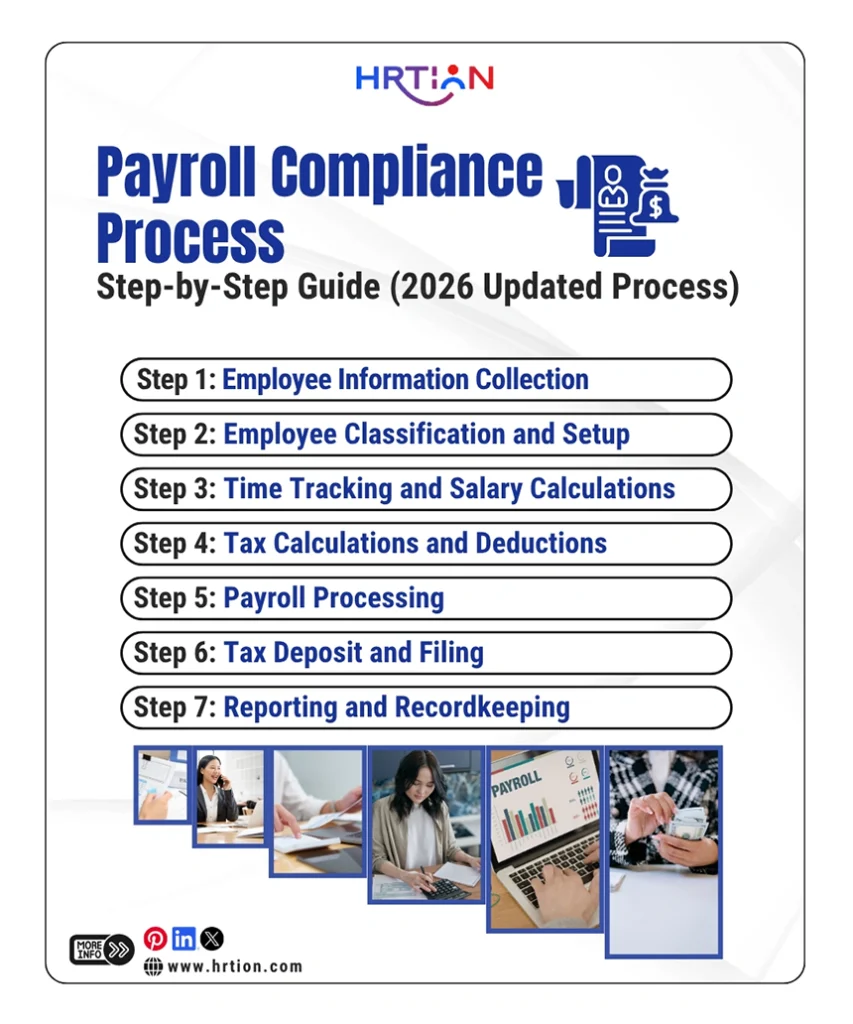
The payroll compliance process follows a structured and well-defined approach. Following this step-by-step method will minimize errors, stay compliant, and streamline payroll processes.
Step 1: Employee Information Collection
The first step is to collect employee data such as social security number, tax filing status, and employment eligibility. Employees must fill out the forms, like W-4, to ensure the withholding of federal income tax.
Step 2: Employee Classification and Setup
Next is to classify the workers based on exempt and nonexempt under the FLSA. This ensures that employees getting paid are correctly eligible for overtime, minimum wage, and benefits. Based on these classifications, the payroll system can set up salary structure, deductions, and pay schedules.
Step 3: Time Tracking and Salary Calculations
Employers track working hours, overtime, leaves, and bonuses of the workers to calculate the gross pay. It can be based on a fixed or hourly basis. In this step, staying compliant with the wage laws is quite significant, as it ensures that employees are paid accurately and fairly.
Step 4: Tax Calculations and Deductions
Then, the employees calculated all related and mandatory deductions such as Social Security and Medicare under FICA. Then, the business computes the unemployment tax in accordance with the Federal Unemployment Tax Act.
Step 5: Payroll Processing
After the calculations are done, the net salary is processed and paid rightfully to the employees through bank deposits or checks. Payslips are generated showcasing earnings, deductions, and taxes.
Step 6: Tax Deposit and Filing
Employers then deposit the withheld taxes on a monthly or semi-weekly basis. They file forms such as Form 941 (quarterly) and Form 940 (annually for unemployment tax) for compliance in a timely manner.
Step 7: Reporting and Recordkeeping
At last, employers issue Form W-2 annually to employees and maintain payroll records. Maintaining accurate records, audits, and reporting income and taxes correctly is essential to ensure compliance with federal, state, and local laws.
Who is Responsible for Maintaining Payroll Compliance?
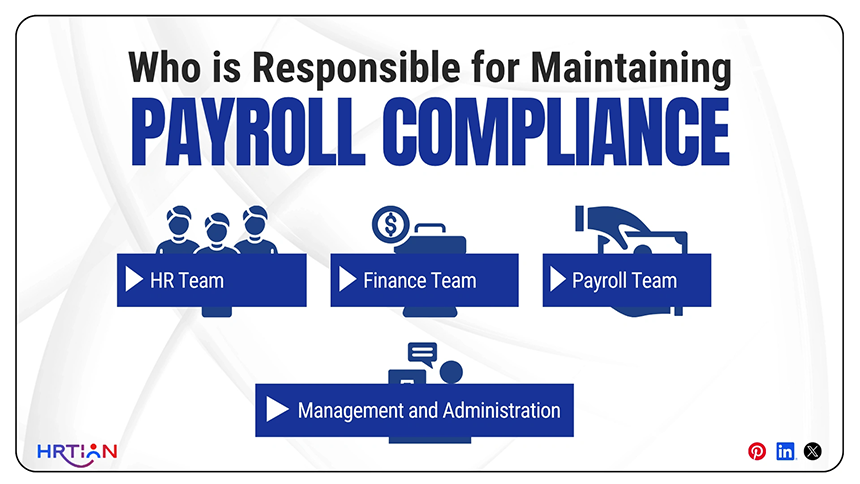
Maintaining payroll compliance is a collective effort and responsibility that different departments and teams share.
- HR Team: To maintain accurate employee records and verify documents. HR professionals ensure that all data used for payroll is updated and compliant with the laws.
- Payroll Team: They handle salary calculation, apply deductions, and ensure that payroll is processed in accordance with laws and policies.
- Finance Team: The finance professionals manage salary disbursements, tax filings, and statutory payments to stay financially compliant.
- Management and Administration: The authorities are legally accountable for ascertaining that payroll practices are aligned with the regulations and company standards.
How to Ensure Payroll Compliance?
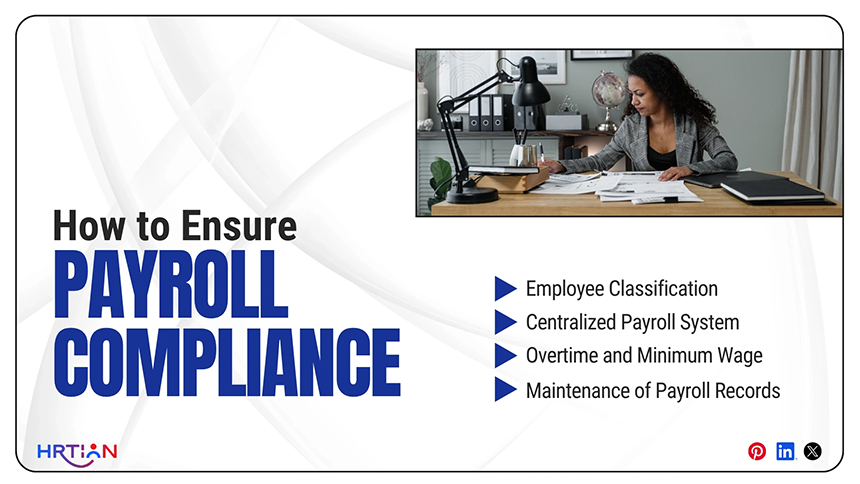
Ensuring payroll compliance involves different activities such as classifying employees, calculating wages, and recordkeeping. Here are the most effective ways to maintain compliance.
- Employee Classification: Properly categorizing employees as full-time, part-time, or contractors based on legal definitions is an important step for payroll compliance. Invalid classification risks penalties, compliance issues, and disputes.
- Centralized Payroll System: Inclusion of employees in a centralized payroll system ensures accuracy in salary processing, tax deductions, and compliance. This also aids in reducing the chance for errors, improves transparency, and maintains consistency and reliability in payroll records.
- Overtime and Minimum Wage: Following proper minimum wage and overtime regulations, as well as tracking working hours, ensures sufficient compensation for employees working extra hours. Payroll policies should also be updated regularly to reflect any legal or regulatory changes.
- Maintenance of Payroll Records: Keeping a track of detailed and organized payroll records, which include salaries, deductions, tax filings, and payslips, allows for resolving disputes and meeting legal requirements for record retention and data accuracy. Proper documentation aids during audits and maintains compliance amongst the employees.
Best Practices for Payroll Compliance in 2026
Payroll compliance best practices include adopting automation, training employees, updating records, and more. All these practices are quite helpful in staying compliant with laws and regulations.
1. Automation Of Tasks
Using AI-driven payroll tools to automate calculations, tax deductions, and reporting helps to reduce manual errors, increase accuracy, and save time.
2. Utilizing Reliable Centralized Payroll Systems
Implementation of reliable payroll systems to manage all employee data in one place ensures consistency in data. This also improves recording and the prevention of duplication or errors within the data across many departments and locations.
3. Focus on Regular Training
Provision of ongoing training for HR and payroll teams on compliance updates and system usage enables employees to stay informed about legal changes and prevent costly mistakes.
4. Assurance of Timely Salary Payments
Payment of salaries should be given on or before the due dates to comply with labor laws and help in building employee trust. This not only helps to avoid penalties but also allows for strengthening organizational credibility.
5. Monthly Compliance Checks
Running monthly reviews of payroll processes allows for the detection and identification of errors early. Constant checks ensure adherence to tax laws, labor regulations, and internal policies.
6. Confirming Statutory Deductions
Accuracy should be maintained in calculating and verifying deductions like taxes, PF (Provident Fund), and insurance. Precise verification maintains compliance with government regulations and prevents penalties and disagreements.
7. Transparency
Clear and direct communication should be maintained with employees regarding salary structure, deductions, and benefits. This builds trust and reduces the chances of payroll-related misunderstandings.
8. Outsourcing
For certain complex payroll structures, considering outsourcing payroll to expert providers can help in terms of better accuracy and compliance management.
9. Payroll Legislation
Tracking changes in labor laws, tax rules, and government regulations periodically and accurately is necessary to avoid legal and financial risks in the payroll processes, as well as ensuring compliance.
Common Payroll Compliance Mistakes to Avoid
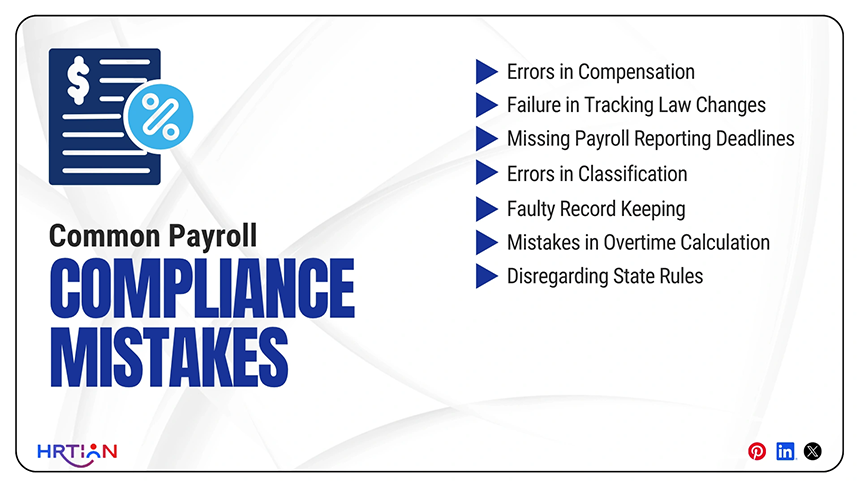
Errors in payroll compliance can lead to legal troubles, fines, and a poor reputation; therefore, it is essential to address these errors and fix them on time.
1. Errors in Compensation
Errors in calculating or reporting employee compensation often lead to legal issues and penalties. Sometimes, improper categorization and classification of job roles or risk levels may also lead to underpayment or overpayment of insurance coverage.
2. Failure in Tracking Law Changes
Failing to stay updated with changing labor laws and tax rules can lead to non-compliance. These may also risk fines, audits, or inaccurate payroll processing, which can affect both employees and the organization.
3. Missing Payroll Reporting Deadlines
Delays in the submission of payroll reports or tax filings can incur penalties and interest charges. This creates problems with compliance as well as issues with government authorities.
4. Errors in Classification
Misclassification of employees as contractors or vice versa can cause legal and tax problems. This may also lead to unpaid benefits, fines, or arguments with workers or regulators.
5. Faulty Record Keeping
Incomplete or inaccurate payroll records can create many problems during audits or inspections. Misplaced documents like payslips, tax records, or attendance data can cause compliance failures.
6. Mistakes in Overtime Calculation
Mistakes in the calculation of overtime pay can lead to underpayments or overpayments of employees. This causes violations of labor laws, resulting in penalties or disputes with employees.
7. Disregarding State Rules
Not keeping up with state-specific payroll laws and regulations leads to issues with compliance, fines, or legal complications. These rules may vary from region to region, so adherence to such regulations is necessary for maintaining compliance with the government authorities.
Simplify Payroll Compliance Management with HRtion
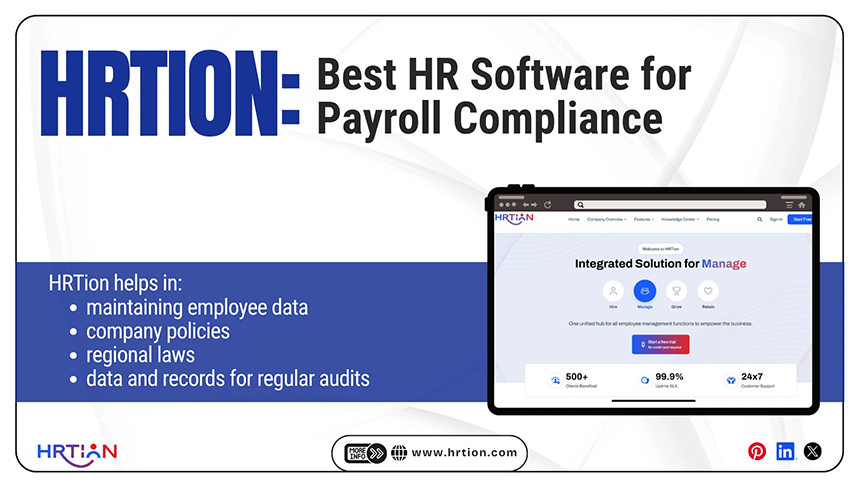
Payroll compliance is a critical function that is not limited to processing salaries. It is a complex process that requires accuracy, precision, and consistency.
The best way to handle payroll and statutory compliance is to adopt automation and digital companions like HRtion, a tool designed to help businesses in maintaining data and records for regular audits. Also, it offers a centralized platform to maintain employee data, company policies, and regional laws, helping in successful payroll compliance.
Frequently Asked Questions (FAQs)
What is payroll compliance?
Payroll compliance is the process of following legal rules and tax laws related to employee compensation. It includes calculating salaries, taxes, benefits, and recordkeeping.
Why is payroll compliance important?
Payroll compliance is crucial to ensure that all employees are paid fairly and businesses can avoid legal penalties. It helps build trust among employees and boosts the company’s reputation.
What are the 5 key areas of compliance?
The 5 key areas of payroll and statutory compliance are:
- Leadership and Governance
- Risk assessment
- Standards and Controls
- Training and Communication
- Monitoring and Auditing
What are the 5 C’s of compliance?
The 5 C’s of compliance are Commitment, Compliance culture, Communication, Controls, and Continuous improvement.
What is the payroll compliance checklist?
The payroll compliance checklist is the list of tasks that are performed to maintain compliance with compensation laws. It includes employee record verification, salary calculations, tax deductions, tax filing, and meeting deadlines.

Sunita Kumari is a Freelance Contributor Writer at HRTion, writing accurate, reliable, and informative content. She completed her Bachelor's from Rajdhani College of the University of Delhi. She has been a Human Resources Recruiter for almost 2 years, including over 1 year with Battersea Web Expert. Drawing on her recruitment and HR processes experience, she writes clear and practical payroll-related guides that help employees and job candidates better understand HR procedures and workplace practices.