
- What is an Applicant Tracking System (ATS)?
- Why Businesses Use Applicant Tracking Systems
- How an Applicant Tracking System Works
- Key Features of an Applicant Tracking System
- Benefits of Using an ATS in Recruitment
- How to Select an ATS in Few Simple Steps
- Types of Applicant Tracking Systems
- List of Top 5 Applicant Tracking Systems
- ATS vs. CRM vs. Recruitment Software
- What Are the Challenges with ATS
- Conclusion
- FAQs
An independent study has revealed that in 2024, 98% of Fortune 500 companies used Applicant Tracking System to automate and manage hiring processes.
But what made ATS so popular across the industries?
The answer is simple: the competition! Companies are in a rush to acquire the right talent before their competitors do. The right talent is key to scalability and growth, as it’s the people who make an organization work. And ATS helps in finding and hiring those people.
In simple terms, ATS is software that is designed to handle the hiring process digitally. From posting jobs and screening resumes to selecting candidates, an ATS can do all this single-handedly, reducing HR and administrative workload.
This comprehensive guide explains all the intricacies related to Applicant Tracking System, including features, benefits, types, and how to select one.
What is an Applicant Tracking System (ATS)?
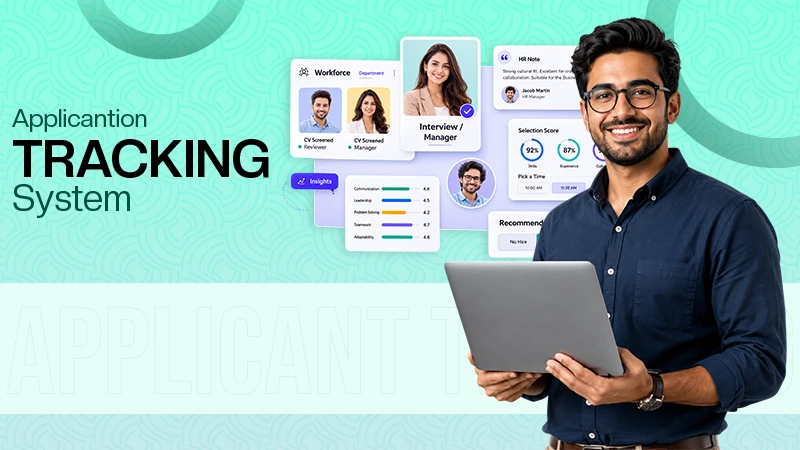
ATS stands for Applicant Tracking System. It is a recruitment software that helps organizations manage hiring needs through a digital platform.
These systems are designed to collect, manage, and track the applications through one centralized platform. It is used to sort resumes automatically instead of using manual processes like spreadsheets or paper-based data management.
Furthermore, ATS platforms are mostly integrated with job boards, company career pages, and social media platforms. It ensures smoother and more efficient recruitment.
Overall, an ATS platform acts as a fully loaded arsenal for companies to track candidates throughout the hiring process.
Why Businesses Use Applicant Tracking Systems
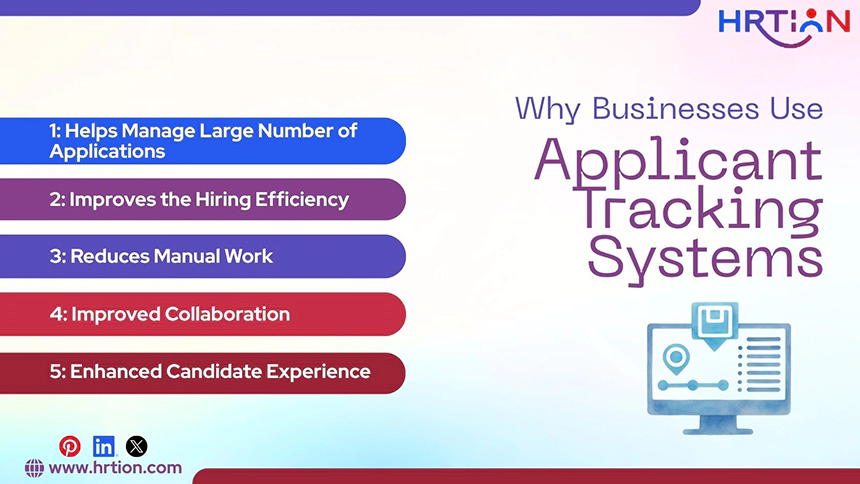
The major reason for using an Applicant Tracking System is to simplify and digitize the hiring process. This simplifies the recruitment cycle, enabling smoother, more effective hiring and onboarding.
- Helps Manage Large Number of Applications
Companies need to handle a large number of applicants for one job posting. And ATS software helps the company organize and filter applications quickly.
- Improves the Hiring Efficiency
Hiring involves reviewing resumes, tracking the candidate process, and communicating with applicants, and an ATS platform makes the entire process smooth and rapid.
- Reduces Manual Work
ATS digitizes repetitive and time-consuming tasks such as resume screening and interview scheduling through automation.
- Improved Collaboration
For successful hiring, collaboration between hiring managers and HR staff is mandatory. And the ATS tool allows filtering and evaluating candidates together.
- Enhanced Candidate Experience
Not only HRs and managers, but this tracking system also empowers candidates to apply easily and receive timely updates.
Manage the payroll, attendance, shift roles, and more in an all-encompassing HR suite. Your ultimate HR toolkit is just a click away.
How an Applicant Tracking System Works
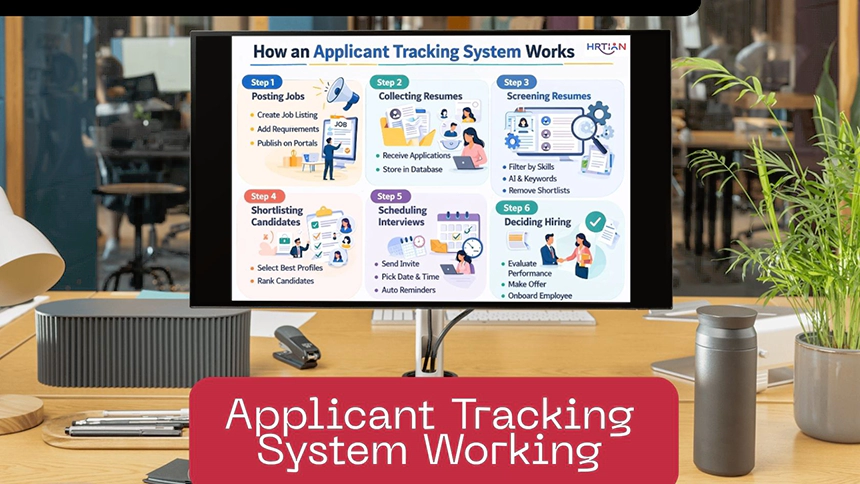
Step 1: Posting Jobs
Recruiters first create the job posting and use ATS to publish it on different job boards and career websites with just one click.
Step 2: Collecting Resumes
Then, ATS automatically collects the resume and application from different sources and stores them in a centralized database.
Step 3: Screening Resumes
The system then scans the resumes based on the preset factors such as keywords, qualifications, experience, and other requirements. It identifies the ideal candidates for the profile.
Step 4: Shortlisting Candidates
Qualified candidates are shortlisted by the tool itself and ranked according to their relevance to the job role.
Step 5: Scheduling Interviews
Scheduling an interview is a daunting task, which ATS software can handle without requiring any manual effort. Companies can schedule interviews and coordinate with managers throughout the hiring process.
Step 6: Deciding Hiring
ATS system tracks the candidate’s progress and stores feedback to help the organization to make the final hiring decisions.
Key Features of an Applicant Tracking System
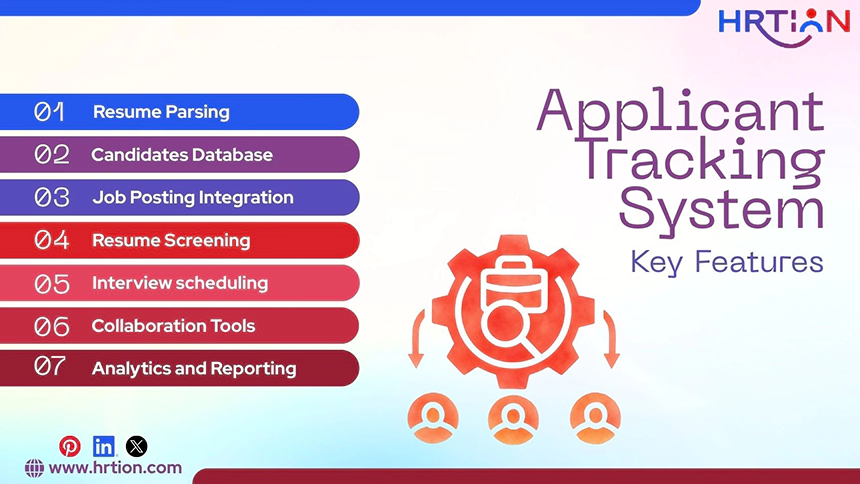
Modern ATS platforms are loaded with numerous robust and AI-powered features that streamline the entire hiring process.
Some important ATS features are the following:
- Resume Parsing
It automatically extracts the candidate information, such as name, education, skills, experience, and other criteria.
- Candidates Database
Stores applicant profiles and resumes to create a functional database, which can be accessed anytime.
- Job Posting Integration
Easier and seamless job posting on multiple platforms simultaneously. This saves time and effort; just create a JD, and ATS will handle the rest
- Resume Screening
With predefined criteria and keywords, ATS performs automated screening for the company. It filters resumes and provides the best suitable ones.
- Interview scheduling
The scheduling interview feature helps recruiters to organize and conduct interviews efficiently.
- Collaboration Tools
The added collaboration tools allow HR teams and managers to share feedback and evaluate employees’ skills as well as capabilities before making the final hiring decision.
- Analytics and Reporting
The tool offers in-depth insights about the recruitment metrics, such as right time-to-hire, cost per hire, conversion rates, and hiring sources. This helps in creating future hiring strategies.
Benefits of Using an ATS in Recruitment
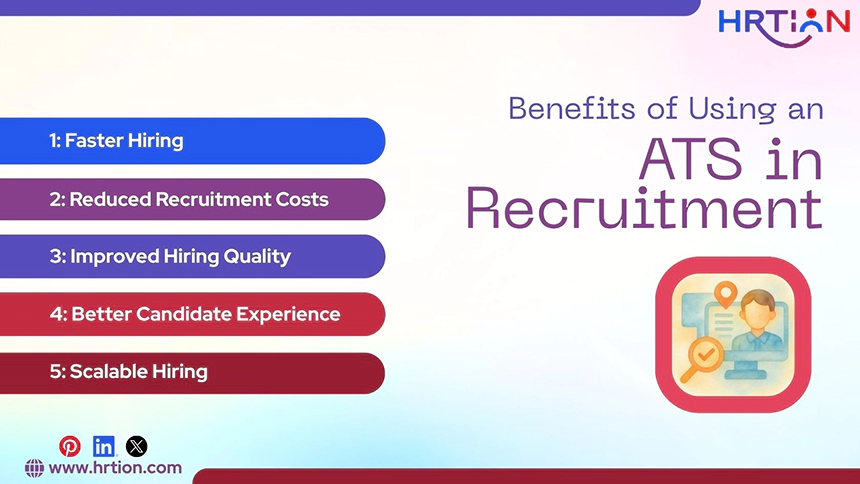
Faster Hiring
According to studies by SelectSoftware Reviews, ATS can decrease the average hiring time by 60%. This is due to the automated resume screen and data filtration, as it reduces the time spent on manual application review and analysis.
Reduced Recruitment Costs
With everything handled automatically, the manual administrative work is reduced significantly, and this lowers the recruitment costs. ATS can even take down the sourcing cost up to 45%.
Improved Hiring Quality
With built-in AI-driven candidate matching, ATS enables organizations to identify candidates who are suitable and skilled for the job. With ATS tools improving candidate quality significantly, organizational growth becomes certain.
Better Candidate Experience
Enhanced and automated communication positively impacts the overall candidate experience. It also keeps the candidate informed about the progression of the application throughout the hiring process.
Scalable Hiring
Large recruitment usually causes increased HR workload. But with an ATS system, companies can handle huge recruitment campaigns without investing excessively in resources.
How to Select an ATS in Few Simple Steps
To select the right Applicant Tracking System, follow the instructions given here:
Step 1: Identify Recruitment Needs
Before picking an ATS software, organizations must first analyze their own requirements, such as
- Hiring volume: How many positions are required to be filled?
- Number of recruiters and managers: The system should be able to accommodate everyone involved.
- Recruitment processes: Find what are the weak spots in your hiring process and find an ATS that can align with those.
Step 2: Check Integration Capabilities
The ATS system you are selecting must be able to integrate with other HR software to form a unified HR ecosystem. It must be able to integrate with:
- HRIS systems: To ensure that all employee data flows smoothly.
- Job boards and career portals: For making multi-channel posting easier.
- Communication tools: Supporting internal communication among HRs and managers.
Step 3: Evaluate User Experience
Having a user-friendly interface is a must. The ATS tool must be easy to navigate for hiring managers and recruiters. Make sure to consider:
- Ease of use for creating job postings and tracking online applications.
- Clean and navigable dashboards for efficient hiring.
- Candidate-friendly dashboard for a smooth application process.
Step 4: Assess Automated Features
The major reason for corporations to incorporate an ATS is to leverage AI-powered features and functionality. Thus, the tool must consist of capabilities, such as
- Resume screening: AI-driven tools to identify the best resumes and top candidates based on education, skills, and experience.
- Interview scheduling: Automated scheduling saves time for recruiters.
- Candidate tracking: The tool must provide a structured and insightful overview of an application’s progress and candidate interactions.
Step 5: Analyze Reporting Tools
A data-driven and detailed overview of every application is important for a successful recruitment campaign. Thus, the tool should offer analytical features, like the following:
- Provide KPIs such as time-to-hire, cost-per-hire, and holistic candidate quality.
- Measure the shortcomings and inefficiencies of the entire recruitment process.
- Help in making an informed decision about workforce planning and talent strategy for the company.
Step 6: Consider Plans and Pricing
ATS pricing depends upon several factors like features, user counts, and size of the company. When analyzing the plan, specifically consider:
- Pricing models: The annual or monthly plans, per-recruiter fee, or one-time license.
- Features provided: The affordable plans often consist of basic features like posting and tracking, whereas the advanced plans offer AI tools, analytics, and complex automation.
- Hidden costs: Apart from the direct cost, check for other investments involved, such as implementation, training, or premium technical support. These may increase the total expense of the tool.
Types of Applicant Tracking Systems
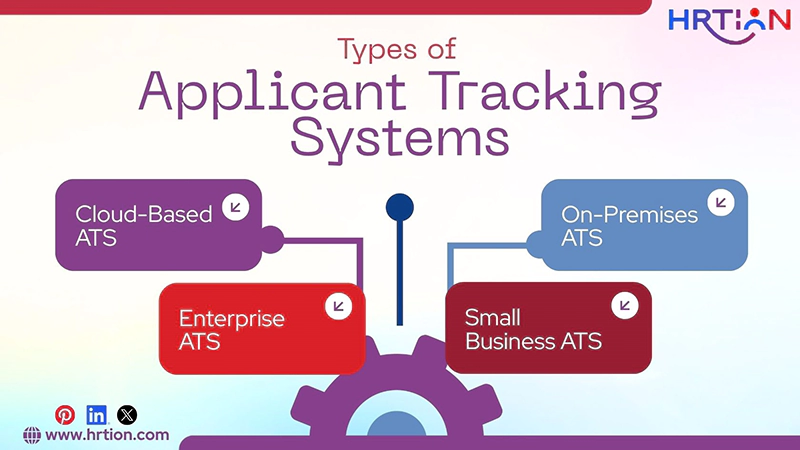
Different organizations have different recruitment needs, budgets, and integration capabilities, and thus multiple types of ATS software exist. Here are the main ATS types to select from:
- Cloud-Based ATS
Cloud-based ATS is hosted online and can be accessed using a web browser. It does not require any complex integration or installation process. The key features of it are:
- It is highly accessible through any device with an internet connection. Therefore, it is best suited for remote or distributed teams.
- It updates automatically on the vendor’s server. Thus, there is no maintenance cost involved.
- Cloud-based solutions are highly scalable and best suited for growing companies. Any number of users can be added to it anytime.
- It is highly popular and reliable, as 70% of the market uses cloud-based ATS software due to its flexibility, affordability, and ease of use.
- On-Premises ATS
On-premises ATS platforms are installed locally on the company’s server. They are rare to find these days but are preferred by some organizations because:
- It provides complete control over the data, so companies requiring higher security and data protection can use this.
- On-premises solutions offer deeper customization and are thus ideal for corporations with unique recruitment processes.
- This system offers higher control and stability. So, firms that require stability over flexibility often settle on on-premises ATS.
- Enterprise ATS
Enterprise ATS systems are designed for larger organizations that deal with high-volume recruitments. They are laced with advanced features, including:
- Automated resume parsing, candidate matching, bulk communication, and interview scheduling.
- Advanced analytics and reporting are used to track hiring results across the departments, locations, and regions.
- High integration capabilities with advanced tools like HRIS, payroll software, LMS, and other recruitment tools.
- Supports scalability to handle hundreds of job postings and applications simultaneously.
- Small Business ATS
Small business ATS platforms are tailor-made for startups, small teams, and growing companies. They handle the basic recruitment requirements and provide a limited range of features. They are effective if the company needs
- An affordable option that can align with the needs of cost-conscious companies, as they offer only essential features and keep the price lower.
- A user-friendly interface for straightforward hiring and workflows. It eliminates the need for extensive training.
- A core tool to handle typical tasks like job posting, candidate tracking, and basic reporting.
- Quick installation with rapid setup, fast adoption, and immediate impact on the recruitment processes.
List of Top 5 Applicant Tracking Systems
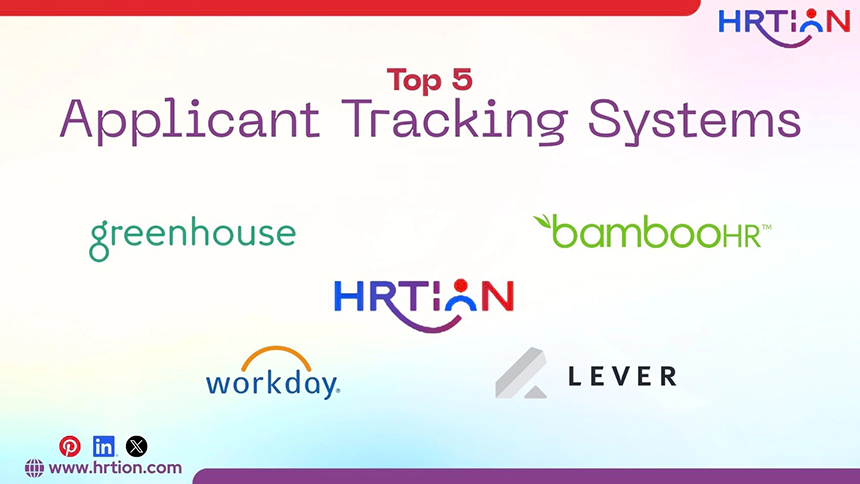
The most popular ATS software that is adopted by organizations across the industry is the following: each of them offers a unique set of features.
- HRtion: A flexible and integrated system that offers HR management along with a workable Applicant Tracking System. It’s best for companies in need of a broader tool and an affordable option to manage hiring needs.
- Workday Recruiting: A part of the Workday HCM suite, it offers a comprehensive and enterprise-level hiring solution. Also known for its advanced integration capabilities.
- Greenhouse: The most configurable ATS, focused on structured hiring and enhanced candidate experience. It provides advanced interview scheduling, scorecards, and analytics to help teams make more informed decisions.
- Lever: It combines ATS and CRM-like capabilities, enabling proactive talent sourcing and application management. The clean interface provides enhanced collaboration between recruiters and hiring managers.
- BambooHR: A simple and effective HR software with an ATS module. Best suited for smaller organizations with basic recruitment needs. It focuses on ease of use and employee self-service.
ATS vs. CRM vs. Recruitment Software
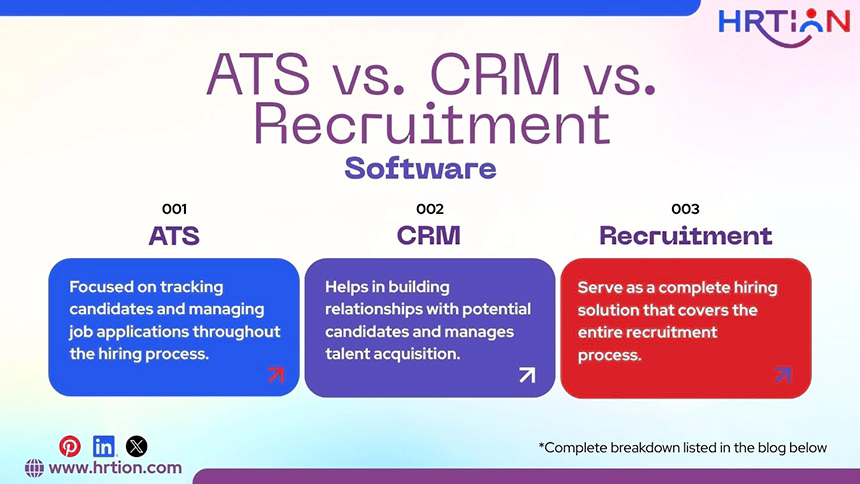
ATS is used to manage applications, CRM is focused on candidate relationships, while recruitment software combines multiple hiring tools under one roof. The key differences in their functionality is explained below:
| Tool | Purpose | Key Functions |
| ATS (Applicant Tracking System) | Focused on tracking candidates and managing job applications throughout the hiring process. | Mainly does resume screening, candidate tracking, and interview scheduling. |
| CRM (Candidate Relationship Management) | Helps in building relationships with potential candidates and manages talent acquisition. | Supports candidate engagement, talent pool management, and enhanced communication across the company. |
| Recruitment Software | Serve as a complete hiring solution that covers the entire recruitment process. | It consists of ATS, CRM, interview scheduling, and different onboarding tools. |
What Are the Challenges with ATS
Undoubtedly, the ATSs are loaded with useful features to give a seamless hiring experience, but there are a few challenges that need to be addressed:
- The keyword-based screening may rely heavily on the provided keywords. This may result in losing qualified candidates if they’ve missed adding those keywords to the resume.
- Some ATS require intensive training to use the advanced features and understand complex analytics.
- The company may need to bear additional or hidden costs related to implementation and customization.
- Candidates may find the ATS-based application process lengthy and complex, which can discourage them from completing the application.
Conclusion
When a company visualizes growth and scalability, it needs to keep up with the trends to stay ahead of the competition. This is when the adoption of technology and automation becomes necessary.
Therefore, currently, a huge section of the large enterprises relies on Applicant Tracking Systems. With every passing day, ATS is becoming an essential part of modern hiring processes. It is best at dealing with a large volume of applications at once and improving the overall hiring quality.
FAQs
What is ATS applicant tracking system?
An ATS is software that automates hiring and manages the entire recruitment process digitally. It helps track, organize, and filter candidates for faster and more efficient hiring.
How do I know if my CV is ATS?
There are a few resume checkers and parsing tools available in the market to check if your resume is ATS-friendly. They help in formatting, keywords, and structure to form a compatible CV.
Can ATS automatically reject resumes?
Yes, ATS follows a certain CV structure based on keywords, format, and company-specific parameters. It can reject a resume that doesn’t align with the requirements.
Do small businesses need ATS?
Yes, small businesses can leverage ATS as it facilitates smoother, faster, and higher-quality hiring, saving the investments on third-party agencies or additional HR resources.

Bhavesh is a Guest Writer at HRTion with an academic background in HR. He did an HR management course in 2025. Before transitioning to HR content writer, he worked as an Academic Content Writer at Trident Management for over 6 years. His expertise in recruitment processes & strategies helps him write detailed and clear content that is not only informative but also accessible for everyone.