
- What is Talent Acquisition?
- Why is a Talent Acquisition Strategy Important?
- Key Components of the Talent Acquisition Strategy
- Steps to Build an Effective Talent Acquisition Strategy
- Modern Talent Sourcing Techniques in 2026
- Best Tips to Build a Talent Acquisition Strategy
- Challenges With Talent Acquisition Strategy
- HRtion to Support Talent Acquisition Strategy
- Conclusion
- FAQs
According to LinkedIn’s Global Talent report, “73% of talent professionals say talent acquisition has become more strategic over the past few years,” emphasizing the prevalence and importance of an effective talent acquisition strategy.
The hiring strategy framework revolves around finding, hiring, and retaining the right talent for the business. It not only focuses on resume filtering but also on employer branding, incorporating technology, and improving candidate experience.
A rightly built talent acquisition strategy enables smarter and data-driven decision-making. Here is all a business needs to know while building a talent acquisition strategy to acquire new talent.
What is Talent Acquisition?
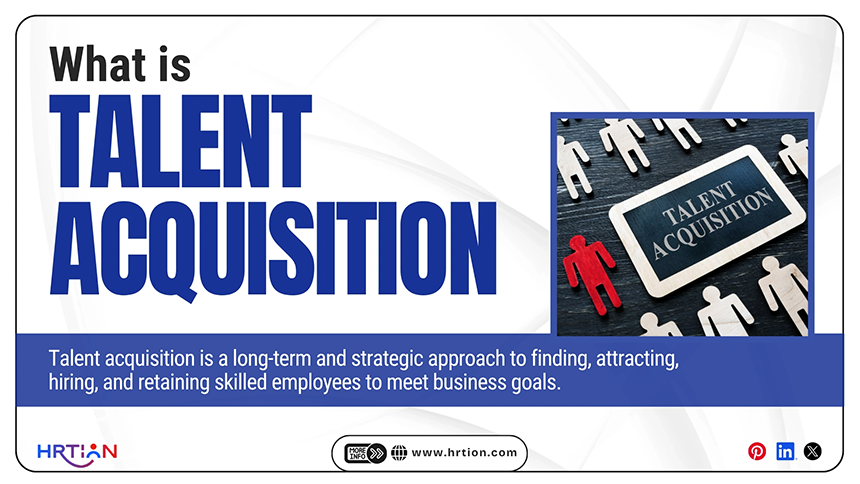
Talent acquisition is a long-term and strategic approach to finding, attracting, hiring, and retaining skilled employees to meet business goals.
Unlike the traditional recruitment process, which focuses on immediate hiring, the talent acquisition strategy is about the following:
- Building the talent pipelines for hiring.
- Workforce planning for the company.
- Employer branding.
- Planning long-term hiring goals.
Talent acquisition is mainly about forming a proactive and strategic approach instead of hiring randomly.
Why is a Talent Acquisition Strategy Important?
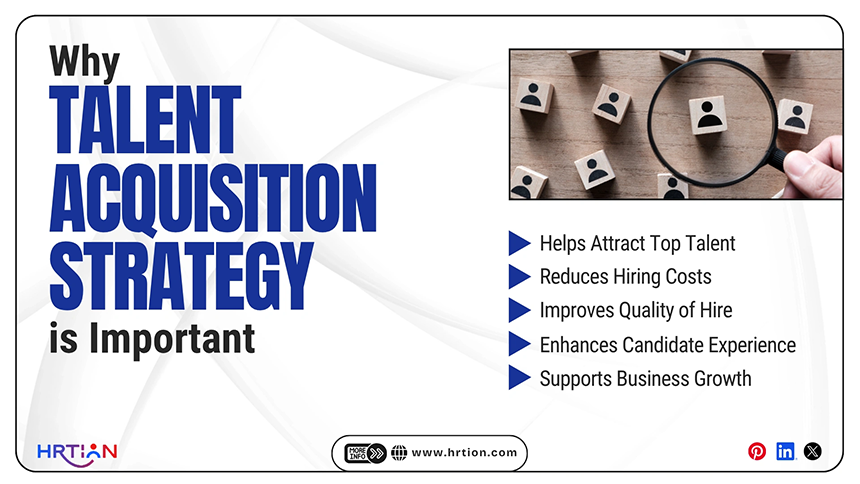
A well-defined talent acquisition strategy is important because it helps companies find and hire the best talent, focusing on long-term business growth by reducing costs, improving hiring quality, and ensuring a smooth recruitment process.
1. Helps Attract Top Talent
With increasing competition, skilled professionals have multiple job opportunities; thus, a company needs to move forward strategically. According to Glassdoor, “75% of job seekers consider an employer’s brand before applying.”
2. Reduces Hiring Costs
Companies with a structured hiring process usually incur the lowest cost-per-hire. Also, it reduces turnover rates. The Society for Human Resource Management (SHRM) estimates that the average cost per hire is around $4,700, which can increase if there is no strategy or plan in the process.
3. Improves Quality of Hire
Companies can hire better employees with the help of data and analytics. It helps businesses focus on skills, cultural fitness, and potential to make informed hiring decisions.
4. Enhances Candidate Experience
With positive candidate experience, the acceptance rates accelerate quickly. A stronger company reputation can lead to various other advantages in terms of hiring and retaining employees.
5. Supports Business Growth
Talent acquisition aligns hiring business goals with the company’s growth. This helps choose the right people in the required roles at the right time.
Manage the payroll, attendance, shift roles, and more in an all-encompassing HR suite. Your ultimate HR toolkit is just a click away.
Key Components of the Talent Acquisition Strategy
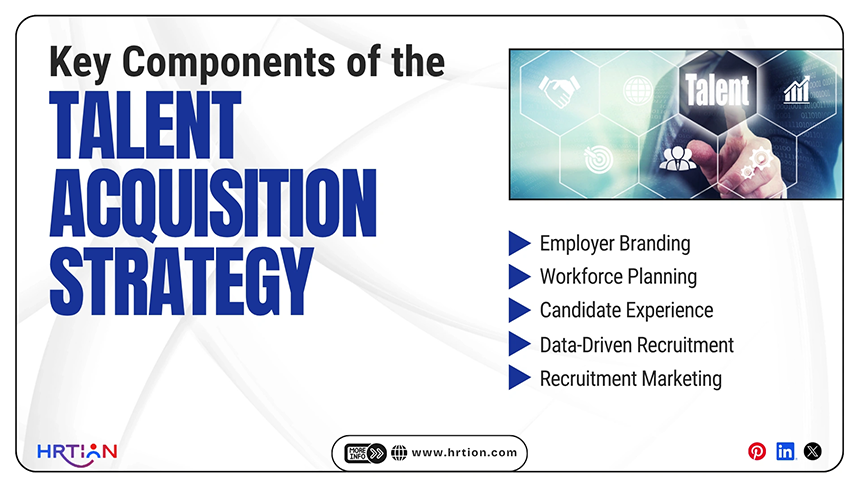
A successful talent acquisition strategy consists of several different components that, when combined, can help hire candidates efficiently. These elements focus on forming a mature and growth-oriented hiring strategy.
1. Employer Branding
Employer branding is how people perceive your company as a workplace. It is quite essential because it helps in attracting quality candidates. Companies can build a good image by showcasing their work culture, sharing employee experiences, and highlighting the benefits of being part of the team. A good reputation can make recruitment easier and cheaper.
2. Workforce Planning
Workforce planning is about making futuristic strategies for how many people are required in the company. This depends on the business growth, market changes, and required skills for the open positions. With the right planning, companies can avoid sudden hiring problems and ensure that there are the right people available for the job.
3. Candidate Experience
Candidate experience is how a job applicant feels about the entire hiring process. A positive, smooth, and simple process makes a good impression. This refers to an easier application system, clear communication, and quick feedback. When the candidates have a good experience, they are likely to accept job offers quickly.
4. Data-Driven Recruitment
Data-driven recruitment means using data and numbers to improve and speed up the hiring process. Companies track elements like data and numbers for informed decisions. This helps bring new ideas, improve overall teamwork, and make the workplace better.
5. Recruitment Marketing
Recruitment marketing is about promoting job openings like a product. Companies use social media, career websites, and other digital content to attract more quality candidates. This helps reach more people at once and builds interest in working for the company.
Steps to Build an Effective Talent Acquisition Strategy
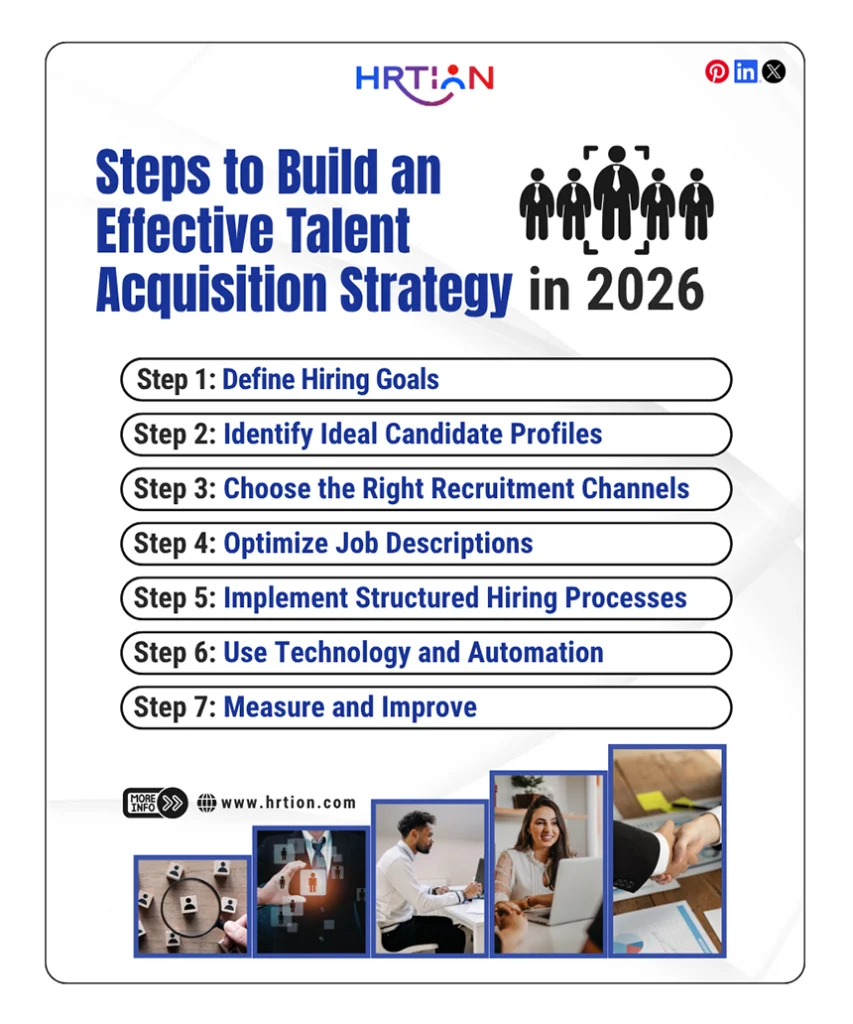
Building a powerful talent acquisition strategy requires a structured approach that helps meet the business goals. It involves finding the right talent, choosing the right resourcing methods, and optimizing the process of hiring.
Step 1: Define Hiring Goals
The first step in building a hiring talent acquisition strategy is defining the goals precisely. These goals must align with business objectives so that recruitment can contribute to growth and success. Whether the company is scaling, filling skill gaps, or replacing existing employees, having clear goals is essential for better planning and sorting out confusion.
Step 2: Identify Ideal Candidate Profiles
Once the goals are clear, the next step is to understand when and what kind of candidates are needed in the company. Creating a detailed candidate profile helps companies focus on finding and attracting the right talent. These profiles must consist of technical skills, personality traits, cultural needs, and the candidate’s value system.
Step 3: Choose the Right Recruitment Channels
Selecting the right platform to find the candidate is quite necessary for successful hiring. Using multiple channels helps reach a wider audience and increases the chances of finding the best-suited candidates. Different roles require different platforms, as there is no size fit for all.
Step 4: Optimize Job Descriptions
Well-written job descriptions can help attract the right candidates and set clear expectations. The JD must be simple, engaging, and informative so that applicants can easily understand the role. Clear job descriptions also reduce confusion and improve hiring quality.
Step 5: Implement Structured Hiring Processes
A structured hiring process can bring consistency and eliminate bias for the applicants. When candidates go through the same process and follow the same steps, it becomes easier to shortlist the right ones. This supports better evaluation, improves overall efficiency, and boosts professionalism in the recruitment process.
Step 6: Use Technology and Automation
Technology is another crucial aspect that makes recruitment faster and more efficient. Incorporating tools like Applicant Tracking Systems (ATS) and AI-based screening helps manage a large volume of applications and accelerate the process. This saves the time and effort of recruiters by automating the repetitive recruitment tasks.
Step 7: Measure and Improve
The final step is tracking and improving the process through the related metrics. By measuring important recruitment metrics, companies can understand what is working and what needs to be improved. This helps in making the right decisions and building a stronger talent acquisition strategy. Track time-to-hire, cost-per-hire, and quality of hire.
Modern Talent Sourcing Techniques in 2026
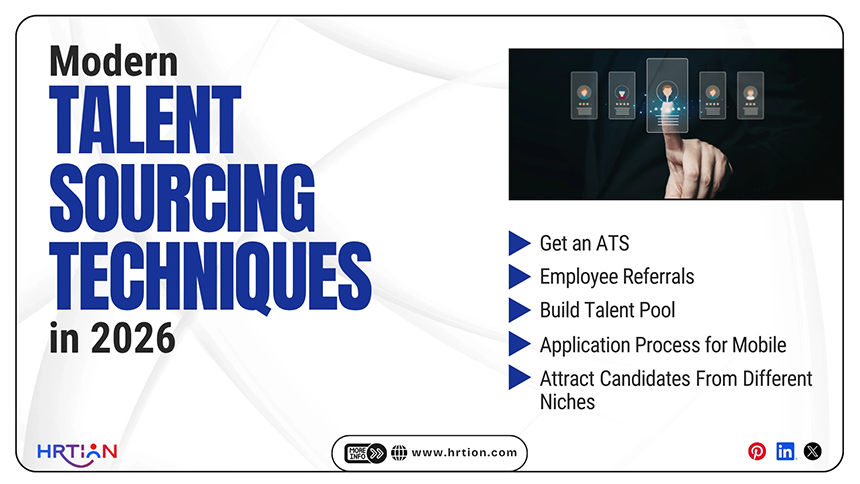
The modern talent sourcing techniques mainly focus on using automation and digital methods to find and hire candidates. Here are the most used talent sourcing techniques in concurrent times.
1. Get an ATS
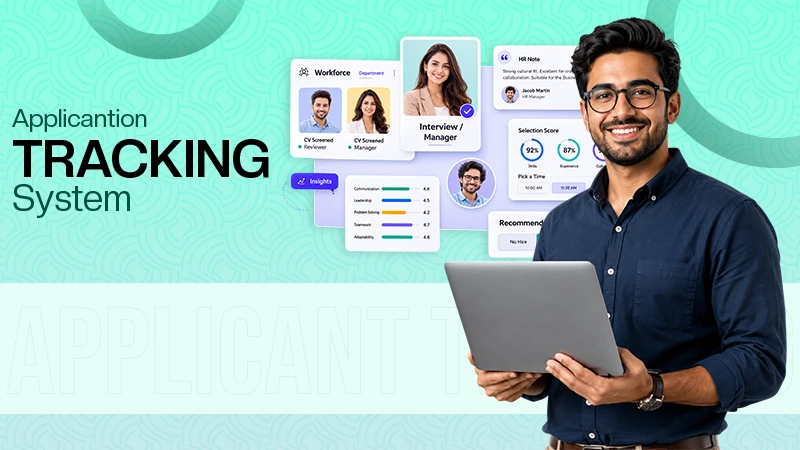
An ATS helps companies manage job applications in an easy and more organized way. It saves time by sorting resumes and tracking candidates automatically in one place. This also makes the communication smoother and more effectual.
- It stores all data in one unified system.
- Helps in filtering and shortlisting resumes.
- Tracks candidates’ progress
- Improves overall productivity
2. Employee Referrals
Employee referrals mean hiring candidates referred or recommended by current employees. In simple words, hiring candidates through the contacts of people already working at the company. It speeds up the hiring process by:
- Bringing trusted candidates.
- Reducing hiring times
- Improving retention rates
- Encouraging employee retention
3. Build Talent Pool
A talent pool is a list of candidates who can be hired in the future. It helps companies fill the roles without starting the search from scratch. This makes everything quick and easy.
- Keeps future candidates already ready
- Reduces time to hire
- Helps in quick decision-making.
- Maintains long-term applicant pipeline.
4. Application Process for Mobile
A mobile-friendly application process enables candidates to apply through their phones, making the application quick and convenient. It attracts employees in greater volume.
- It makes application possible anytime, anywhere.
- Simple and fast application steps.
- Reduces the drop-off rate.
- Improve user experience and company reputation.
5. Attract Candidates From Different Niches
Hiring candidates from different niches refers to the process of hiring and sourcing candidates from different industries as well as backgrounds. This brings new ideas and creativity to the workplace. It also helps in building DEI (Diversity, Equity, and Inclusion) by providing a broader talent pool.
Best Tips to Build a Talent Acquisition Strategy
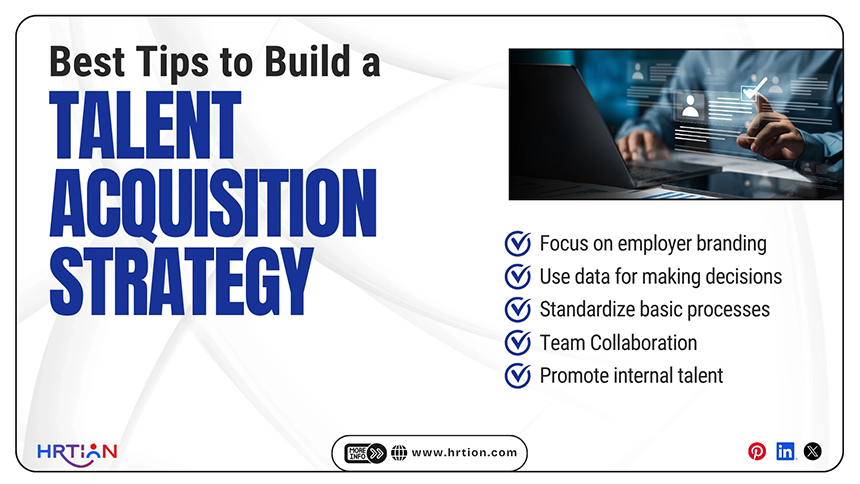
Creating a strong talent acquisition strategy requires a mix of planning, using digital tools, and understanding candidate expectations. With the right practices, companies can have the right people added to their teams.
- Focus on employer branding: A strong promotion strategy attracts quality candidates naturally.
- Use data for making decisions: Track and analyze the KPI and recruitment metrics at regular intervals to stay informed about the hiring trends.
- Standardize basic processes: Make sure the entire company is following the same hiring standards, such as taking regular feedback, orienting new candidates, and application evaluation.
- Team Collaboration: Besides directly related teams such as HR, multiple teams must collaborate to fulfill the hiring needs. It includes team leaders, executives, and partners.
- Promote internal talent: Once the employees have been in the company for a longer period of time, they become familiar with the culture and the process. Their skills must be appreciated and taken into use by promoting them to senior roles when needed.
Challenges With Talent Acquisition Strategy
Talent acquisition strategies often come with different challenges, such as talent shortage, high competition, and rapidly changing expectations of job seekers.
- Finding skilled and talented employees is difficult in most of the industries. According to ManpowerGroup, 75% of employers report difficulty filling roles.
- The competition is quite high, and skilled applicants have multiple options and offers waiting for them, making hiring more competitive.
- Continuously changing employee expectations can make it difficult to fill the position, as they expect the highest flexibility, work-life balance, and career growth.
- Not all organizations can effectively implement HR strategies; this keeps them behind due to a lack of technology adoption.
- Unconscious bias in hiring can affect the decisions related to diversity and shrinking talent pools.
- Hiring the right candidates is easier, but retaining them is quite challenging. When not retained successfully, the growth and business goals can be affected.
HRtion to Support Talent Acquisition Strategy
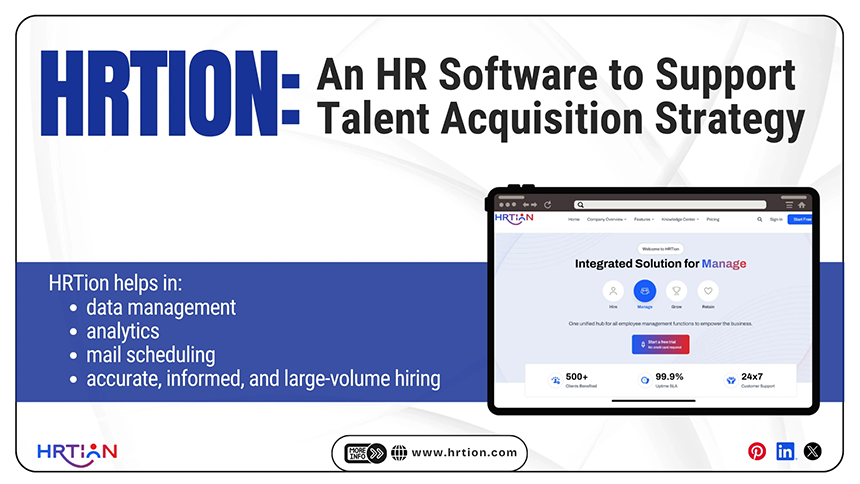
HRtion is an HR software designed to streamline and automate talent acquisition, improving the overall efficiency of recruitment. With various advanced features like data management, analytics, mail scheduling, and more, it becomes easier to collaborate with teams and communicate with applicants.
It is specifically advantageous for businesses that need to modernize HR functions for accurate, informed, and large-volume hiring.
Conclusion
Talent acquisition strategy should be designed keeping the company’s growth in mind. Innovation, convenience, and communication are the main pillars of a hiring strategy. With a futuristic approach, companies can attract top talent in the industry, expedite hiring, and drive long-term growth.
As the competition continues to grow, businesses must adopt a tailored talent acquisition strategy to stay ahead.
FAQs
What is a talent acquisition strategy?
Talent acquisition strategy is a long-term plan that helps companies attract, identify, and hire the right talent to meet business goals. It focuses on proactive hiring, branding, and building talent pipelines.
What are the 4 pillars of talent acquisition?
The 4 pillars of talent acquisition are the following:
- Sourcing
- Recruitment marketing
- Candidate experience
- Data & analytics.
How is talent acquisition different from modern recruitment?
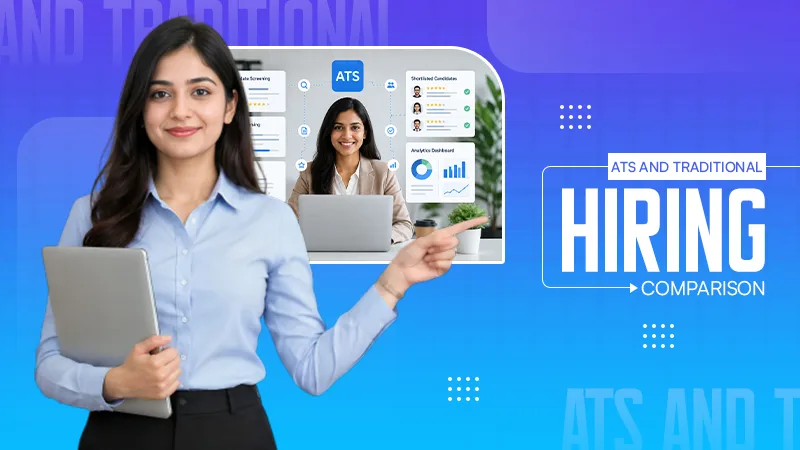
Traditional recruitment focuses on immediate hiring needs, whereas talent acquisition focuses on long-term strategy involving planning, branding, and workforce development.
What are the main components of a talent acquisition strategy?
The main components of a talent acquisition strategy:
- Employer branding
- Workforce planning
- Candidate experience
- Data-driven recruitment
- DEI initiatives
What tools are used in a talent acquisition strategy?
Common tools that are mainly used in talent recruitment are:
- Applicant Tracking Systems (ATS)
- HR analytics platforms
- AI-based recruitment tools

Bhavesh is a Guest Writer at HRTion with an academic background in HR. He did an HR management course in 2025. Before transitioning to HR content writer, he worked as an Academic Content Writer at Trident Management for over 6 years. His expertise in recruitment processes & strategies helps him write detailed and clear content that is not only informative but also accessible for everyone.