
- ATS vs Manual Hiring: A Quick Comparison Table
- What is an Applicant Tracking System (ATS)?
- What is the Manual Recruitment Process?
- Major Differences Between ATS VS Manual Hiring Processes
- Challenges with the Manual Recruitment Process
- Benefits of Recruitment with Application Tracking Systems
- Cost Comparison Between ATS and Traditional Recruiting
- How to Choose the Right ATS for Your Business
- HRtion: Best Tool for Recruitment Management
- Conclusion
- Frequently Asked Questions
Recruitment has been the backbone of organizational growth. Selecting the right candidate can be quite challenging through the manual approach; thus, automation has become part and parcel of the overall hiring process.
An Application Tracking System (ATS) is a digital assistant that helps recruiters handle resume parsing, candidate filtering, and managing applications quicker and more organized.
Though the manual hiring process feels more human and flexible, it may lack efficiency, speed, and the focus of personal judgment.
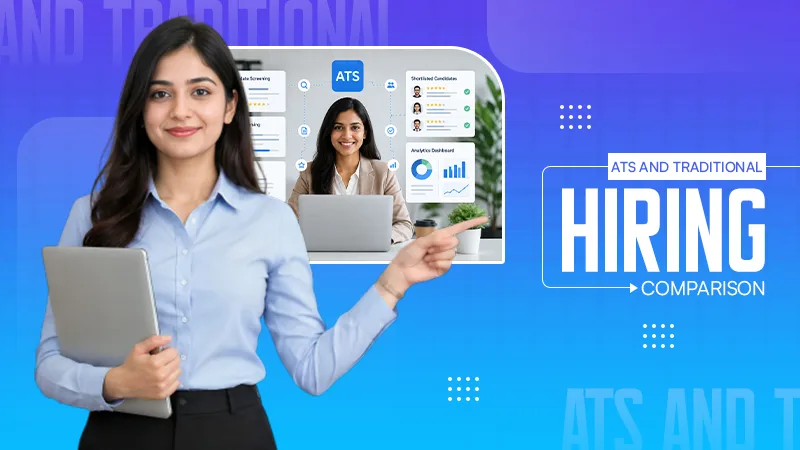
Here is the guide explaining the differences between ATS vs Manual Hiring Recruitment Process and how both can be used in combination for strategic recruitment.
ATS vs Manual Hiring: A Quick Comparison Table
| Application Tracking System | Manual Hiring |
| Fast and automated | Slow and time-consuming |
| Automatic resume filtering and parsing | Manual and slow resume filtering |
| Suitable for handling larger volumes | Difficult to manage a large number of applications |
| Higher accuracy | Lower to moderate accuracy |
| Reduced human errors | Higher risks of human errors |
| Centralized digital platform for data organization | Scattered and unorganized files and papers |
| Built-in team collaboration features for smoother communication | Manual follow-ups and feedback sessions. |
| Initial investment but cost-effective in the longer run | Higher costs due to time and labor |
| Includes real-time insights and metrics | No analytical data or insights |
| Consistent and professional candidate quality | Quality may depend on the recruiter |
What is an Applicant Tracking System (ATS)?
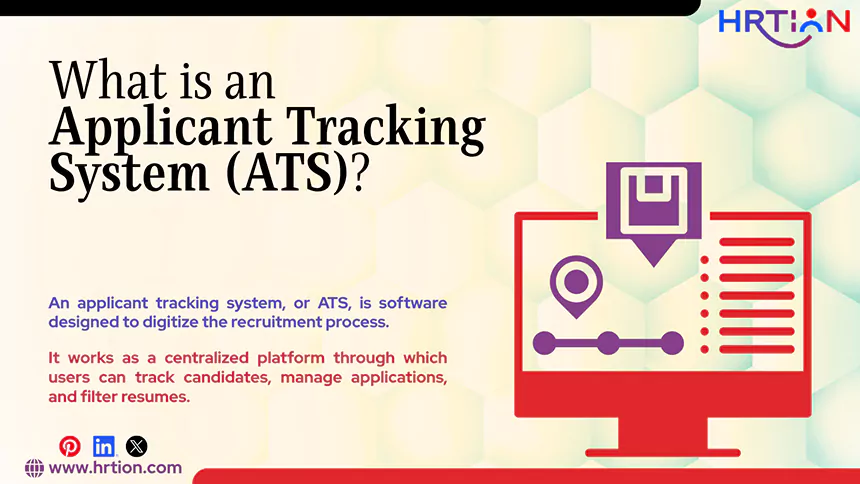
An applicant tracking system, or ATS, is software designed to digitize the recruitment process. It works as a centralized platform through which users can track candidates, manage applications, and filter resumes.
How ATS works:
- Creates and posts jobs online.
- Collect and sort resumes from multiple digital platforms.
- Resuming parsing and managing candidate data.
- Screen resumes using AI.
- Shortlisting candidates and scheduling interviews.
- Communicate with candidates and collect feedback.
- Automate the onboarding process.
Benefits and Limitations of ATS:
| Benefits | Limitations |
| Reduced time to hire by automating the resume screening and interview process. | Requires initial investments in setup, training, and implementation |
| Automatically applies filters to shortlist the most relevant resumes | Recruiters’ time to get used to the system. |
| Stores data in one centralized platform | Keyword filtering might reject the qualified candidates. |
| Enables feedback sharing faster and easier | Automation can cause limited personalized interactions. |
| Provides regular updates and insights to plan better | System or downtime issues can cause delays |
| Best for hiring a larger volume of applications | Needs technical expertise to handle the process. |
Manage the payroll, attendance, shift roles, and more in an all-encompassing HR suite. Your ultimate HR toolkit is just a click away.
What is the Manual Recruitment Process?
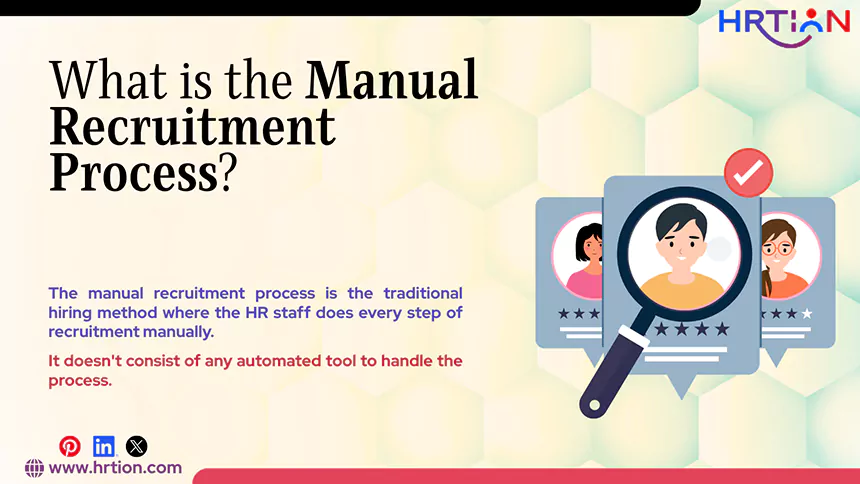
The manual recruitment process is the traditional hiring method where the HR staff does every step of recruitment manually. It doesn’t consist of any automated tool to handle the process.
How manual recruitment works:
- Writing a job description.
- Posting openings on different job boards.
- Receiving resumes via email or calls
- Screening resumes manually.
- Contacting candidates individually
- Scheduling interviews through calls
- Collecting feedback
- Sending an offer letter through email
Benefits and Limitations of Manual Recruitment Process
| Benefits | Limitations |
| Allows personalized and direct communication with candidates | Continuous manual screening can take a lot of time. |
| Helps assessing soft and interpersonal skills of the candidates | Highly prone to human errors in data entry. |
| Highly flexible and can be adjusted as per hiring needs | Poor data management due to scattered sheets |
| Doesn’t require an initial investment in tools or platforms | No in-depth insights of recruitment process |
| Recruiters take care of every step of the hiring process. | Delayed communication can cause frustration and cause candidates to back off. |
Major Differences Between ATS VS Manual Hiring Processes
There are fundamental differences between approaches to recruitment in both hiring methods. Below is the explanation of how ATS and manual recruitment differ in respect to the most crucial factors.
Speed: ATS automates the repetitive tasks and reduces hiring time, but manual recruitment requires recruiters to handle each step individually.
Efficiency: An automated system streamlines the recruitment process, while manual recruitment processes often lead to delays, errors, and inefficiencies.
Accuracy: ATS reduces human errors through digital platforms, whereas a manual process can lead to human errors.
Candidate Experience: Automatic tools update the candidates regularly about the process, whereas manual recruitment does not provide instant replies to the candidates.
Scalability: With automation, handling a higher number of applications is easier, whereas a manual process can struggle to scale.
Data Management: ATS offers a centralized online platform to store data, while manual hiring involves scattered information.
Challenges with the Manual Recruitment Process
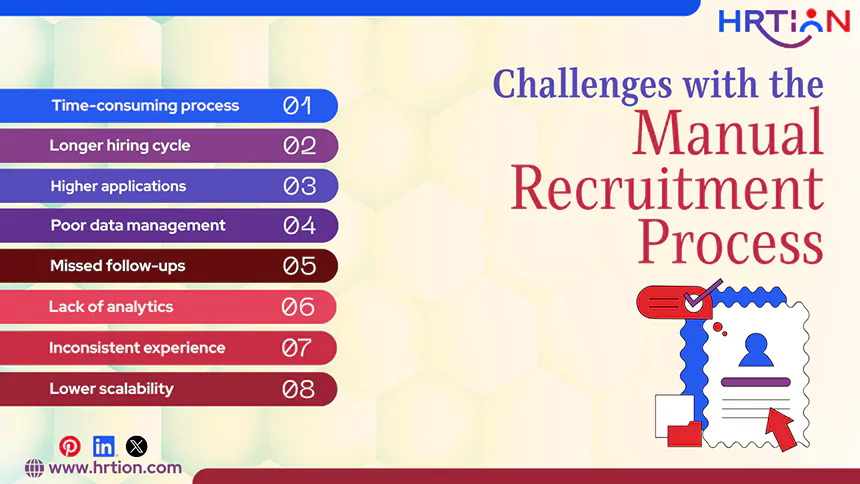
The manual recruitment process often involves a number of limitations and challenges that can result in struggle in hiring the quality candidates and inconsistent decision-making.
- Time-consuming process due to manual resume screening and coordination.
- A longer hiring cycle may cause delays in filling in the urgent opening.
- Difficulty in managing when the number of applications is higher in number.
- Emails, files, and spreadsheets can cause poor data management.
- Missed follow-ups and scheduling conflicts can be a major challenge.
- Lack of analytics and insights causes ineffective decision-making.
- Inconsistent candidate experience negatively affects the company’s reputation.
- Lower scalability can adversely affect the growth of a business as it causes challenges during increased hiring needs.
Benefits of Recruitment with Application Tracking Systems
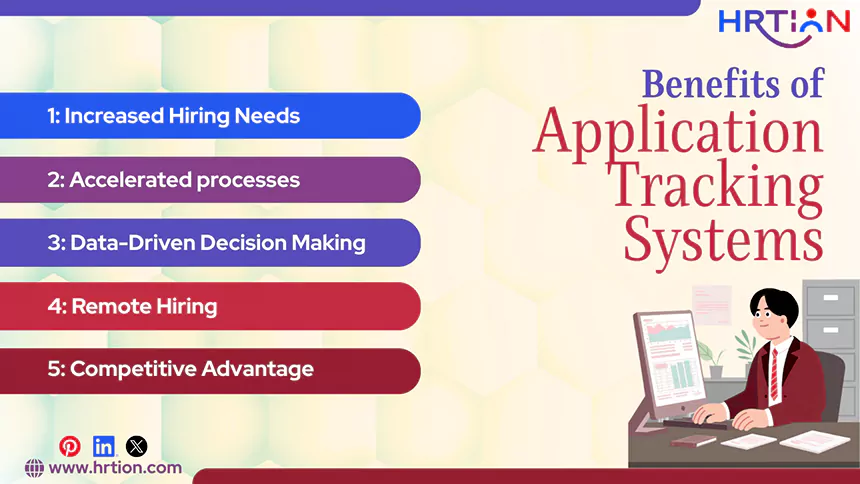
Recruitment with ATS helps companies streamline hiring through automation; it offers multiple benefits, offering a competitive edge.
Businesses increasingly rely on recruitment software to automate repetitive hiring tasks, improve candidate engagement, and reduce the time spent on administrative recruitment activities.
- Increased Hiring Needs
Businesses constantly need to hire people continuously. And handling the constantly emerging recruitment need requires a tool for sorting resumes, tracking candidates, and managing data.
- Need for Speed
The right candidate won’t stay available for a long time, and thus companies need a system that can accelerate processes like interview scheduling, update sharing, and interview management.
- Data-Driven Decision Making
Making hiring decisions can be complex without the availability of real-time analytics and insights. ATS stores and secures useful data such as location, experience, skill set, and preferences. This helps businesses to improve the hiring process and make faster decisions.
- Remote Hiring
Hybrid and remote work cultures have become highly popular. Thus, companies now hire people from distant locations. ATS supports online interviews, tests, and communication and helps businesses manage candidates from anywhere.
- Competitive Advantage
Businesses use application tracking systems to stay ahead of the competition because of streamlined hiring processes. Automation enables efficient candidate management for faster and qualitative hiring.
Cost Comparison Between ATS and Traditional Recruiting
ATS requires more upfront investment but saves money over time, whereas a manual recruitment process may seem cheaper at first but leads to long-term expenses.
| Aspect | ATS Recruitment | Manual Recruitment |
| Initial Investment |
|
|
| Operational Cost |
|
|
| Overall Cost Effectiveness |
|
|
How to Choose the Right ATS for Your Business
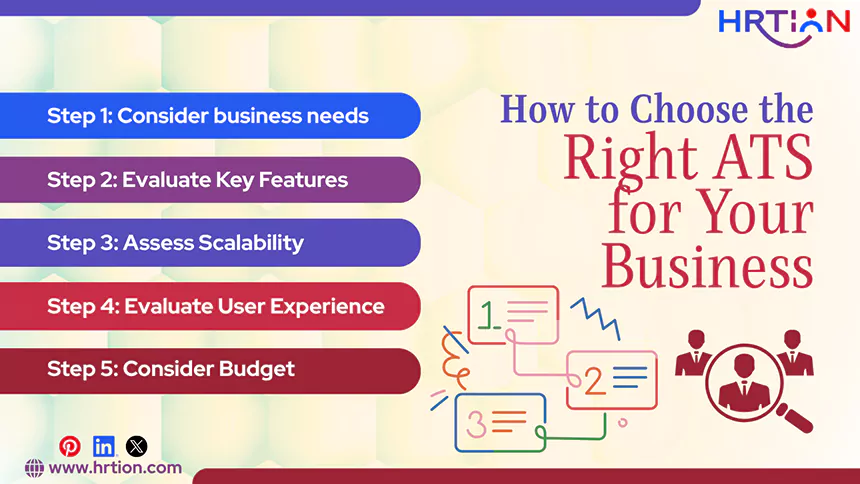
Choosing the right ATS depends upon certain preferences such as scalability, affordability, and integration capabilities. Here are the steps to follow if you are in the hunt for an ideal ATS for your business.
Step 1: Consider business needs
First understand the hiring volume, budget, and business goals to choose the right-fit ATS.
Step 2: Evaluate Key Features
An ATS must consist of basic recruitment features like resume parsing, automation tools, analytics & insights, and integration capabilities.
Step 3: Assess Scalability
The hiring tool must be able to handle the growth. It must be able to scale as your business grows.
Step 4: Evaluate User Experience
The platform must be user-friendly so that HR, managers, and candidates can use the system with ease.
Step 5: Consider Budget
Balance between cost and features is important. The business must select ATS that offers long-term value.
HRtion: Best Tool for Recruitment Management
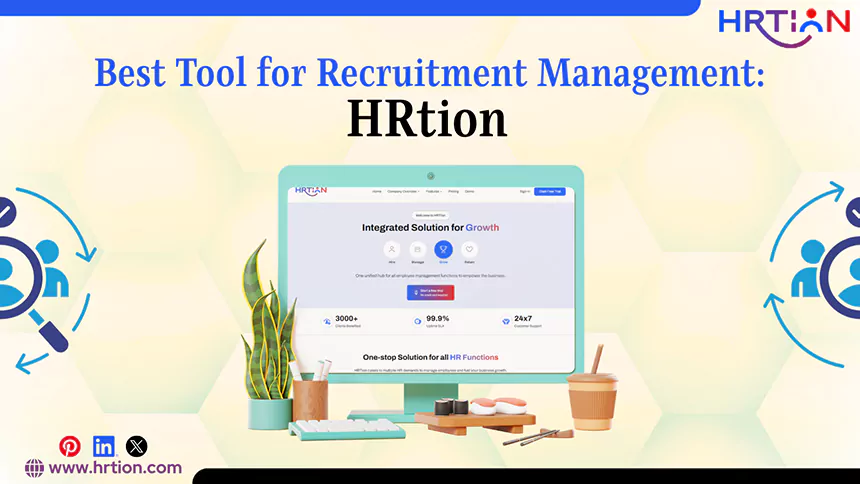
HRtion is an advanced HRMS that helps in hiring, onboarding, and recruitment. It is considered to be one of the best platforms for reducing manual work in mass recruitment.
It can handle hiring well by simplifying and optimizing the entire process. This tool works ideally for businesses of all sizes and helps hire top talent with ease.
Not only hiring but also HRtion also aids in overall employee management. It handles all sorts of pre- and post-recruitment necessities.
Benefits of HRtion:
- Unified and centralized platform for data storage.
- Provides an analytical dashboard for real-time insights.
- Interactive interface for straightforward communication.
- Complete data security for sensitive information.
- Mail scheduling to stay connected.
- Onboarding tools for easy training and integration.
Conclusion
Recruitment is continuously developing and changing and automation is the only way to stay competitive. Manual recruitment provides a personal touch, but it is slow, erroneous, and hard to scale. Thus, to overcome these setbacks, the only panacea is automation.
Application tracking systems (ATS) offer a faster and more effective option to handle recruitment. It automates repetitive tasks, improves candidate experience, and offers useful data for better decision-making.
To make the best of both worlds, it is essential to combine both manual and automated processes. Simply put, it is important to stay efficient with ATS while preserving human touch and judgment.
Frequently Asked Questions
What is ATS?
An Application Tracking System (ATS) is a digital tool that automates and manages the recruitment process automatically.
What is better, manual or traditional recruiting?
Manual recruitment suits small businesses with limited hiring needs. However, ATS works well for all business sizes, as it saves time and reduces errors.
What are the benefits of ATS?
ATS is best for improving hiring speed, better candidate tracking, and automated manual work. Also, it offers data-driven insights for optimal decision-making.
Drawbacks of traditional recruitment methods?
Traditional or manual recruitment can be time-consuming, prone to errors, difficult to scale, and can lack proper data management.
Is ATS better than manual recruitment?
Yes, ATS is generally better for efficiency, scalability, and accuracy. But manual processes can be useful where human judgment is much required.

Bhavesh is a Guest Writer at HRTion with an academic background in HR. He did an HR management course in 2025. Before transitioning to HR content writer, he worked as an Academic Content Writer at Trident Management for over 6 years. His expertise in recruitment processes & strategies helps him write detailed and clear content that is not only informative but also accessible for everyone.