
- Why Small Businesses Need HR Software in 2026
- Introducing HRtion: Best HR Software for Small Businesses
- Features That Make HRtion Ideal for Small Businesses
- Major Highlights of HRtion for Small Companies
- HRtion Pricing and Plans for Small Businesses
- How to Get Started with HRtion
- Who Should Use HRtion?
- Frequently Asked Questions (FAQs)
In the concurrent era of automation, small businesses are striving to gain accuracy and growth. Therefore, they need HR software that can serve their purpose without affecting their budget.
The best HR software for small businesses must consist of features like attendance tracking, shift scheduling, communication, and performance monitoring to support the growth and scalability of the company. One such software is HRtion.
HRtion is acclaimed to be the most-used human resource software for small businesses, as it offers ease, affordability, and scalability at once.
If you are a small company looking to accelerate growth and productivity, you have landed in the right place. Keep digging!
Why Small Businesses Need HR Software in 2026
Small businesses need a helping hand to manage their administrative operations so that HR, managers, and even employees can save their time and energy, which can be used for better purposes.
Here is how HR software makes life easier for SMBs
- Payroll and attendance management: The biggest reason small organizations need HR software is to automate payroll, salary processing, and deductions to reduce pay-related errors.
- Support hybrid environments: As the workforce is transforming into hybrid and remote environments, ideal HR software allows managing people working from different locations. It diminishes the location barrier by enabling managers to track WFH employees smoothly.
- Employee experience: The modern workforce expects transparency, rationalism, and self-service portals. An automated HR system provides quick access to critical information such as payslips, leave balances, and company policies.
- Reduce manual processes, errors, and inefficiency: Errors, inefficiency, and operational errors are the major stumbling blocks for a growing organization. Automation helps develop streamlined workflows, reduce workload, and plan better strategic activities.
- Improved communication and collaboration: Instead of sending emails for everything, a systematic arrangement can bring uniformity across the organization. Human Resource software for small businesses usually contains portals to update leaves, share feedback, and communicate other important information.
Introducing HRtion: Best HR Software for Small Businesses
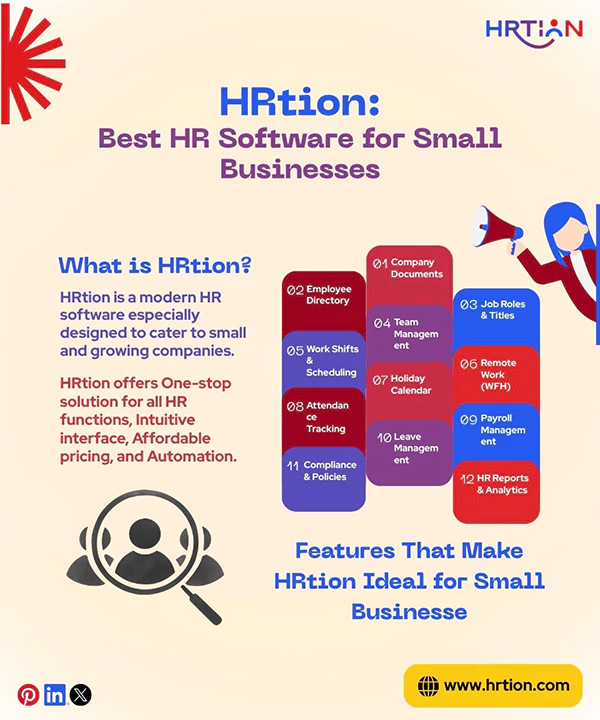
HRtion is a modern HR software especially designed to cater to small and growing companies.
The three important factors for a small to mid-sized business are simplicity, scalability, and affordability. HRtion promises to bring you these three qualities, along with strong customization capabilities. So that you only pay for what you use, instead of being imposed upon unnecessary features,
Most enterprise-sized HR systems come at a high cost and are complex to navigate, requiring additional training.
HRtion offers:
- One-stop solution for all HR functions.
- Intuitive interface for quick adoption.
- Features that grow with your company.
- Affordable pricing without hidden costs.
- Automation designed for lean HR teams.
Manage the payroll, attendance, shift roles, and more in an all-encompassing HR suite. Your ultimate HR toolkit is just a click away.
Features That Make HRtion Ideal for Small Businesses
The thoughtfully crafted features of HRtion make it best suited for startups, small organizations, and expanding businesses that are planning to transition from manual to digital.
1. Company Documents
HRtion provides secure storage for all important company documents, company policy, rulebooks, licenses, payslips, ID proofs, and more. Moreover, it offers controlled access for saved documents to keep things protected.
2. Employee Directory
Finding personal and professional details of an employee is no longer daunting. The employee directory contains a real-time database of employees as per their role, department, and date of joining to maintain clear visibility and improved company structure.
3. Job Roles & Titles
Categorises employees as per their job role, titles, responsibilities, and reporting hierarchy. This helps make informed decisions regarding hiring and workforce management.
4. Team Management
With HRtion, managers can assign tasks, update reviews, and track performance. This effectively improves productivity, encourages transparency, and ensures accountability among teams.
5. Work Shifts & Scheduling
It is easier to plan and assign shifts to employees. Also, HRtion lets you track late arrivals, uninformed leaves, and other related data to form a better schedule for the team to maintain a productive workflow.
6. Remote Work (WFH)
Micromanagement can adversely affect hybrid or work-from-home arrangements, so manage remote teams with a centralized login and leave portal that uses advanced face recognition.
7. Holiday Calendar
Create a customizable holiday calendar based on region, department, or company policy. The calendar automatically syncs with the leave management system, ensuring no attendance-related errors.
8. Attendance Tracking
Use the portal to track attendance, leaves, and late arrivals. It is compatible with portal, biometric, and mobile devices to make marking and tracking attendance simpler.
9. Payroll Management
The automated system can calculate salary calculations, deductions, taxes, PF, and ESI and generate payment accurately and accordingly. Not only this, but it also creates automatic payslips with controlled access.
10. Leave Management
Managers and employees benefit alike from this feature. HRtion allows you to manage leave types, rejected leaves, carry-forwards, and leave trends with automated notifications.
11. Compliance & Policies
The integrated policy management system updated data according to company policies, tax regulations, and state laws. It offers PF and ESI tracking and audit-ready documentation.
12. HR Reports & Analytics
HRtion generates a comprehensive HR report with advanced filters and dashboards that are operated by role-based access. This eliminates manual spreadsheets and promotes data-driven decision-making.
Major Highlights of HRtion for Small Companies
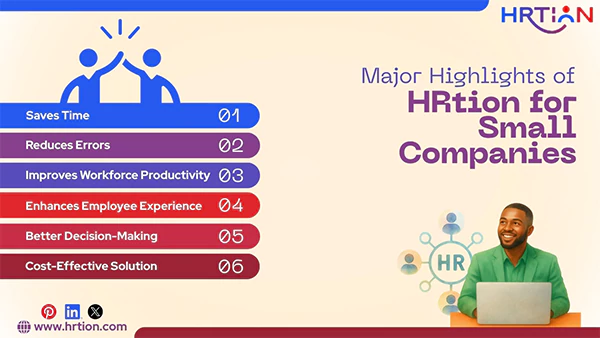
HRtion is a go-to platform for small businesses. Wondering why? Check the list:
- Saves Time:
HRtion offers unmatched automation that helps organizations with limited HR staff. It manages repetitive tasks like attendance and leave management, payroll processing, and employee record management. This way, the HR team can focus on the growth of the organization instead of handling administrative tasks.
- Reduces Errors and Improves Accuracy:
Manual data entry and spreadsheet management can lead to a lot of data redundancies, compliance issues, or payroll errors. And HRTion removes human errors by automating calculations and maintaining centralized data.
- Improves Workforce Productivity:
With real-time attendance, performance, and employee activities, HRtion allows managers to create a plan to remove the productivity gaps and make informed decisions. This helps in better utilization of the workforce and, thus, improving productivity.
- Enhances Employee Experience
Employees can access the self-service portal; they can check their payslips, leftover leaves, apply for leaves, and update personal information. They can also use features like holiday calendar, feedback, and updating attendance while working from home.
- Supports Better Decision-Making
The analytical insights regarding employee trends, costs, and performance help the administration make better decisions. Small organizations can plan hiring, make a budget, and improve operations using these metrics.
- Cost-Effective Solution
Small to mid-sized firms need an HR solution that offers value for money. This is when HRtion comes into play. It combines all HR features in one platform, thus costing less and providing better ROI.
HRtion Pricing and Plans for Small Businesses
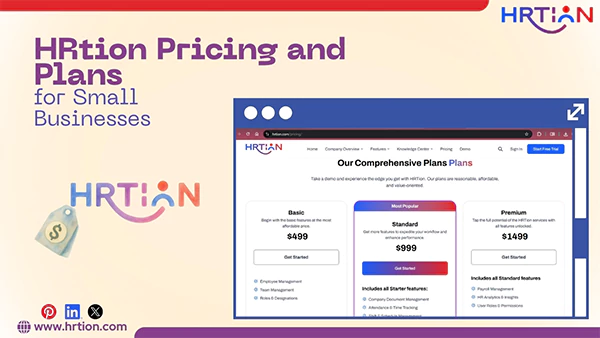
Affordability has always been a major concern for companies running at the small scale. This is why HRtion offers plans that are worth the price.
| Plan | Price | Features | Best For |
| Basic | $499 | Most affordable for entering the HR digitization space. Includes features like Employee Management, Team Management, Roles & Designations | Small Companies starting with automation |
| Standard (Most Popular) | $999 | A balanced plan with all basic features combined with Company Document Management, Attendance & Time Tracking, Shift & Schedule Management | Growing companies needing intensive tracking and workforce management. |
| Premium | $1499 | An all-in-one plan with all standard features and payroll management, HR analytics & insights, User Roles & permissions. | Scaling and growing companies that need a full-featured HR suite. |
How to Get Started with HRtion
Instead of wasting time on extensive training, SMBs need a platform that is quick to learn and start with, and HRtion is the dream-space for those organizations. A few clicks and it is all set to use:
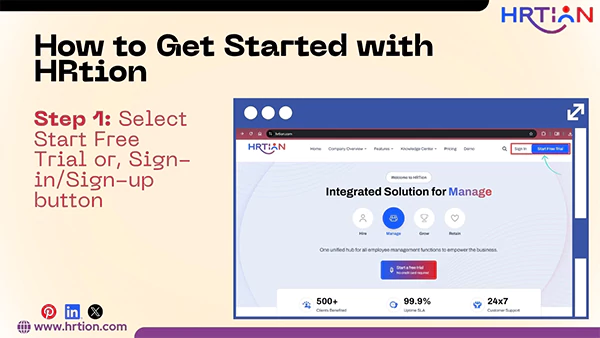
- On the webpage, select Start Free Trial or, Sign-in/Sign-up button.
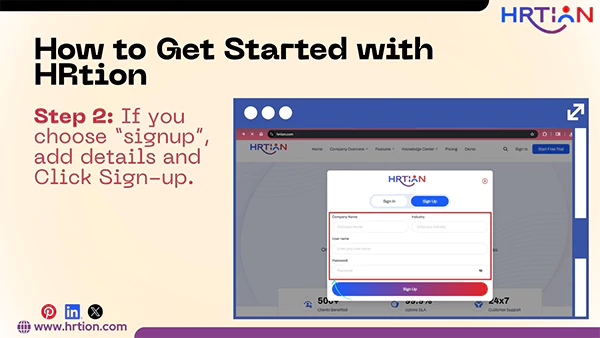
- If you choose “signup”, add details like company name, industry, username, and password.
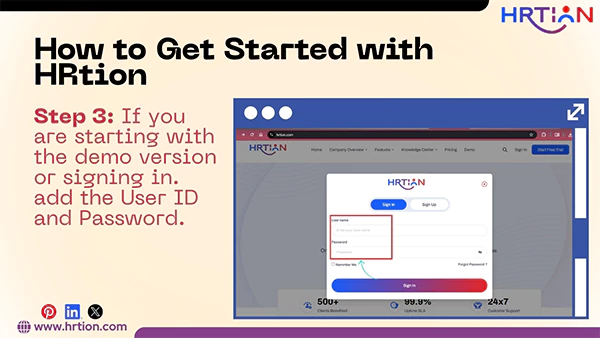
- But, if you are starting with the demo version or signing in, just add the User ID and Password.
- First-time users then need to enter the company details, departments, roles, and employee information into the system.
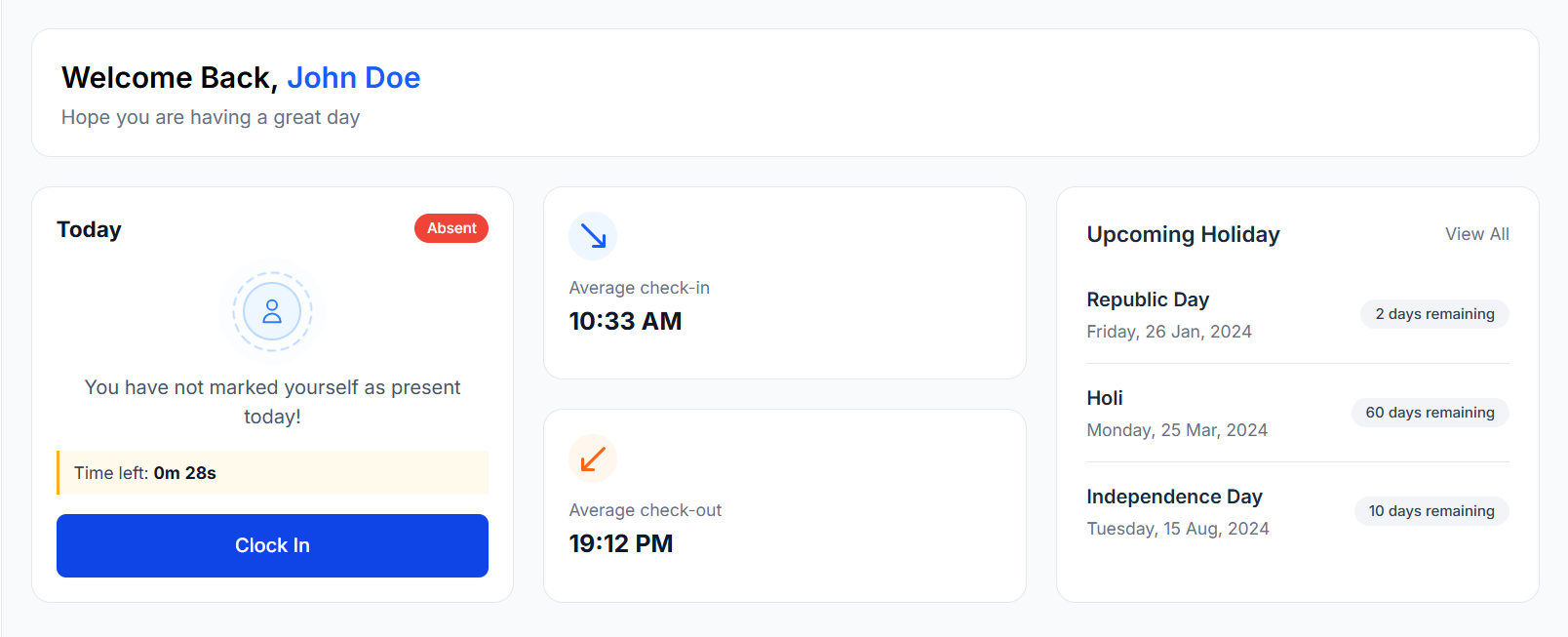
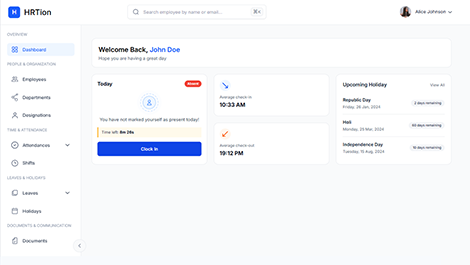
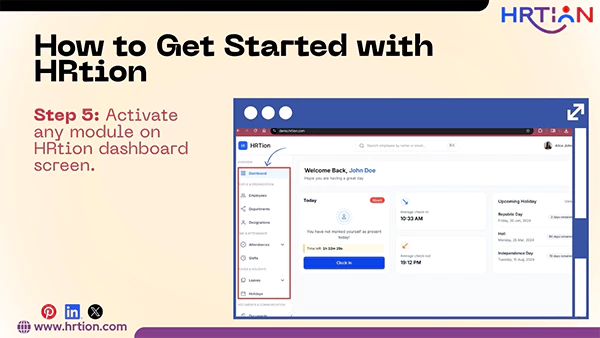
- You can activate any module, such as company docs, employees, attendance, shifts, holidays, analytics, roles, and more, from the left menu present on the dashboard screen.
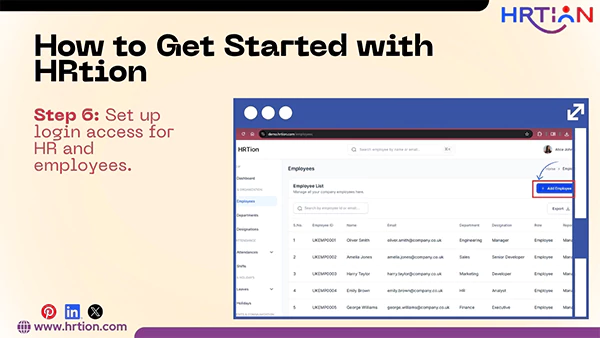
- Now, set up login access for HR and employees and share details with them for seamless HR management.
Who Should Use HRtion?
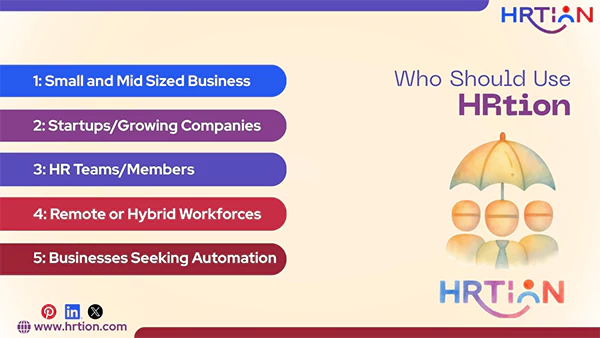
Are you not sure whether you need HRtion as a small company? If you are one of the following, you need it right away.
1. SMBs (small and mid sized business)
Small and mid-sized businesses often operate with minimal resources and a limited HR team and thus need a solution that can automate their tasks without costing a fortune, and HRtion serves those organizations best. With basic and standard features like payroll, attendance, employee records, and compliance, the day-to-day HR tasks are handled with ease.
Manual processes often lead to waste of time and operational errors, but HRTion helps combat such challenges and focus on growth and strategy by digitizing administrative tasks.
2. Startups and Growing Companies
Startups often go through numerous changes as the company grows, and thus, they need a solution that is scalable and consistent with their growth. HRtion allows for expansion without requiring any additional work.
Thriving companies can benefit from its incomparable capabilities, such as onboarding, employee management, and performance tracking. You can add as much data as required without worrying about changing platforms as your company expands.
3. HR Teams and Managers
HR team and managers are responsible for a large number of processes, and thus they require a platform that can simplify their responsibilities, and HRtion does the same.
From onboarding, performance reviews, recruitment, compliance, and workforce management, HRtion handles repetitive administrative tasks efficiently. This enables HRs to focus on more productive things like talent development, employee retention, and company culture.
4. Companies with Remote or Hybrid Workforces
Modern workplaces are no longer confined to one place. Small organizations usually hire remote and hybrid employees and thus require a digital solution to manage them. HRtion allows managers to stay close to people working from far locations and manage attendance, workflow, and collaboration through a single platform.
The self-service platform also enables remote employees to keep the connection maintained and thus improve transparency, accountability, and communication across distributed teams.
5. Businesses Seeking Automation at Minimal Costs
Complex HR software is often expensive and complex. But small companies need something that fits in their budget and offers all the required features, and HRtion is one such solution that is cost-effective and feature-rich at the same time.
Instead of using multiple disconnected tools, SMBs can rely on a single tool and empower their HR team, managers, and employees alike. Thus, HRtion is ideal for organizations that want to modernize and automate their HR processes for improved efficiency while keeping costs under control.
Frequently Asked Questions (FAQs)
What is HR software for small businesses?
HR software for small businesses is an automated solution to digitize HR processes and administrative tasks. It is a common portal for HRs, managers, and employees to share and organize data such as attendance, leaves, holidays, payroll, and more.
Why Small businesses need HR software?
Small businesses usually have limited HR staff; thus, to improve the speed and efficiency of the company operations, an automated HR tool is required. HR software allows small firms to focus on growth instead of just handling repetitive tasks.
What is the best HR software for small businesses?
In modern times, HRTion is said to be the best HR software for small businesses, as it offers all types of basic, standard, and even premium features without disturbing the budget. With numerous SMB-friendly features, it is one of the most relied-on HR tools.
What features should I look for in HR software for small companies?
The HR software for small companies must consist of features like attendance tracking, reporting dashboards, payroll processing, time and attendance tracking, onboarding tools, performance management, compliance support, etc. Also, the tool must be scalable and intuitive.
What is Payroll software for small businesses? Which HR software has a payroll feature?
Payroll software is a digital solution to manage all pay-related tasks such as generating payslips, calculating income and deductions, and managing taxes. HRtion is one of the smartest HR software programs that consists of payroll features so that companies do not require an additional tool.

Sunita Kumari is a Freelance Contributor Writer at HRTion, writing accurate, reliable, and informative content. She completed her Bachelor's from Rajdhani College of the University of Delhi. She has been a Human Resources Recruiter for almost 2 years, including over 1 year with Battersea Web Expert. Drawing on her recruitment and HR processes experience, she writes clear and practical payroll-related guides that help employees and job candidates better understand HR procedures and workplace practices.