
- What is HRIS (Human Resource Information System)?
- What is HRMS (Human Resource Management System)?
- What is HCM (Human Capital Management)?
- HRIS vs HRMS vs HCM: Key Differences at a Glance
- Core Features Explained: HRIS vs. HRMS vs. HCM
- Benefits and Limitations of Each System for Businesses
- Similarities Between HRIS, HRMS, and HCM
- HRIS vs. HRMS vs. HCM: Which One is Right for Your Company?
- Cost Comparison between HRIS vs HRMS vs HCM
- Future Trends in HR Technology
- Conclusion
- FAQS
HRMS, HRIS, and HCM are the products of continuous advancements in the field of HR technology. Businesses have ditched manual paperwork and spreadsheets and are choosing HR systems that can automate workflow, improve efficiency, enhance employee experience, and better support decision-making.
Though all three terms – HRMS, HRIS, and HCM are used interchangeably, picking one can be tricky if you are unfamiliar with the fundamentals.
All three systems are members of the HR technology ecosystem, but they differ in features, scope, and impact.
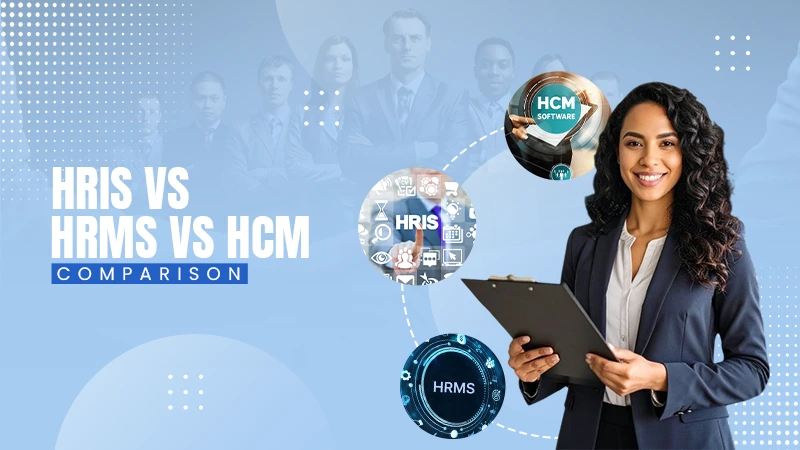
Here is an explanatory guide that defines and highlights differences between HRIS, HRMS, and HCM so that you can find one that is best suited for your business.
What is HRIS (Human Resource Information System)?
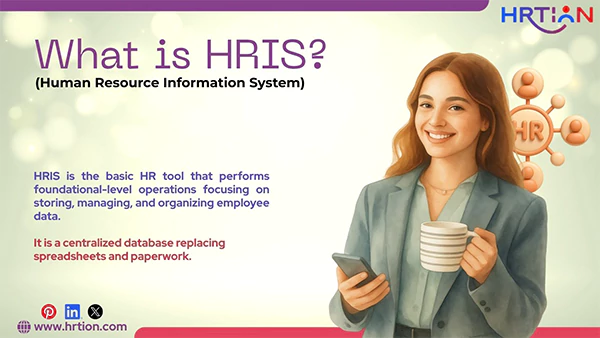
Human Resource Information System (HRIS) is the basic HR tool that performs foundational-level operations focusing on storing, managing, and organizing employee data. It is a centralized database replacing spreadsheets and paperwork.
HRIS systems are designed to streamline core HR and administrative tasks, reduce data accuracy, and eliminate manual efforts. It automates redundant workflow operations like administration, time and attendance, and payroll. It helps small and growing businesses the most.
What is HRMS (Human Resource Management System)?
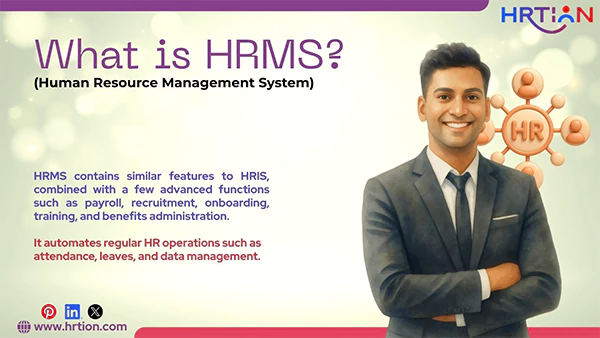
Human Resource Management System (HRMS) is a broader tool than an HRIS. It contains similar features to HRIS, combined with a few advanced functions such as payroll, recruitment, onboarding, training, and benefits administration.
Moreover, it automates regular HR operations such as attendance, leaves, and data management. Just like HRIS, HRMS too centralized employee information, but in an extensive manner; it covers the entire employee cycle, from hiring to retirement. It works well for mid-sized and scaling companies.
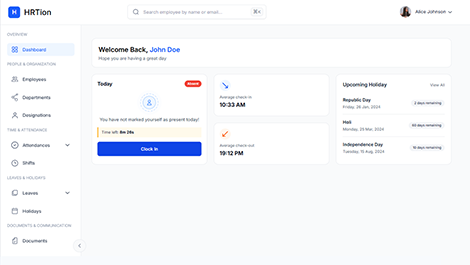
Manage the payroll, attendance, shift roles, and more in an all-encompassing HR suite. Your ultimate HR toolkit is just a click away.
What is HCM (Human Capital Management)?
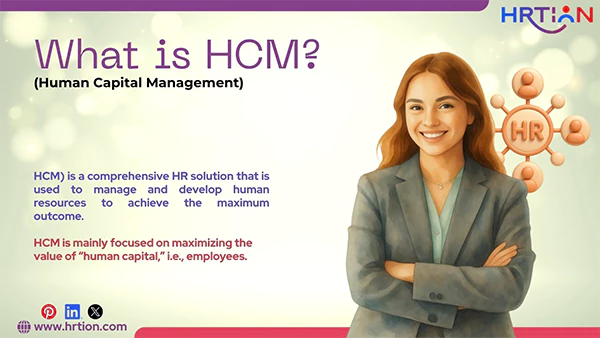
Human Capital Management (HCM) is a comprehensive HR solution that is used to manage and develop human resources to achieve the maximum outcome. Unlike HRIS and HRMS, HCM is mainly focused on maximizing the value of “human capital,” i.e., employees.
HCM covers all the basic HR management features but mainly focuses on training, analytics, benefits management, retirement, advanced strategic planning, and workforce management to help organizations make informed development decisions. It is generally suited to large and growing enterprises.
HRIS vs HRMS vs HCM: Key Differences at a Glance
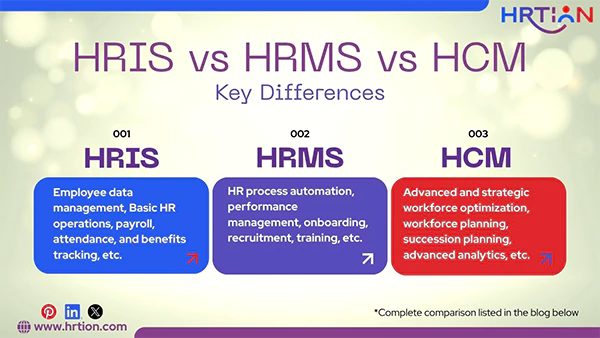
| Aspect | HRIS (Human Resource Information System) | HRMS (Human Resource Management System) | HCM (Human Capital Management) |
| Primary Focus | Employee data management | HR process automation | Advanced and strategic workforce optimization |
| Scope | Basic HR operations | Broader HR operations | Comprehensive & strategic HR management |
| Core Functions | Employee records, payroll, attendance, and benefits tracking | All HRIS features + performance management, onboarding, recruitment, training. | All HRMS features + workforce planning, succession planning, advanced analytics |
| Integral Role | Administrative support | Operational efficiency | Business strategy management |
| Talent Management | Limited or basic | Moderate (recruitment & performance tracking) | Advanced (talent value, development, retention strategy) |
| Analytics & Reporting | Standard reports | Active reporting & dashboards | Predictive analytics & workforce insights |
| Automation Level | Basic automation | Moderate automation | High automation with AI-driven insights (in modern systems) |
| DecisionMaking Support | Data storage & retrieval | Process-based insights | Strategic forecasting & planning tools |
| Best For | Small businesses that need core HR tracking | Growing companies that need integrated HR processes | Medium to large enterprises focused on long-term talent management. |
| Employee Lifecycle Coverage | Partial (mainly employment) | Most stages (hire to retire) | Full employee lifecycle, including workforce strategy & leadership planning |
| Outcome | Organized employee database | Streamlined HR operations | Optimized workforce performance & business growth |
Core Features Explained: HRIS vs. HRMS vs. HCM
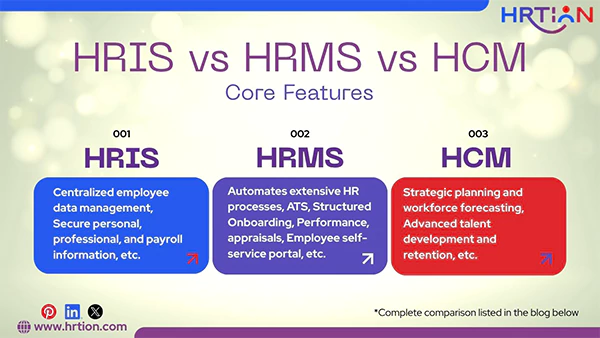
The major difference between HRIS, HRMS, and HCM lies in the spectrum of features each system offers; hence, by understanding what each consists of, you can easily find out how the three systems are different from each other.
Human Resource Information System (HRIS) Core Features:
- Centralized employee data management: It centralizes employee data and stores all information in one place for easy access.
- Secure personal, professional, and payroll information: Everything from contact details, salary, work history, and qualifications to photographs is end-to-end encrypted.
- Basic payroll processing and taxing: HRIS performs basic calculations related to salary, taxes, and deductions without requiring additional accounting software.
- Attendance and leave tracking: It tracks the hours worked, leaves, absences, and carry forwards in a transparent manner.
- Recordkeeping and benefit management: It maintains data of employee benefits such as health insurance, retirement plans, and provisional funds.
- Standard HR operations and documentation: HRIS can keep a record of all essential documents, such as employee forms, contacts, and national ID proofs.
- Legal compliance through record maintenance: Keep the company aligned with labor and tax laws to ensure that the company meets the regulatory requirements.
- Reduced paperwork and manual data entry: Due to digital storage capacity
- Focused on data and administration: HRIS is primarily used for organizing information instead of forming strategies.
- Best suited for small businesses: It is ideal for those companies that need support for regular HR functions without complex automation or analytics.
Human Resource Management System (HRMS) Core Features:
- Includes all features of HRIS: HRMS offers the same features as HRIS, along with advanced GR analytics.
- Automates extensive HR processes: It handles tasks like payroll, leave approvals, and performance tracking automatically without requiring any manual efforts.
- ATS (applicant tracking system) and recruitment support: HRIS supports hiring processes, tracks candidates for interviews, and processes onboarding.
- Structured Onboarding: It automates employee onboarding processes such as document submissions, training assignments, and induction provisions.
- Performance, appraisals, and reviews management: It facilitates companies with features including goal setting, performance tracking, and timely evaluations.
- Training and development reports: To make the best of humans as resources, HRMS offers frequent training and development reports. It helps employees to stay updated and benefit the company.
- Employee self-service portal: With an easy-to-access web portal, employees can update their information, request leaves, and access their payslips as well as other documents with role-based access.
- Advanced payroll and compliance management: With complex payroll and compliance management tools, HRMS handles multiple deductions, benefit allotment, and compliance reporting.
- Operational efficiency and better collaboration: Through streamlining processes across the organizations, collaboration becomes easier, improving efficiency and productivity.
- Ideal for growing and mid-sized organizations: HRMS is well-suited to companies that require both administration and operation automation, along with reporting and tracking capabilities.
Human Capital Management (HCM) Core Features:
- Includes all HRMS functions: HCM builds on HRMS and HRIS’s features paired with administration and operational automation to leverage human capital.
- Strategic planning and workforce forecasting: It anticipates the future HR needs and helps planning staffing and aligning talent with the organizational growth.
- Advanced talent development and retention: It focuses on finding out the true potential of the employees, refining skills, and reducing turnover rate.
- Succession planning and redefined leadership: Not only employees, but it also ensures leaders are trained and groomed too.
- Cutting-edge performance management: It uses sophisticated KPIs, feedback, and regular performance tracking to maintain progress records.
- Integrated learning management system (LMS): It centralizes training programs, learning modules, and skill development measures to promote constant growth and innovation.
- Calculations of compensation and rewards: HCM keeps track of compensations and rewards according to the company objectives and incentivizes employees according to preset rules.
- Workforce analytics and predictive insights: It uses fed data to predict attendance & leave trends, simplify recruitment, and streamline operations.
- Align HR strategies with business goals: HCM transforms HR processes and ensures goals are met strategically.
- Meant for medium to large enterprises: Best for companies looking for long-term business growth through workforce management.
Benefits and Limitations of Each System for Businesses
Each system comes with its own benefits and limitations, and knowing them will help you make a better choice for your business. Here is a quick walkthrough of the pros and cons of each software:
Human Resources Information System (HRIS)
| Benefits | Limitations |
| Cost-effective implementation. | Limited scalability. |
| Easy to use | A lesser number of strategic tools. |
| Faster deployment | Basic reporting. |
| Minimizes manual work |
Human Resources Management System (HRMS)
| Benefits | Limitations |
| Comprehensive workforce management. | Costlier than HRIS. |
| Improved productivity across the organization. | Requires some intensive training. |
| Includes engagement tools. | It can be complex to implement. |
| Scalable for business growth. |
Human Capital Management (HCM)
| Benefits | Limitations |
| Strategic decision support | More expensive than the other two contemporaries. |
| Advanced analytics report | Complex to use and implement. |
| Global scalability | Requires HR expertise to use. |
| Includes AI automation |
Similarities Between HRIS, HRMS, and HCM
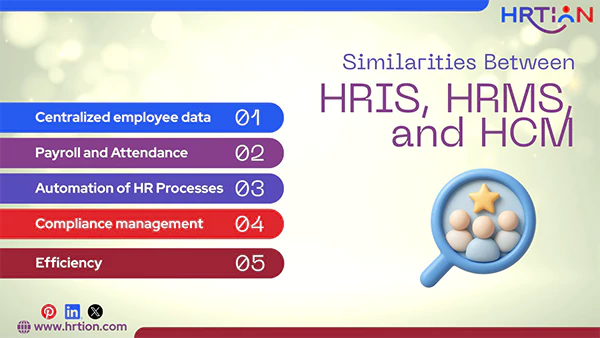
HRIS, HRMS, and HCM differ in features, scope, and functionality, their foundation and purpose are the same: simplifying administrative operations.
Understanding their similarities will help businesses recognize that these solutions are interconnected but built on different maturity levels of HR systems.
- Centralized employee data
All three HR systems work well in centralizing employee data, become single source of truth. They store personal details, job history, payroll data, and benefits records without requiring manual data entry.
- Payroll and Attendance
They manage salaries, taxes, and time tracking, but HCM is more complex than HRMS, and HRMS is more complicated than HRIS.
- Automation of HR Processes
Streamline all HR tasks like leave approvals, onboarding, and payroll, and reduce errors.
- Compliance management
They help an organization to stay compliant with labor and tax regulations.
- Efficiency
Reduced workload and manual data entry to improve efficiency in the HR team and employees alike.
HRIS vs. HRMS vs. HCM: Which One is Right for Your Company?
For Small Business and Startups:
| Aspect | Option 1: HRIS | Option 2: Entry-Level HRMS |
| Features |
|
|
| Costing |
|
|
| Ease of Use |
|
|
For Mid-Sized Businesses:
| Aspect | Option 1: HRMS | Option 2: Mid-level HCM |
| Features |
|
|
| Cost |
|
|
| Ease of Use |
|
|
For Large Enterprises
| Aspect | Option 1: Enterprise-level HRMS | Option 2: HCM Suite |
| Features |
|
|
| Cost |
|
|
| Ease of Use |
|
|
Cost Comparison between HRIS vs HRMS vs HCM
Human Resources Information System (HRIS)
It is the most affordable option out of all. It is usually priced per month with features like payroll, attendance, and employee data management. Best suited to small businesses with basic HR needs.
Cost Factors:
- Number of users (employees).
- Basic HR modules.
- Add-ons like support services and more.
Estimated Cost Range:
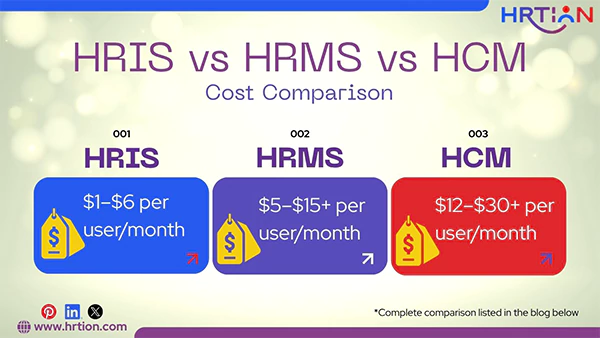
- Cloud HRIS basic plans: $1–$6 per user/month
- Small business packages: $50–$300 per month flat
- Add-ons may cost upfront.
Human Resources Management System (HRMS)
It costs more than HRIS because it consists of automation, recruitment, performance management, and an employee self-service portal. Suitable for growing and mid-sized companies.
Cost Factors:
- Recruitment tools.
- Performance and appraisal tools.
- Advanced payroll automation.
- Integration capabilities.
Estimated Pricing:
- SaaS HRMS packages: $5–$15+ per user/month
- All-in subscription: $300–$1,200+ per month total
- Option add-ons may cost more.
Human Capital Management (HCM)
The most expensive option due to advanced features like workforce planning, succession planning, analytics, LMS, and strategic compensation tools. It is designed to serve medium to large enterprises for long-term growth.
Cost factors:
- Workforce planning and forecasting tools.
- Integrated LMS and integration capabilities.
- Succession planning.
- Predictive analysis and navigable dashboards.
- Customization available.
Estimated Pricing:
- Enterprise SaaS HCM: $12–$30+ per user/month
- Packaged enterprise contracts: $2,000–$10,000+ per month
- Implementation and training support may cost extra.
Future Trends in HR Technology
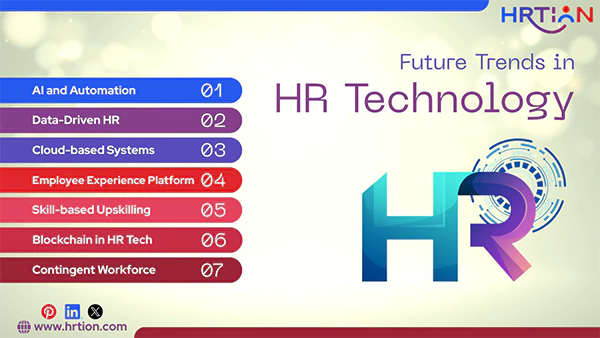
With HR technology evolving at a rapid speed, new trends are emerging with each passing year. Here are a few expected trends in the near future; this will help you stay competitive, innovative, and people-centric.
- Artificial Intelligence and Automation
AI is taking the world by storm, and HR technology is no exception. Automation in HR processes like recruitment, resume screening, onboarding, and engagement analysis can reduce manual workload and limit costs spent.
- People Analytics and Data-Driven HR
HR teams are increasingly focused on analytical dashboards and real-time insights. This data is used to make strategic decisions related to hiring, compensation, productivity, and retention.
- Cloud-based and Mobile-first Systems
Companies are looking for software that offers remote accessibility. With mobile-first systems, leaders, HR personnel, and employees can access HR services anytime to manage remote workforces.
- Employee Experience Platform
Organizations are now becoming more employee-centric, thus preferring platforms that offer employee satisfaction, engagement, and well-being.
- Skill-based Talent Management and Upskilling
Organizations are searching for a skilled workforce rather than just a job title. Thus, HR systems with learning management systems, upskilling, internal mobility, and career guidance are the most anticipated features.
- Blockchain in HR Technology
Blockchain may be used in HR systems in the future. This will ensure employee credential verification, payroll processing, and data transparency, resulting in reduced fraud and improved trust among employees.
- Contingent Workforce support
A contingent workforce consists of temporary workforces, freelancers, independent contractors, and temporary agency staff. This feature helps organizations to gain flexibility, fill skill gaps, and manage seasonal demand.
Conclusion
HRIS, HRMS, and HCM are not competitors but are different levels of HR maturity and organizational needs. Where HRIS focuses on core administrative efficiency, HRMS combines standard features with automation, while HCM is a strategic tool that treats employees as a valuable asset.
Choosing one depends upon the company’s size, budget, feature requirements, and future business goals. Small businesses often go for HRIS due to simplicity and affordability; mid-sized companies prefer HRMS for its core features paired with automation, and larger enterprises focus on strategic value by using HCM.
BONUS TIP: But, if you are unable to make a choice, get one tool that performs basic as well as advanced functions, and one such tool is HRTion. It is a comprehensive HR system that is designed for all sizes of business.
FAQS
What are the 4 types of HR?
The four HR types are:
- Administrative Expert (for managing HR processes)
- Employee Champion (for focusing on engagement and well-being)
- Change Agent (for driving organizational transformation)
- Strategic Partner (for aligning HR with business goals)
Is HRIS part of HCM?
Technically, yes, because HCM includes all standard features that HRIS consists of, along with the most advanced HR technologies like strategic development, robust integrations, and training and skill development modules.
What are the 5 types of HRIS?
The five main types of human resources information systems are operational, tactical, strategic, comprehensive (all-in-one), and limited-function (specialized).
What is the difference between HRIS and HRMS?
HRIS focuses mainly on basic HR functionalities like employee data management, payroll, and attendance tracking. Whereas HRMS includes all features of HRIS, combined with talent management, performance tracking, and employee development tools.

Sunita Kumari is a Freelance Contributor Writer at HRTion, writing accurate, reliable, and informative content. She completed her Bachelor's from Rajdhani College of the University of Delhi. She has been a Human Resources Recruiter for almost 2 years, including over 1 year with Battersea Web Expert. Drawing on her recruitment and HR processes experience, she writes clear and practical payroll-related guides that help employees and job candidates better understand HR procedures and workplace practices.