
Organizations are transforming from manual processes to digital solutions, and Human Resources is the primary field that has adopted automation significantly. But the market is heaped with all sorts of Human Resource software; thus, finding the right one can be difficult.
To make things easier for you, we’ve prepared a list of the 10 best HR software that will help your organization to improve productivity, compliance, and employee experience.
In this guide, we will explore the top 10 HR software available in the market so that you can find the one that is perfect for your business.
Top 10 Best HR Software for Businesses in 2026
The list of top 10 best HR software includes HRTion, BambooHR, Zoho People, Rippling, and more. Each software has its different features and services that makes them unique among others.
Let’s get brief of all 10 softwares to choose the best for your business:
1. HRTion
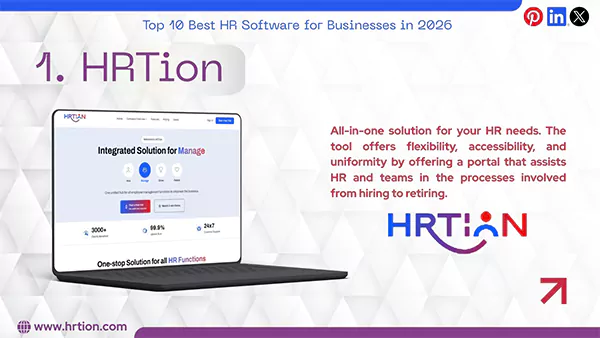
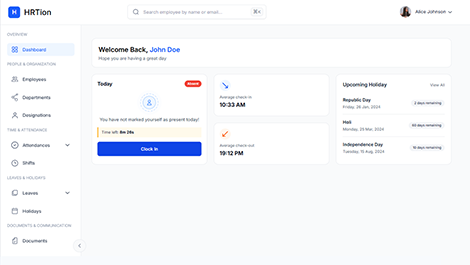
HRTion tops the chart for being the most versatile HR platform. It is an all-in-one solution for your HR needs.
The tool offers flexibility, accessibility, and uniformity by offering a portal that assists HR and teams in the processes involved from hiring to retiring.
The centralized HR system eliminates errors, prevents miscalculations, and reduces manual efforts. HRtion boasts transparency and cost-effectiveness and is thus a perfect fit for both growing and established organizations.
Key features:
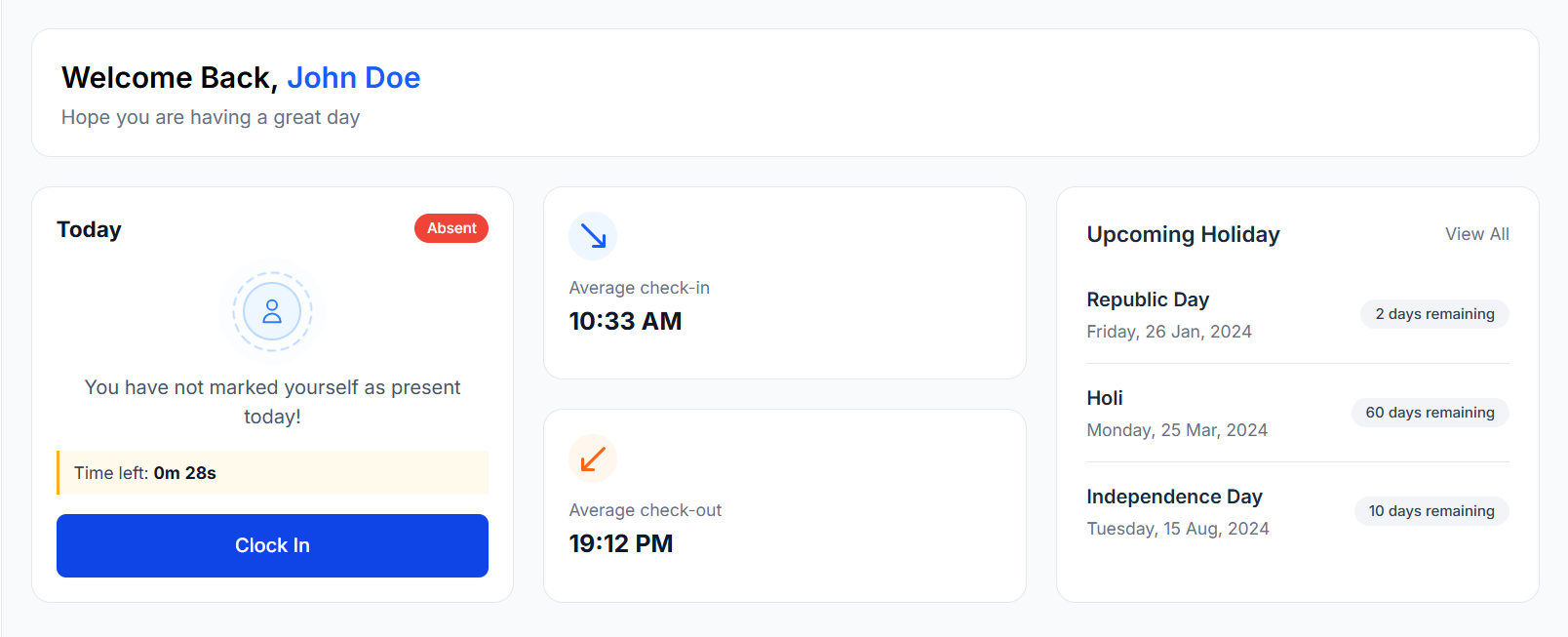
- Employee attendance tracking system.
- A leave system to manage absenteeism, half-days, early leaves, and more.
- Shift scheduling to keep the workflow goals aligned.
- Payroll automation to manage deductions, basic pay, and more.
- Performance tracking, feedback sharing, and target-setting tools.
- Secure and encrypted storage to manage crucial documents.
- Fully optimized mobile interface for remote reporting.
- Self-service portal for employees.
Pricing and Plans
| Free Demo Version | Basic | Standard | Premium |
| Includes introductory features for free. | Get starter features best for regular HR management at $499 only. | Consists of exclusive features at the price of $999. | Get full potential of a robust HR management system at only $1499 |
2. BambooHR
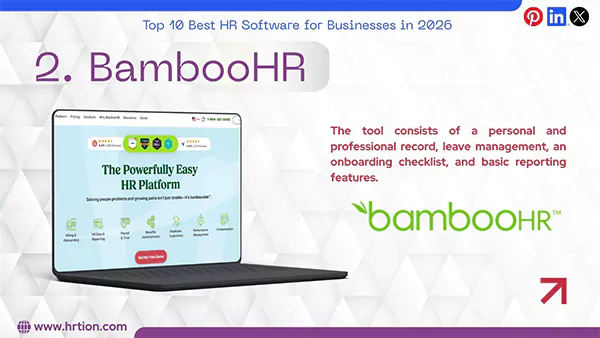
BambooHR is another popular tool that is designed to be a perfect HR software small companies to mid-sized businesses due to its clean interface and user-friendly features.
The tool consists of a personal and professional record, leave management, an onboarding checklist, and basic reporting features. The interface is quite intuitive and easy to adapt to. It also offers a mobile-friendly dashboard, making HR management possible on the go.
Key Features:
- Employee record and profile management.
- Time-off and leave portal.
- Employee onboarding and offboarding.
- Reporting and analysis for smoother management.
- Provides quick access to HR insights.
Pricing and Plans:
| Core | Pro | Elite |
| $10 per employee/per month | $17 per employee/per month | $25 per employee/per month |
3. Zoho People
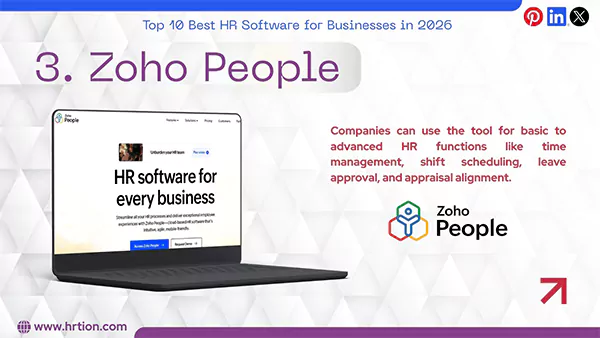
ZohoPeople is part of the Zoho franchise that offers various other tools for small to large businesses.
It is mainly known for its customization capabilities. Companies can use the tool for basic to advanced HR functions like time management, shift scheduling, leave approval, and appraisal alignment.
The integration with other Zoho products, such as Zoho Payroll, Zoho Recruit, and Zoho CRM, is best for a broader range of HR and business operations.
Key Features:
- It offers customizable workflows.
- Attendance and shift management.
- Role-based access control.
- Seamless integration with other Zoho tools.
- Performance and appraisal management.
Pricing and Plans:
| Essential HR | Professional | Premium | Enterprise | People Plus |
| $1.50/user/month | $2.00/user/month | $3.00/user/month | $4.50/user/month | $9.00/user/month |
4. Rippling
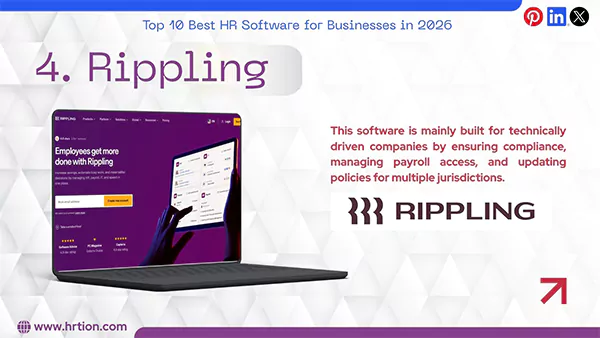
Rippling is an innovative Human Resource software that is designed to manage global payroll support. It offers data management, employee records, and device provisioning all in one place. When a new employee is added, all details and prospects, such as license, access permissions, and company policies, are updated automatically.
This software is mainly built for technically driven companies by ensuring compliance, managing payroll access, and updating policies for multiple jurisdictions.
Key Features:
- Global payroll management.
- Employee benefit management.
- IT provisioning and access control.
- HR reporting and analytics.
Pricing and Plans:
| EOR Global PEO | Global Payroll | Global Contractors | Global HRIS |
| $499 | $35 | $30 | $8 |
5. Workday
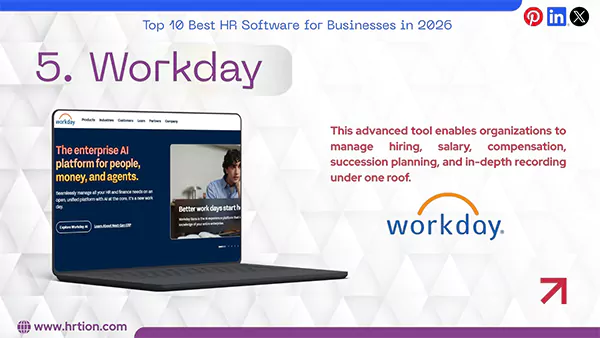
Workday is an HCM (Human Capital Management) that works best for larger organizations. With one unified cloud-native system, it combines all functions such as HR, finance, payroll, workforce planning, and analytics in one place.
This advanced tool enables organizations to manage hiring, salary, compensation, succession planning, and in-depth recording under one roof.
The global compensation and payroll management system of Workday helps manage international workforces seamlessly; thus, it works best for MNCs and larger/global organizations.
Key Features:
- Talent and resource planning.
- Learning and development of employees.
- Global payroll system.
- Unified access to compensation and payroll.
- Advanced data insights.
Plans and Pricing:
Workday is a custom-quote-based tool.
6. Gusto
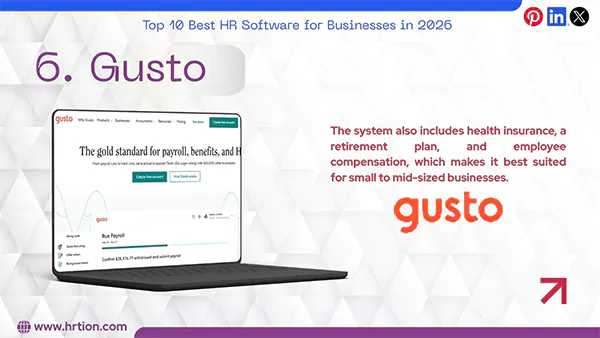
Gusto is an HR and payroll management system that offers basic HR functions like payroll processing, tax compliance, and benefit management without any complexity.
The system also includes health insurance, a retirement plan, and employee compensation, which makes it best suited for small to mid-sized businesses.
Key Features:
- Automated tax filing options.
- Employee benefit administration.
- Employee service portal.
- Intuitive interface for SEMs and startups.
- Onboarding and time tracking.
Pricing and Plans:
| Simple | Plus | premium |
| $49/mo$6/mo per person | $80/mo$12/mo per person | $180/mo$22/mo per person |
7. ADP Workforce Now
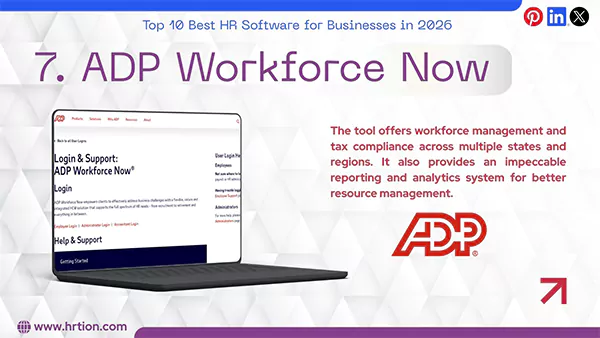
ADP Workforce Now is a cloud-based HR management software aimed at catering to mid- to small-sized organizations. Designed by ADP, one of the most established HR and payroll system providers globally, ADP Workforce Now combines HR administration, payroll processing, talent acquisition, and compliance management in one place.
The tool offers workforce management and tax compliance across multiple states and regions. It also provides an impeccable reporting and analytics system for better resource management.
Key Features:
- Unified HR database and employee records.
- Automated payroll processing with tax filing.
- Benefits administration and compliance management.
- Performance management tools.
- Time tracking and shift scheduling.
Plans and Pricing:
Custom-based-quote platform
8. Paycor
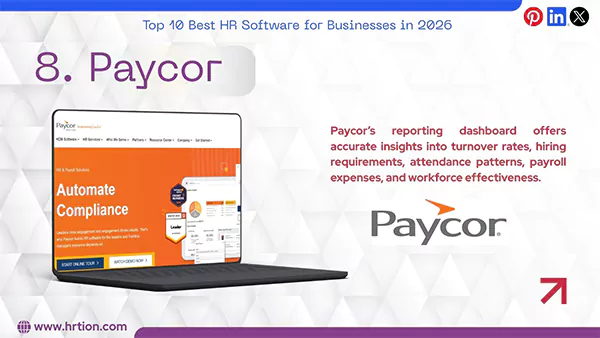
Paycor is a cloud-based HR platform that consists of workforce analytics, recruiting, and onboarding management, along with compliance tools. It combines reporting and analytics, making decision-making easier.
Paycor’s reporting dashboard offers accurate insights into turnover rates, hiring requirements, attendance patterns, payroll expenses, and workforce effectiveness.
Companies that need HR functions along with data-driven insights can rely on Paycor for maintaining accuracy and compliance in the organization.
Key features:
- HR database and employee records.
- Payroll processing and hiring requirements.
- Recruiting and onboarding.
- Data-driven analytics and a customizable dashboard.
- Combined HR and payroll system.
Pricing and Plans:
Custom quote-based platform
9. Workable HR
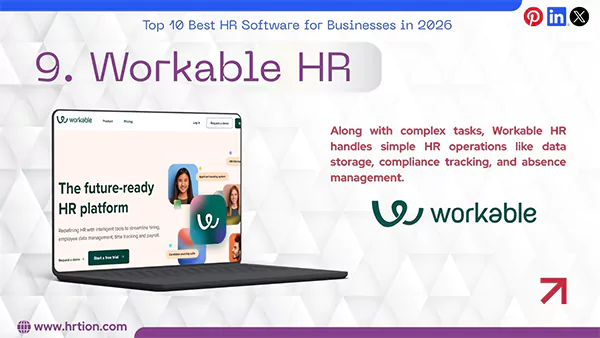
Workable HR is a blend of ATS (applicant tracking system) and an HR management portal. It works best for employee records, onboarding workflows, and time-off tracking. It was primarily developed to help the HR team in planning and managing resources through job board integrations, resume filtering, collaborative hiring tools, and an interview management portal.
Along with complex tasks, Workable HR handles simple HR operations like data storage, compliance tracking, and absence management.
The user-friendly interface and recruitment-managing capabilities make it desirable to businesses of all sizes.
Key Features:
- Resource management tendencies.
- Centralizes recruitment and HR tasks altogether.
- Maintain employee and onboarding records.
- It supports interview scheduling.
- Includes all essential HR tools
Pricing and Plans:
| Standard | Premier |
| $299/month | $599/month |
10. HiBob
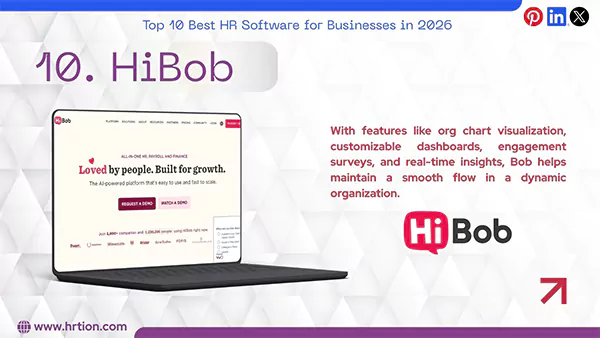
HiBob or Bob is a modern cloud-based solution to all HR problems. The tool is mainly focused on providing a seamless employee experience, improved culture, and better engagement by offering an interface that feels familiar to users.
With features like org chart visualization, customizable dashboards, engagement surveys, and real-time insights, Bob helps maintain a smooth flow in a dynamic organization.
The system is best suitable for all sorts of startups and mid-sized organizations that want a flexible and advanced system to manage regular HR operations.
Key Features:
- Centralized database with org charts.
- Time and attendance tracking.
- Leaves and absenteeism management.
- Custom dashboards and real-time analytics.
- Engagement surveys and social feeds for improved engagement.
- Integrated tools like payroll, SLACKS, and productivity apps.
Plans and Pricing
Custom quote-based platform. It generally ranges from $8 to $25 per employee per month (PEPM).
Quick Comparison Table of Top 10 HR Software
| HRtion | BambooHR | Zoho People | Rippling | Workday | Gusto | ADP Workforce Now | Paycor | Workable HR | HiBob | |
| Employee Database | ✅ | ✅ | ✅ | ✅ | ✅ | ❌ | ✅ | ✅ | ❌ | ✅ |
| Payroll & Tax | ✅ | ❌ | ❌ | ✅ | ✅ | ✅ | ✅ | ✅ | ❌ | ✅ |
| Time & Attendance | ✅ | ✅ | ✅ | ✅ | ✅ | ✅ | ✅ | ✅ | ✅ | ✅ |
| Onboarding/Offboarding | ✅ | ✅ | ✅ | ✅ | ✅ | ✅ | ✅ | ✅ | ✅ | ✅ |
| Performance Management | ✅ | ✅ | ✅ | ❌ | ✅ | ❌ | ✅ | ✅ | ❌ | ✅ |
| Analytics & Reporting | ✅ | ✅ | ✅ | ✅ | ✅ | ✅ | ✅ | ✅ | ✅ | ✅ |
| Customization | ✅ | ✅ | ✅ | ✅ | ❌ | ✅ | ✅ | ✅ | ✅ | ✅ |
| Remote Employee Management | ✅ | ✅ | ✅ | ✅ | ✅ | ✅ | ✅ | ✅ | ✅ | ✅ |
| Compliance and Policy | ✅ | ✅ | ✅ | ✅ | ✅ | ✅ | ✅ | ✅ | ✅ | ✅ |
Manage the payroll, attendance, shift roles, and more in an all-encompassing HR suite. Your ultimate HR toolkit is just a click away.
Best HR Platforms by Feature Category
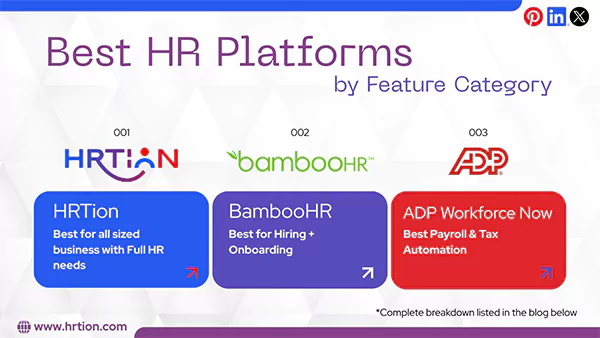
Want a quick guide to help you find the right tool without going through any extensive R&D process? Here is a list of HR platforms according to the feature category they best fit in, so that you can pick one that speaks for your business.
| Best for all sized business with Full HR needs | HRtion |
| Best for SMBs | Zoho People, BambooHR |
| Best Payroll + Compliance | ADP Workforce Now, Workday, Paycor |
| Best Payroll & Tax Automation | Rippling, ADP Workforce Now, Gusto |
| Best for Performance & Engagement | HiBob, Workday |
| Best for Remote Workforce Support | HRtion, HiBob, Workday |
| Best for Custom HR Workflows | HRtion, Zoho People |
| Best for Hiring + Onboarding | Workable HR, HRtion, BambooHR |
Features to Look For in the Best HR System
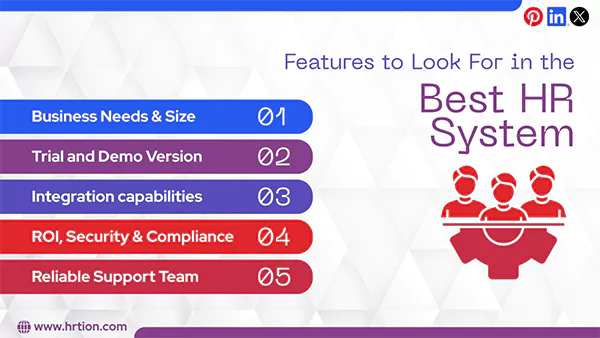
To find the right HR tool that suits your business needs is not easy when the market is full of gimmicks. Hidden charges, limited features, compromised security, and inaccessible customer support are some of the major red flags to steer clear of.
Here is a guide to help you in finding the right HR
- Identify your business needs: Start by finding what challenges your business is facing. They can be payroll errors, manual attendance tracking, or recruitment delays. Choose the tool that caters to solving these issues.
- Consider company size: The HR tool that you are selecting must comply with your company’s size, growth, and vision.
- Check Main Features: Look for major functionalities that the tool is offering, such as employee database management, payroll automation, performance tracking, and compliance tools.
- A clean interface is a must: A user-friendly interface is essential for easier adoption by employees, managers, and the HR team.
- Integration capabilities: The tool must be able to integrate with accounting, finance, or any productivity tools you already use.
- Security & Compliance: Strong data protection, role-based access, and compliance with evolving laws and regulations must be maintained.
- Compare Pricing & ROI: Ensure that the price you are paying is worth the features and advantages you are getting. Also, check what add-ons cost in case you need them later on.
- Trial and Demo Version: Choose the tool that offers a demo version, which allows you to make an informed decision.
- Reliable Support Team: Readily accessible technical and customer support is the true indicator of quality.
FAQs
What is the best HR software for business in 2026?
The top 10 HR software for businesses in 2026 are the following:
- HRtion
- BambooHR
- Zoho People
- Rippling
- Workday
- Gusto
- ADP Workforce Now
- Paycor
- Workable HR
- HiBob
What features to look for in human resources software?
The basic to advanced features that ideal human resource software must consist of are payroll automation, attendance tracking, compliance management, analysis, onboarding tools, and integration capabilities.
What is the best HR software for small businesses?
Human Resource software for small companies must be affordable, easy to use, and scalable. The tool must combine payroll, attendance, and employee management without any complex setup and high cost.
Is HR software worth it for small businesses?
Yes, small businesses benefit from HR software, as it reduces manual efforts and saves time, reduces administrative errors, and improves employee experience. Even a small number of employees need a well-established HR platform.
Can HR software help with compliance and legal requirements?
Yes, most of the modern HR software includes compliance tools that help the organization to follow labor laws and tax regulations and cut down the risk of legal penalties.

Bhavesh is a Guest Writer at HRTion with an academic background in HR. He did an HR management course in 2025. Before transitioning to HR content writer, he worked as an Academic Content Writer at Trident Management for over 6 years. His expertise in recruitment processes & strategies helps him write detailed and clear content that is not only informative but also accessible for everyone.