
- What is a Competence Assessment Programme?
- Importance of Competence Assessment Programme
- Core Components of an Effective Competence Assessment Programme
- How Does the Competence Assessment Programme Work?
- Commonly Used Competence Assessment Methods
- Best Competence Assessment Programme Examples
- Common Mistakes of the Competence Assessment Programme
- HRtion: Manage Competency Information Automatically
- Conclusion
- FAQs
Having talented employees is not enough to make a company truly successful. There is a more important criterion than experience and knowledge: competence.
A Competence Assessment Programme is a well-structured way to determine whether the hired workforce has the ability to drive the organization’s growth.
This approach is highly useful for companies in identifying skill gaps, areas for development, and strengths.
Here is a complete guide to the Competence Assessment Programme to create a workforce that can meet today’s demands and face tomorrow’s challenges.
What is a Competence Assessment Programme?
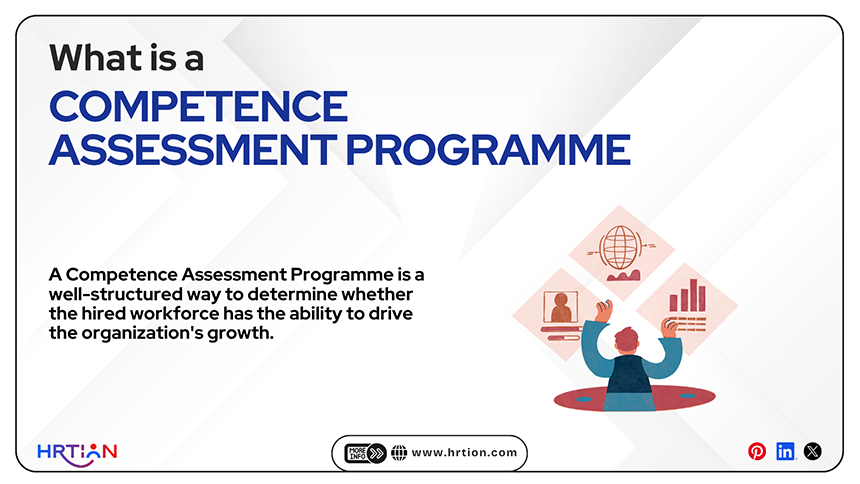
A competence assessment programme is a structured process used by an organization to identify whether employees have knowledge, skills, behaviors, and ability-related gaps that are keeping them from performing their roles effectively.
This goes beyond experience and knowledge and assesses how well an employee can handle the practical work situation.
CAP answers one quite important question:
“Can this employee actually perform the tasks and responsibilities expected in their role?”
Suppose a company wants to promote an employee to a team leader position; the competence assessment programme will help analyze the following:
- Communication skills
- Decision-making ability
- Leadership skills
- Conflict-management skills
- Delegation skills
- Problem-solving tendencies
- Feedback-providing ability
The results can help employers decide whether the employee is ready and fit for the position or requires additional training.
The programme uses well-defined competency standards, assessment criteria, and suitable methods and templates for reviewing performance.
Furthermore, the foremost goal of CAP is to ensure that people are competent, capable, and fit to perform their roles safely and effectively.
Manage the payroll, attendance, shift roles, and more in an all-encompassing HR suite. Your ultimate HR toolkit is just a click away.
Importance of Competence Assessment Programme
According to the Future of Jobs Report 2025, companies expect “63% of employers see skill gaps as a major barrier to business transformation.”
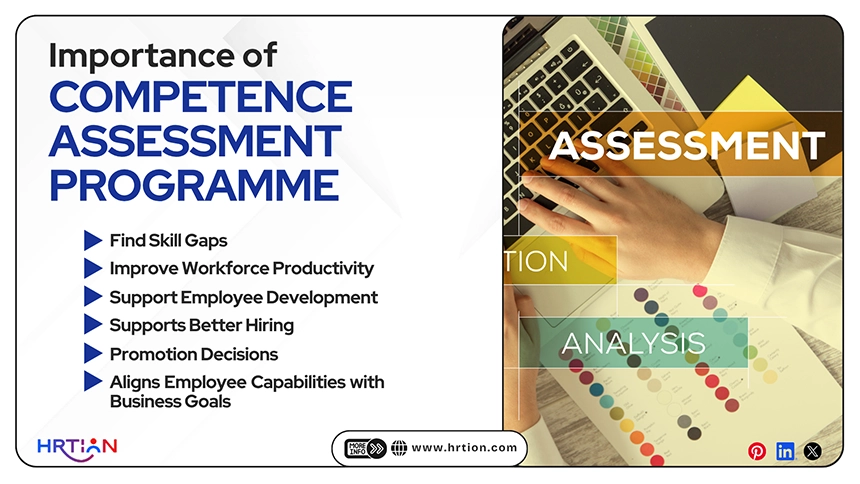
That simply means employers need to understand what skills people have presently and what skills they will require in the future. CAP can help:
- Find Skill Gaps
A competence assessment can help understand the difference between procured skills and skills required:
Skills required for a job − skills currently demonstrated by an employee = competency gap
This is how a company can create more targeted development programs, instead of providing the same training to everyone.
- Improve Workforce Productivity
When employees display the competencies required for their role, they can perform tasks efficiently and make informed decisions.
Assessment can also reveal competency gaps that may be affecting employee productivity.
- Support Employee Development
Competence assessments can provide employees with clear and precise feedback about their current capabilities and areas that require improvement.
This information can be used to create personalized development plans, training programs, mentoring opportunities, and career improvement paths.
- Supports Better Hiring and Promotion Decisions
Competency data can help employers make informed decisions while hiring, promoting, and assigning employees to new roles.
For example, a high-performing employee can contribute to growth but may not have the leadership competencies needed to manage a team. Thus, leadership competency assessment can help find the right candidate for the role or vacancy.
- Aligns Employee Capabilities with Business Goals
An organization may introduce new technology, expand into a market, or change its business model. These changes need new competency requirements.
Regular assessments can help identify whether the workforce has the capabilities and skill set to meet the newly introduced business objectives.
Also Read: Complete Guide on Enterprise Compensation Management
Core Components of an Effective Competence Assessment Programme
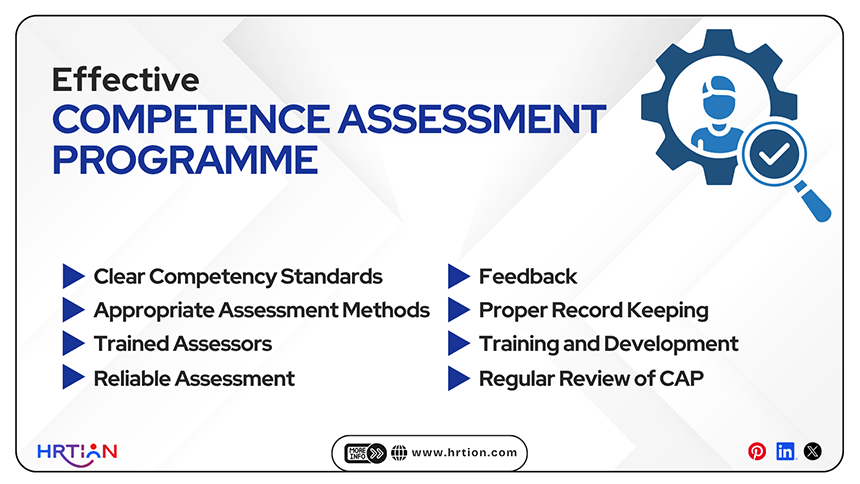
An effective, complete assessment programme follows a clean structure. It should be effective enough to determine whether an individual possesses the right knowledge, skills, abilities, and attitude. The major CAP components are the following:
- Clear Competency Standards
The foundation of the programme must be clearly stated company standards. These standards should specify what an employee is expected to know, understand, and perform in their job role. Doing so will help understand the expected level of performance.
- Appropriate Assessment Methods
Not every competency can be tested the same way; therefore, different methods should be used to assess different types of competence. These may consist of written tests, practical demonstrations, interviews, observations, role plays, and case studies.
- Trained Assessors
Evaluators of the assessment must hold the necessary knowledge, skills, and experience to conduct the assessment. They should be trained to assess employees fairly and without bias.
- Fair and Reliable Assessment
The assessment should measure the actual skills and knowledge required to perform the job competently. The same standards should be applied to all employees so that the results are fair and consistent.
- Clear Assessment Criteria
Employees need to know how they will be assessed. The standard can include clear rules, performance standards, and scoring methods. Continuous assessment is quite helpful to reduce confusion and make processes easier.
- Regular Assessment
Competence should be checked regularly instead in just one cycle. Continuous assessment helps identify the areas that require improvement, and the strengths can be used strategically. It will help create a plan of improvement.
- Feedback
Employees should receive clear and useful feedback after the assessment is completed. Feedback must outline the problematic areas and allow employees to improve performance.
- Proper Record Keeping
All the assessment results and feedback records should be maintained carefully. These records help companies track employee progress and identify training needs.
- Training and Development
If an employee has a competency gap, suitable training, coaching, or mentoring must be provided. This helps employees improve or develop the skills required to enhance performance and contribute to organizational growth.
- Regular Review of CAP
The assessment programme should be reviewed in a timely manner. This ensures that it continues to meet the changing needs of the company, employees, and workplace.
How Does the Competence Assessment Programme Work?
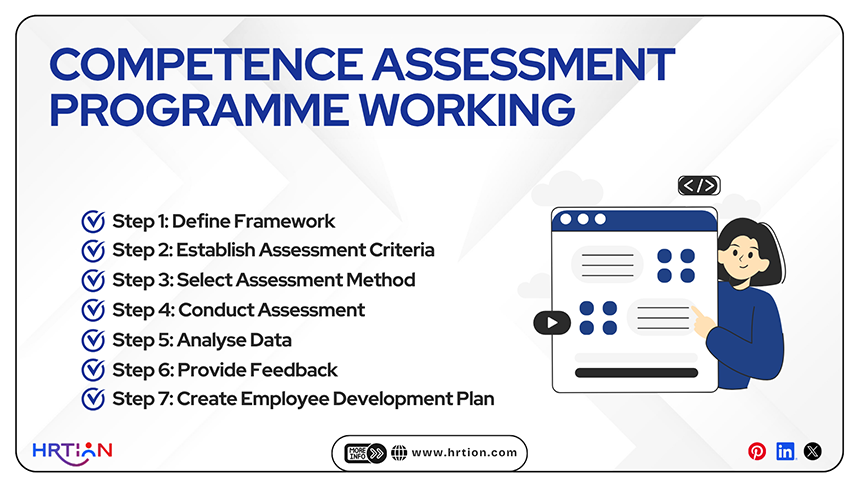
A typical Competence Assessment Programme follows a step-by-step process to evaluate skills, experience, and ability to perform effectively.
Step 1: Define Framework
Start by identifying the key competencies required for each role.
Ask:
“What does someone need to know and be able to do to succeed in this role?”
Take this as a clear roadmap of what employees need to learn, do, and demonstrate to perform their role successfully.
Step 2: Establish Assessment Criteria
Set clear and measurable criteria for each competency. Employees must be informed about what is expected of them and what successful performance will look like.
This prevents managers from judging employees based only on personal opinions.
Step 3: Select Assessment Method
Select the assessment methods that can best match the competencies that need to be assessed. This can consist of methods like practical tasks, knowledge tests, interviews, simulations, observations, or self-assessments.
For example:
Coding skills → practical coding test
Leadership → simulation + manager feedback
Customer service → role-play
Product knowledge → knowledge test
Step 4: Conduct Assessment
Give employees clear instructions and enough information about the assessment process.
It is important that assessors should use the same criteria for everyone performing the same role. This creates a fair and supportive environment for all employees.
Step 5: Analyse Data
Next is to review the assessment results to understand where an employee or set of employees is lacking and where they need additional support. This is used to identify strengths, skill gaps, training needs, and areas requiring improvement.
Step 6: Provide Feedback
Discuss the results with the employee. Make sure the conversation is strictly focused on development rather than criticism.
Also, highlight what they are doing well and where additional support is required. Suggest some practical ways to grow in the professional space.
Step 7: Create Employee Development Plan
At last, it’s crucial to turn assessment insights into action. Create a personalized development plan that outlines specific goals, learning activities, support, and timelines that can help every individual to build their competencies and grow in their role.
Commonly Used Competence Assessment Methods
| Competence Assessment Method | What It Measures | How It Works | Best Suited For |
| Skills Tests | Technical and job-specific skills | Employees complete practical or written tests related to their role | IT, finance, marketing, sales, technical roles |
| Structured Interviews | Knowledge, behaviour, communication, and problem-solving | Candidates or employees answer a standard set of competency-based questions | Hiring, promotions, leadership roles |
| Work Samples | Ability to perform actual job tasks | Employees complete a task similar to what they would do at work | Writing, design, coding, data analysis, administration |
| Role-Play & Simulations | Communication, decision-making, customer handling, and leadership | Employees respond to realistic workplace situations | Sales, customer service, management, HR |
| Assessment Centres | Multiple competencies at the same time | Employees complete several exercises, interviews, group activities, and simulations | Leadership development, promotions, recruitment |
| Self-Assessment | Employee’s perception of their own skills and development needs | Employees rate their own competency levels against defined criteria | Career development and training planning |
| Manager Assessment | Job performance, behaviour, and role-specific competencies | Managers evaluate employees using predefined competency criteria | Performance and development reviews |
| 360-Degree Feedback | Leadership, communication, teamwork, and interpersonal skills | Feedback is collected from managers, peers, direct reports, and sometimes customers | Managers, leaders, and high-potential employees |
| Knowledge Tests | Job-related knowledge and understanding | Employees answer questions related to policies, products, processes, or technical knowledge | Compliance, healthcare, finance, technical roles |
| Case Studies | Analytical thinking, decision-making, and problem-solving | Employees analyse a realistic business situation and recommend a solution | Managers, consultants, analysts, senior professionals |
| Practical Demonstrations | Ability to apply knowledge in real situations | Employees demonstrate how they would perform a specific task | Healthcare, manufacturing, technical, and skilled jobs |
Best Competence Assessment Programme Examples
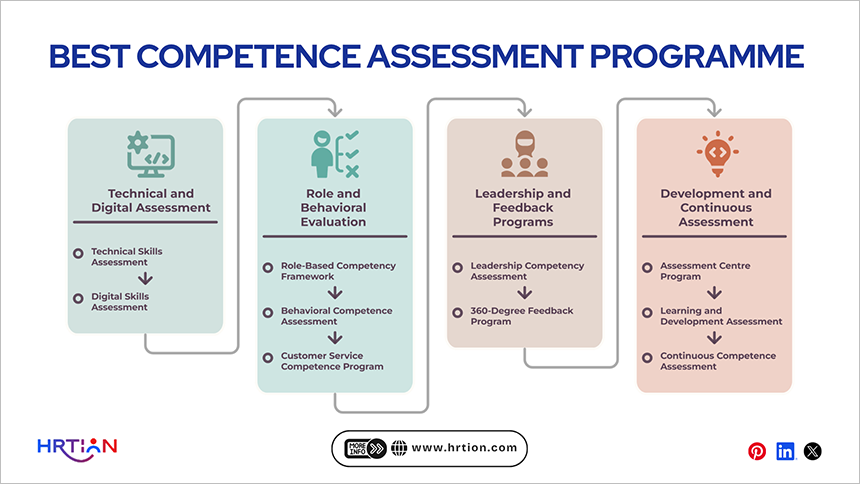
Competence assessment programs provide a lot of value to organizations when measuring specific skills, behaviors, knowledge, and abilities of their employees. Some of the common and effective programs are described below:
- Technical Skills Assessment
Employees and their job-specific technical skills are measured in these programs, often using practical tests and simulations to help the employee show their ability to apply their knowledge in various situations.
- Role-Based Competency Framework
Employees are assessed and compared against clearly defined and detailed proficiency levels.
- Leadership Competency Assessment
Managers are often evaluated on their skills like decision-making, strategic thinking, team management, and general leadership qualities.
- 360-Degree Feedback Program
In order to identify an employee’s strengths and potential developmental areas, the employee is given feedback from managers, peers, co-workers, and any other relevant stakeholders.
- Assessment Centre Program
Participants are introduced to case studies, presentations, role plays, group exercises, and interviews to assess various competencies.
- Digital Skills Assessment
Digital skills like data analysis, cybersecurity, or digital capabilities relevant to an employee’s role and job are examined. Some of these digital capabilities may include utilizing certain tools or software.
- Customer Service Competence Program
Employees are assessed based on communication exercises, problem-solving tasks, service-quality evaluations, and customer scenarios.
- Behavioral Competence Assessment
Behavioral attributes like teamwork, adaptability, accountability, communication, and conflict management are measured and assessed.
- Learning and Development Assessment
Employees are given training and assessed before and after the training to locate skill gaps and record improvements.
- Continuous Competence Assessment
Relying on annual assessments only can often be lacking in effort to guarantee improvements within an organization. As such, organizations favor regular observations, performance reviews, practical assessments, and feedback for continuously measuring development and competence over time.
Common Mistakes of the Competence Assessment Programme
The most common errors that occur while planning and executing the competence assessment program are the following.
- Using Vague Competencies
Avoid using difficult-to-measure competencies like “good attitude.” Instead, add observable behaviors such as “remains professional while handling complaints.”
- Relying on Single Assessment Method
A written test can only check the theoretical knowledge but not the acquisition of the required practical skills. Thus, try to combine different methods for a holistic competence assessment.
- Allowing Personal Bias
Two managers may give different scores to the same employee without setting clear standards. Therefore, apply structured criteria and provide adequate assessor training to reduce bias.
- Making Assessment Too Long
If employees have to spend hours to complete several unnecessary tests, they may feel less engaged, leading to poor participation.
Thus, assess only competencies that are highly crucial for the role.
- Using Old Competency Requirements
Job requirements change over time. According to a report by WEF, “39% of workers’ core skills are expected to change by 2030.” Therefore, the competency framework must be reviewed regularly.
- Not Acting on Results
There is no benefit to identifying a skill gap if no action is taken afterwards. Every major gap should be handled by a well-designed action plan.
- Focus on Weaknesses Alone
Assessment should also identify strengths. A strong communicator may not be suitable for training new employees or taking leadership roles.
HRtion: Manage Competency Information Automatically
Managing all the competency data can be difficult as the organization grows. The HR team may have employee information scattered in different sheets, but HRtion offers a centralized platform for all employee information.
This robust HR technology can help HR teams in various areas, such as:
- Employee records
- Performance management
- Training and Development
- Employee skill information
- Workforce reports
- Manager feedback
- HR data tracking
This can make it easier to connect employee development with other processes. Automation can make this process easier to manage, mainly with larger organizations.
Conclusion
A competence assessment program seems like a simple idea, but it holds an important purpose. This process helps with comprehending what employees can actually do and where they need support to grow.
It can help identify skill gaps, improve employee development, support promotion, plan training, and prepare the workforce for continuously changing job requirements.
FAQs
What is a competence assessment programme?
A competence assessment programme is a structured process used to evaluate whether employees have the knowledge, skills, behaviors, and abilities required for a particular job role.
What are the main types of competence assessments?
The common types of CAPs are technical assessments, behavioral assessments, aptitude tests, leadership assessments, practical tests, role-plays, work samples, self-assessments, and 360-degree feedback.
What is the difference between competence and performance?
Competence is defined as an employee’s ability to perform a certain role, while performance focuses more on actual work results and achievements.
What are the 7 competencies of the Competency-Based Curriculum CBC?
The 7 core competencies of the Competency-Based Curriculum that help learners develop skills and abilities are the following:
- Communication and collaboration
- Critical thinking and problem-solving
- Creativity and imagination
- Citizenship
- Digital literacy
- Self-efficacy
- Learning to learn.
What are the 5 levels of competency?
The five major levels are Novice, Beginner, Competent, Proficient, and Expert, showing progression from basic to expert.

Bhavesh is a Guest Writer at HRTion with an academic background in HR. He did an HR management course in 2025. Before transitioning to HR content writer, he worked as an Academic Content Writer at Trident Management for over 6 years. His expertise in recruitment processes & strategies helps him write detailed and clear content that is not only informative but also accessible for everyone.