
- What is Enterprise Compensation Management?
- Why Enterprise Compensation Management is Important
- Benefits of Enterprise Compensation Management
- Key Elements of Enterprise Compensation Management
- Roadmap to Enterprise Compensation Management Process
- Best Strategies for Effective Enterprise Compensation Management
- Common Challenges with Enterprise Compensation Management
- Manual Process Vs. Enterprise Compensation Management Software
- Best Compensation Management Software in 2026
- Final Thoughts
- FAQs
Compensation is not only about deciding the salary of the employee, but it is also a holistic and strategic process to foster an equitable and satisfying work environment in the organization. The comprehensive approach for this is called Enterprise Compensation Management.
According to Mercer, “approximately 96% of organizations planned salary increases in 2025, with the average increase projected at around 3.3% globally,” explaining the importance of structured compensation planning.
Companies today are investing heavily in enterprise compensation management technologies due to growing employee expectations and ever-changing workforce trends. ECM helps GR leaders maintain fairness, transparency, and compliance while deciding on salaries and rewards.
Here is an insightful overview of the enterprise compensation management system, its benefits, key elements, best strategies, and everything in between.
What is Enterprise Compensation Management?
Enterprise Compensation Management (ECM) is a strategic approach to planning, managing, and optimizing employee compensation across an entire organization throughout the year using different aspects such as policies, technology, data, and analytics.
This process ensures that employees receive competitive, equitable, and performance-based salaries and rewards. It also helps the company control labor costs and comply with labor laws.
The main objectives of Enterprise Compensation Management are the following:
- Maintaining internal pay equity
- Offering competitive salaries
- Rewarding employee performance
- Controlling compensation costs
- Supporting organizational growth
- Increasing employee satisfaction
- Ensuring compliance
- Improving employee retention
- Enhancing workforce productivity
Why Enterprise Compensation Management is Important
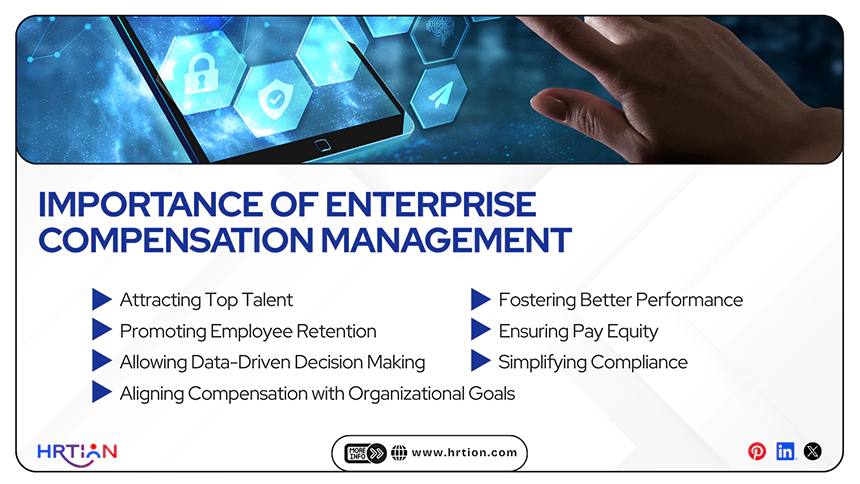
Enterprise Compensation Management plays a major role in helping organizations align compensation with long-term business goals while also addressing employee expectations.
Nowadays, employees and the general workforce expect and value transparency, fairness, career progression, and performance-based rewards as much as their salary itself. Provided below are some points highlighting the importance of Enterprise Compensation Management:
- Attracting Top Talent
According to SHRM, the strongest driving force of recruitment is the competitive compensation packages across different industries. Candidates usually look at many factors while accepting a job offer, and compensation is often the first factor examined.
- Promoting Employee Retention
It has always been much more expensive to replace a skilled employee than to retain them within an organization. Some studies have even estimated that replacements can cost from one-half to two times the employee’s annual salary.
A proper, well-detailed, and structured compensation strategy can greatly decrease the voluntary turnover rate by ensuring that employees feel valued and treated fairly.
- Aligning Compensation with Organizational Goals
Behaviors that directly contribute to organizational goals and success should be promoted and rewarded accordingly. Some of these goals can involve sales growth, innovation, cost reductions, customer satisfaction, project completions, and leadership development.
- Fostering Better Performance
Rather than focusing on and relying on fixed salaries, it is much better for an organization to use performance management systems and include merit increases, bonuses, and incentives to establish a direct relationship between employee contributions and financial rewards.
This boosts the motivation of employees to reach further and achieve organizational goals and also improves employee engagement levels and productivity.
- Ensuring Pay Equity
A major concern for all employers worldwide is pay equity. Any inequities in pay can often come with severe legal risks and consequences for a business. Enterprise compensation management software allows HR teams to identify salary gaps based on factors like gender, job level, department, skills, location, and experience, which provides corrections to pay inequities.
- Allowing Data-Driven Decision Making
Analyzing insights and answering questions regarding salary budgets, market salary rates, compensation costs, and payroll expenses is an important feature of modern compensation software. These workforce analytics make it viable for executives to make informed financial decisions based on data and insights.
- Simplifying Compliance
Every different area, country, and state can have its own varying labor laws and regulations. These regulations often deal with minimum wages, equal pay, tax reporting, overtime, and salary disclosures, and must be followed to avoid any legal risks or compliance issues.
Enterprise compensation management platforms automate policy enforcement and manage audit trails, which helps in reducing these risks and staying compliant with labor laws.
Benefits of Enterprise Compensation Management
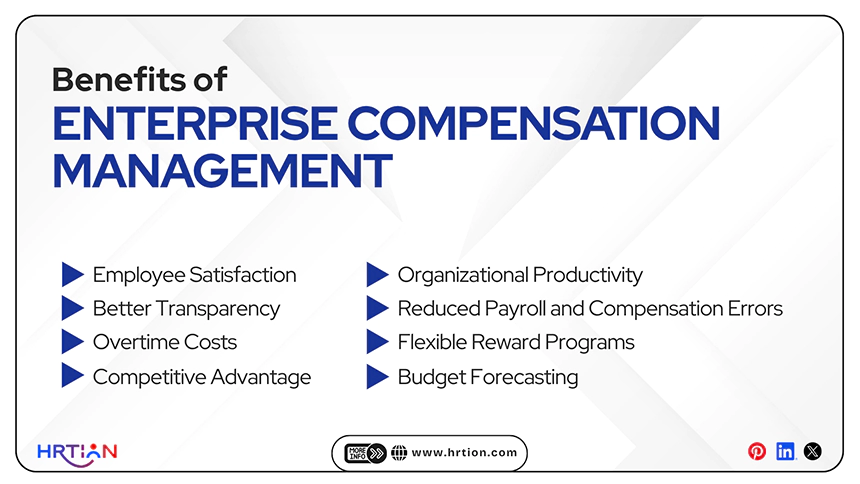
Companies are largely investing in ECM for different reasons. It offers a wide range of benefits that facilitate both employee and employer. Some of the profound benefits of compensation management are listed below.
– Employee Satisfaction
Employees who receive fair compensation for their time and skills are usually more satisfied with their job and employer. Therefore, they tend to stay committed to their workplace.
– Improved Organizational Productivity
By rewarding employee performance and achievements, Enterprise Compensation Management motivates employees to work more efficiently, improve their skills, and contribute to the success of the company.
– Strategic Workforce Planning
ECM helps companies align their compensation strategies with business goals, making it easier to attract, retain, and develop the right talent pool needed for future growth.
– Better Transparency
With clearly defined compensation policies and structured reward systems, communication improves between employees and the employer. It builds trust and reduces confusion regarding pay decisions.
– Reduced Payroll and Compensation Errors
With the automation of salary calculations, bonus distribution, and approval workflows, human and operational errors are reduced significantly. It saves administrative time and improves accuracy.
– Enable Flexible Reward Programs
Enterprise Compensation Management supports different forms of employee rewards, such as performance bonuses, incentives, commissions, stock options, and recognition programs, allowing companies to fulfill different employee needs and expectations.
– Creates Competitive Advantage
A well-planned compensation strategy builds and improves the reputation of an employer. It attracts top talent, improves employee retention, and strengthens its position in the job market.
– Improves Budget Forecasting
The real-time compensation data management helps estimate future expenses and allocate budgets effectively. This controls compensation costs without compromising competitiveness.
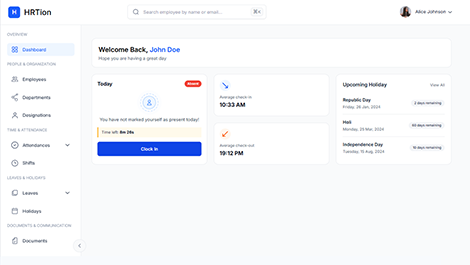
Manage the payroll, attendance, shift roles, and more in an all-encompassing HR suite. Your ultimate HR toolkit is just a click away.
Key Elements of Enterprise Compensation Management
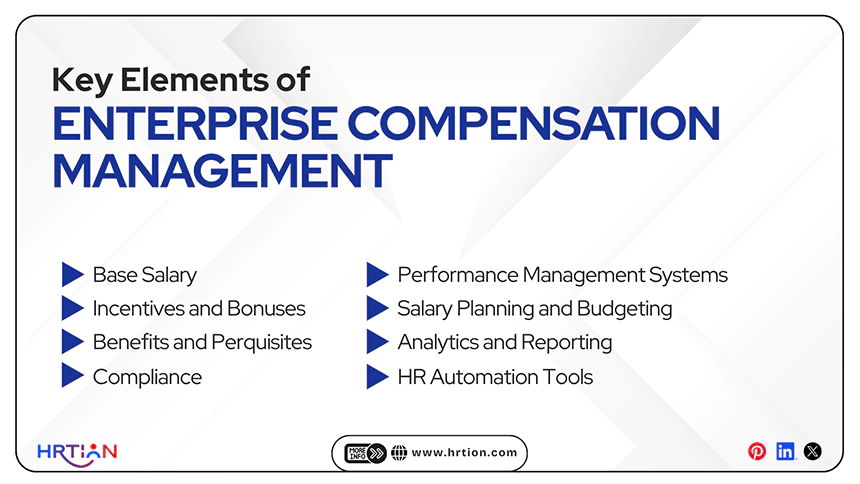
Enterprise compensation management is a multifaceted process, and several components work together to help companies reap the maximum benefits.
– Base Salary
Base salary is the fixed compensation that employers pay to employees for performing their job responsibilities. It is determined by factors such as job role, experience, qualification, skills, and market salary benchmarks.
– Incentives and Bonuses
Incentives and bonuses are different forms of compensation awarded based on individual, team, or organizational performance. These rewards encourage employees to achieve specific goals, improve productivity, and contribute to business success.
– Benefits and Perquisites
Employee benefits include both financial and non-financial rewards provided in addition to the regular salary. These may consist of health insurance, retirement plans, paid leave, wellness programs, flexible working arrangements, and other advantages.
– Performance Management Systems
Performance management systems and ECM work closely. Employee performance evaluation, goal achievements, and competency assessments are used to determine salary increases, bonuses, and promotions.
– Salary Planning and Budgeting
Salary planning is the process of allocating compensation budgets and strategizing salary increments, promotions, and merit increases. Organizations use budgeting tools and workforce planning to create a balance between rewards and objectives.
– Compliance
Organizations need to ensure that compensation planning aligns with labor laws, tax regulations, and equal pay legislation. ECM systems help maintain compliance by automating calculations, audit trails, and report generation for regulatory purposes.
– Analytics and Reporting
Analytics and reporting tools provide insight into pay trends, salary distribution, budget utilization, and workforce costs. HR managers use these insights to figure out the effectiveness of compensation strategies and pay gaps and to make data-driven decisions.
– HR Automation Tools
The HR automation tool is an integral part of the entire compensation management process. These tools perform tasks like workflow approvals, compensation planning, and reporting. Automation reduces manual efforts, improves data accuracy, enhances transparency, and enables organizations to manage compensation effectively.
Roadmap to Enterprise Compensation Management Process
Strategizing compensation management can be difficult if not done carefully. Follow these steps to manage employee compensation successfully.
Step 1: Define Compensation Strategy
The first step in the process is to define the compensation strategy that aligns with the business objectives, workforce needs, and overall HR policies. The strategy must define employees as being rewarded based on performance, skills, experience, and market competitiveness.
Step 2: Evaluate Jobs and Employee Roles
Understand the responsibilities and evaluate the value of each position before assigning salaries.
Consider factors such as:
- Job responsibilities
- Required skills
- Experience
- Education
- Level of responsibility
Evaluating roles and responsibilities ensures that employees with similar job roles receive equal and fair compensation.
Step 3: Compare Salaries with Market
Research industry salary terms to ensure your pay is competitive and can attract top talent. Use different tools and information, such as:
- Salary surveys
- Industry reports
- Recruitment agencies
- Government labor data
Regular salary benchmarking helps hire and attract skilled professionals while controlling underpayment or overpayment.
Step 4: Create Comprehensive Salary Structure
Organize jobs into different salary grades and pay bands. The salary slot must include:
- Minimum salary
- Midpoint salary
- Maximum salary
| Pay Grade | Position | Salary Range |
| Grade 1 | Executive | ₹4–6 LPA |
| Grade 2 | Senior Executive | ₹6–9 LPA |
| Grade 3 | Assistant Manager | ₹9–14 LPA |
| Grade 4 | Manager | ₹14–22 LPA |
Step 5: Plan Bonuses and Incentives
Apart from fixed salaries, create reward programs that can recognize employee performance and compensate them in accordance with their performance.
Performance-based rewards encourage employees to achieve their business goals and stay motivated.
Step 6: Set Compensation Budget
Decide on how much the company can spend on salaries and rewards. The budget must cover salary increments, promotions, bonuses, incentives, employee benefits, and new hire requirements.
Step 7: Run the Merit Cycle
Use performance reviews at regular intervals as part of your organization’s merit cycle to determine salary increases and bonuses. Reward high performers to motivate them and improve overall productivity.
Step 8: Review Pay Equity and Compliance
Before finalizing the salaries, check whether compensation is fair and follows the labor laws. Review areas such as the following:
- Equal pay for similar laws
- Gender pay equity
- Salary consistency
- Compliance with labor regulations
Regular reviews reduce the legal risks and improve trust among employees.
Step 9: Communicate Compensation Changes
Inform employees regarding all the changes to their salary revisions, bonuses, or promotions clearly and transparently. Good communication helps employees set realistic expectations regarding how bonuses are calculated. Doing so will build trust and improve employee satisfaction.
Best Strategies for Effective Enterprise Compensation Management
There are several factors to keep in mind while structuring an enterprise compensation management strategy. Instead of relying on guesswork, use these simple tips and tricks:
- Make sure your compensation matches business goals. It must support objectives and employee performance.
- Maintain transparency policies that clearly communicate how salaries, bonuses, and incentives are decided.
- Compare compensation to industry standards to remain competitive in the market.
- Link incentives and salary increments to measurable and KPI-based employee achievements.
- Be sure to regularly review compensation to promote fairness and reduce pay problems.
- Leveraging technology is another smart move for effective ECM. Automation helps with planning, approvals, and regular reporting
- Combine salaries with benefits, incentives, and recognition programs to ensure the rewards are comprehensive and not shallow.
- Update the pay structure at regular intervals to reflect the latest market trends and business needs.
- Train your managers with the required knowledge to make fair compensation decisions.
Common Challenges with Enterprise Compensation Management
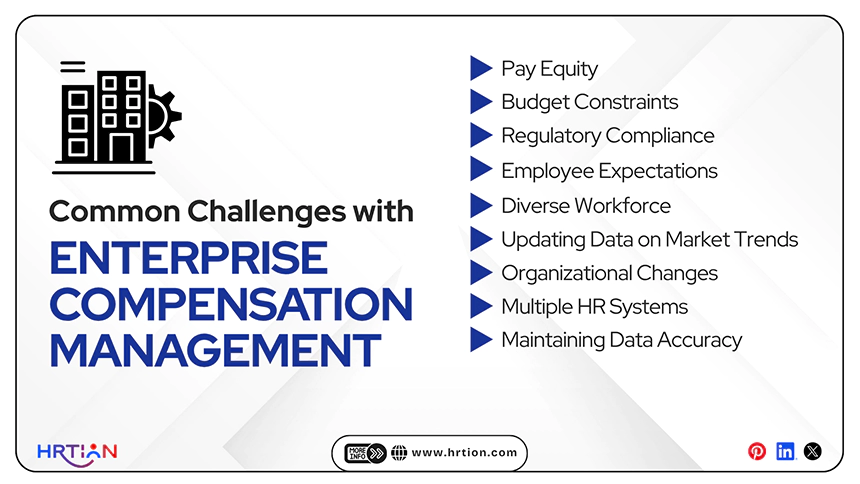
Some of the most common bottlenecks an organization faces while managing compensation are listed here:
- Ensuring Pay Equity: With the diverse variety of job functions and locations, it is a common yet difficult problem to guarantee that employees with similar roles receive fair and consistent compensation, with the problem being more acute in larger businesses.
- Understanding Budget Constraints: Businesses must be willing to understand and balance profitability and labor costs with competitive salaries and rewards.
- Following Regulatory Compliance: Labor laws, tax regulations, and equal pay legislation, especially across various regions and states, must be followed properly to avoid compliance issues and heavy risks.
- Handling Employee Expectations: It may be challenging to accurately communicate compensation decisions and address concerns about pay fairness with employees, especially during salary reviews and promotions.
- Managing Diverse Workforce Needs: Different employees will have different expectations about salaries, benefits, work arrangements, and incentives. This needs to be managed carefully to design compensation programs that meet these diverse expectations.
- Updating Data on Market Trends: Organizations should regularly review and update compensation structures based on the changes that occur frequently in industry salary standards, as well as employee expectations.
- Adapting to Organizational Changes: To maintain consistency and fairness, companies should revise compensation policies when approaching business expansions, mergers, acquisitions, and restructuring.
- Properly Integrating Multiple HR Systems: Without proper technology integration, it can be difficult to combine compensation management with payroll, performance management tools, and HR information systems.
- Maintaining Data Accuracy: Since compensation decisions rely heavily on accurate employee, payroll, and performance data, any mistakes and errors can lead to incorrect payments and issues with reporting.
Manual Process Vs. Enterprise Compensation Management Software
Manual processes are prone to errors and time-consuming, whereas ECM software automates the complex process and saves administrative efforts.
| Aspect | Manual Process | ECM Software |
| Accuracy | The process is prone to errors and discrepancies | Provide accuracy by eliminating human errors |
| Data Management | Through spreadsheets and separate files | Using one centralized platform |
| Budget tracking | Difficult to track real-time changes | Real-time budget overview |
| Efficiency | Time-consuming and labor-intensive | An automated process saves time and effort |
| Salary Planning | Requires manual calculations and approvals | The salary processes and workflow approvals are automated |
| Performance Integration | Performance data must be collected and matched manually | Integrates performance evaluations directly into compensation decisions. |
| Reporting and analytics | Limited reporting capabilities and complex data analysis | Generates real-time reports, dashboards, and compensation analytics |
| Scalability | Difficult to manage as the company grows | Easy to scale, as it can support large and geographically dispersed workforces |
| Compliance | Manual compliance tracking is prone to errors | Help with compliance management using labor laws and compensation regulations. |
| Decision-making | Decisions are handled through manual records and human judgment. | Supports data-driven decision-making using real-time insights and data. |
Best Compensation Management Software in 2026
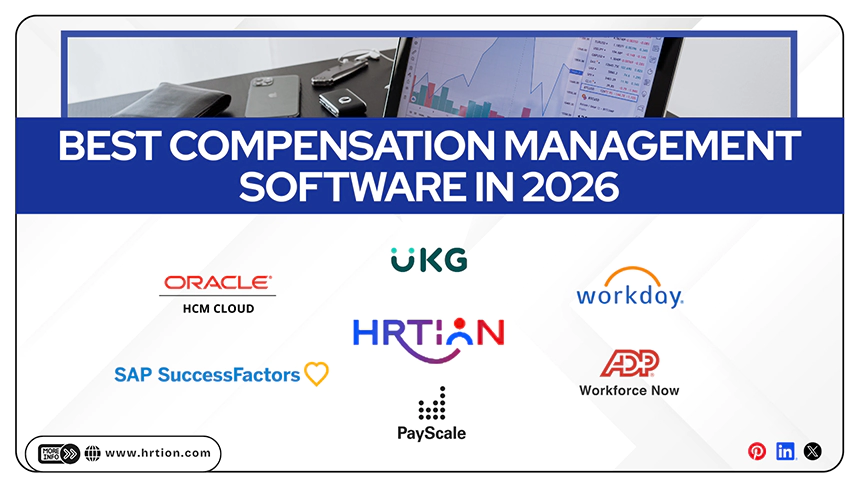
Here is the list of the most recommended compensation management software for large enterprises and small businesses to handle compensation management effectively and accurately.
HRtion: HRtion is an integrated HR management platform that helps companies manage data, payroll reports, attendance, performance, and compensation processes. It is suitable for organizations looking for centralized processes that help with compensation management.
Workday: Workday offers enterprise-level compensation management tools for planning salaries, bonuses, incentives, and workforce analytics. It is best suited for large organizations with complex structures.
SAP SuccessFactors: SAP SuccessFactors helps companies with planning, salary reviews, incentives, and performance-linked rewards. It can handle global workforces for large and multinational companies.
Oracle Fusion Cloud HCM: This software is designed to offer compensation planning, salary management, bonus administration, and workforce analytics. Oracle Fusion is ideal for enterprises that require a comprehensive cloud-based HR system.
ADP Workforce Now: ADP Workforce Now combines compensation management with other benefits like payroll, performance, and HR management. It is best suited for growing businesses requiring an integrated HR system.
Payscale: It focuses mainly on maintaining compensation data, salary benchmarking, pay equity, and market analysis. It allows companies to make informed decisions about employee salaries.
UKG Pro: UKG Pro includes compensation planning with payroll, performance management, workforce analytics, and employee management tools. It works best for mid-sized and growing businesses.
Final Thoughts
Enterprise Compensation Management is an integral part of modern workforce management. It is not only about salary management but also about combining compensation planning, salary benchmarking, performance rewards, incentives, pay equity, compliance, and analytics.
While manual compensation management is suited for small or growing companies, larger businesses require enterprise compensation management software. These platforms work well to reduce administrative tasks, improve accuracy, simplify approval processes, and provide valuable insights for workforce planning.
FAQs
What is Enterprise Compensation Management?
Enterprise Compensation Management is the process to plan, manage, analyze, and optimize employee compensation across the departments. It consists of salaries, bonuses, incentives, commissions, equity, benefits, and performance-based rewards.
What are the main components of Enterprise Compensation Management?
The main components of ECM are:
- Base salary
- Salary structure
- Pay grades
- Bonuses
- Incentives
- Commissions
- Benefits
- Pay equity
- Analytics
What is compensation management software?
Compensation management software is a digital tool that helps companies manage employee salaries, bonuses, incentives, salary reviews, budgets, approvals, and compensation analytics.
What is the difference between compensation management and payroll?
Compensation management focuses on planning and managing employee rewards, salaries, bonuses, incentives, and pay structures. Whereas payroll focuses on calculating and processing employee payments, taxes, deductions, and salary disbursements.
How often should companies review their compensation strategy?
To remain fair and consistent and enable employees to feel valued, review the compensation at least once a year. However, the trends should be analyzed throughout the year.
Sources

Sunita Kumari is a Freelance Contributor Writer at HRTion, writing accurate, reliable, and informative content. She completed her Bachelor's from Rajdhani College of the University of Delhi. She has been a Human Resources Recruiter for almost 2 years, including over 1 year with Battersea Web Expert. Drawing on her recruitment and HR processes experience, she writes clear and practical payroll-related guides that help employees and job candidates better understand HR procedures and workplace practices.