
Performance reviews are essential for consistent success and workforce improvement. But it can be stressful and complicated if there isn’t a direct process.
To set up a well-structured employee feedback process, having the right employee performance review template can make a huge difference.
An evaluation template consists of feedback, achievements, areas of improvement, and goal-setting endeavors.
Here are a few useful performance templates and a guide to creating a personalized one.
What is a Performance Review Process?
An employee performance review process is a method used by companies to evaluate the performance of employees for a specific period. The process is critical and complex, as it includes numerous components such as challenges, accomplishments, goals, and feedback. With a constructive template, tracking the progress becomes convenient and error-free.
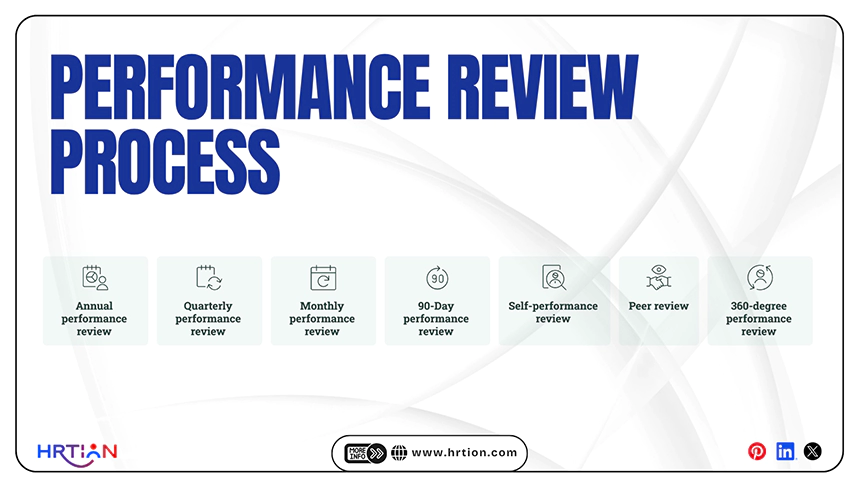
Some of the most common types of performance reviews are:
- Annual performance review
- Quarterly performance review
- Monthly performance review
- 90-Day performance review
- Self-performance review
- Peer review
- 360-degree performance review.
The reviews are then used for the performance appraisal process, future planning, resource control, and performance management digitally or manually.
Importance of Performance Review Templates
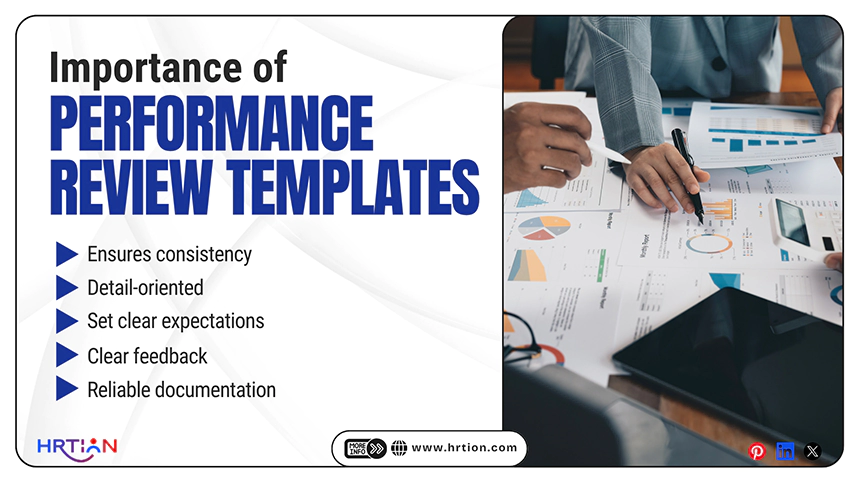
A well-constructed performance review template can help both employees and employers assess specific areas and make evaluations more consistent, objective, people-driven, and valuable.
Some key benefits of such templates are the following:
- Ensures consistency: It creates consistency in the process as every employee is evaluated on the same criteria. Also, this eliminates bias of any kind and ensures complete fairness.
- Detail-oriented: With a standardized format, managers and HR managers can create a review from scratch. This helps them not miss any crucial details.
- Set clear expectations: Templates focus on key areas like knowledge, productivity, teamwork, communication, and goal achievement. This reduces the randomness and allows employees to know the expectations of their leaders.
- Clear feedback: With a clear structure, managers can provide balanced feedback, comparing strengths and weaknesses at the same time. This eventually helps employees to identify gaps and improve strategically.
- Reliable documentation: Templates ensure consistent review records, as everything is documented. The records can be used for crucial decisions like promotions, increments, recognition, and rewards.
Manage the payroll, attendance, shift roles, and more in an all-encompassing HR suite. Your ultimate HR toolkit is just a click away.
Best 7 Performance Review Templates of 2026
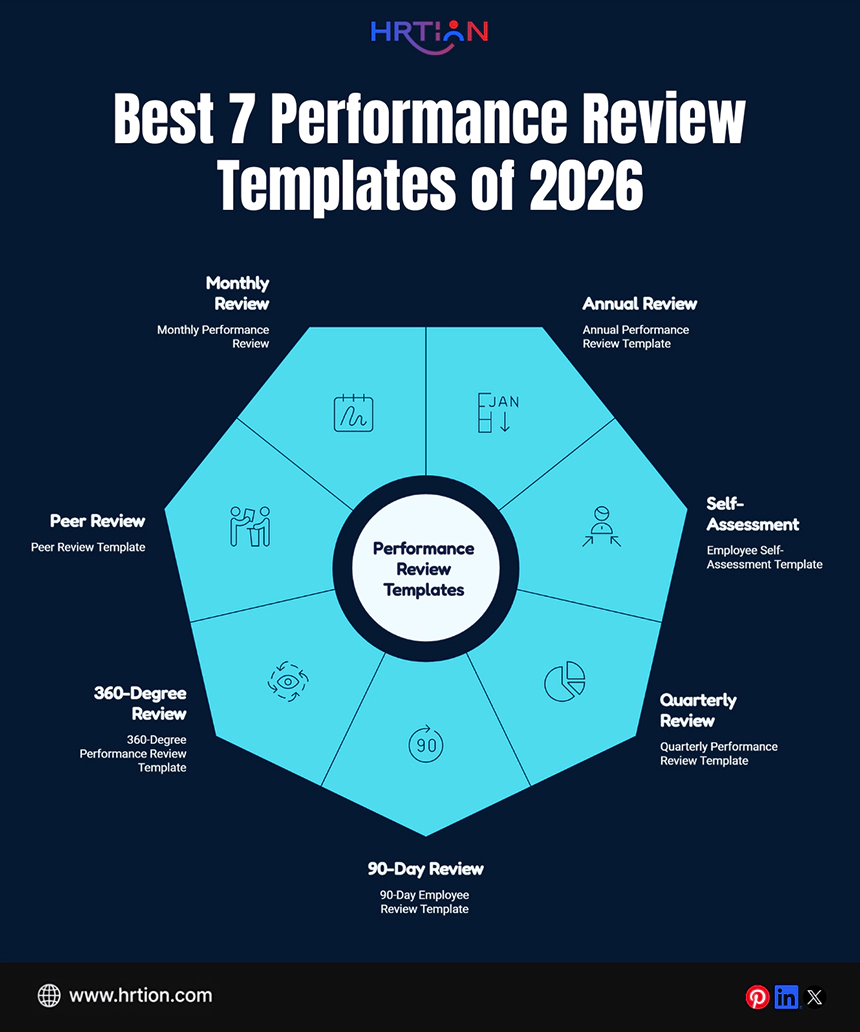
Here are the top 7 performance review templates most commonly used to review employees over different periods and in different ways. Simply download and print the template as per your company’s requirements and begin your review process with utmost ease.
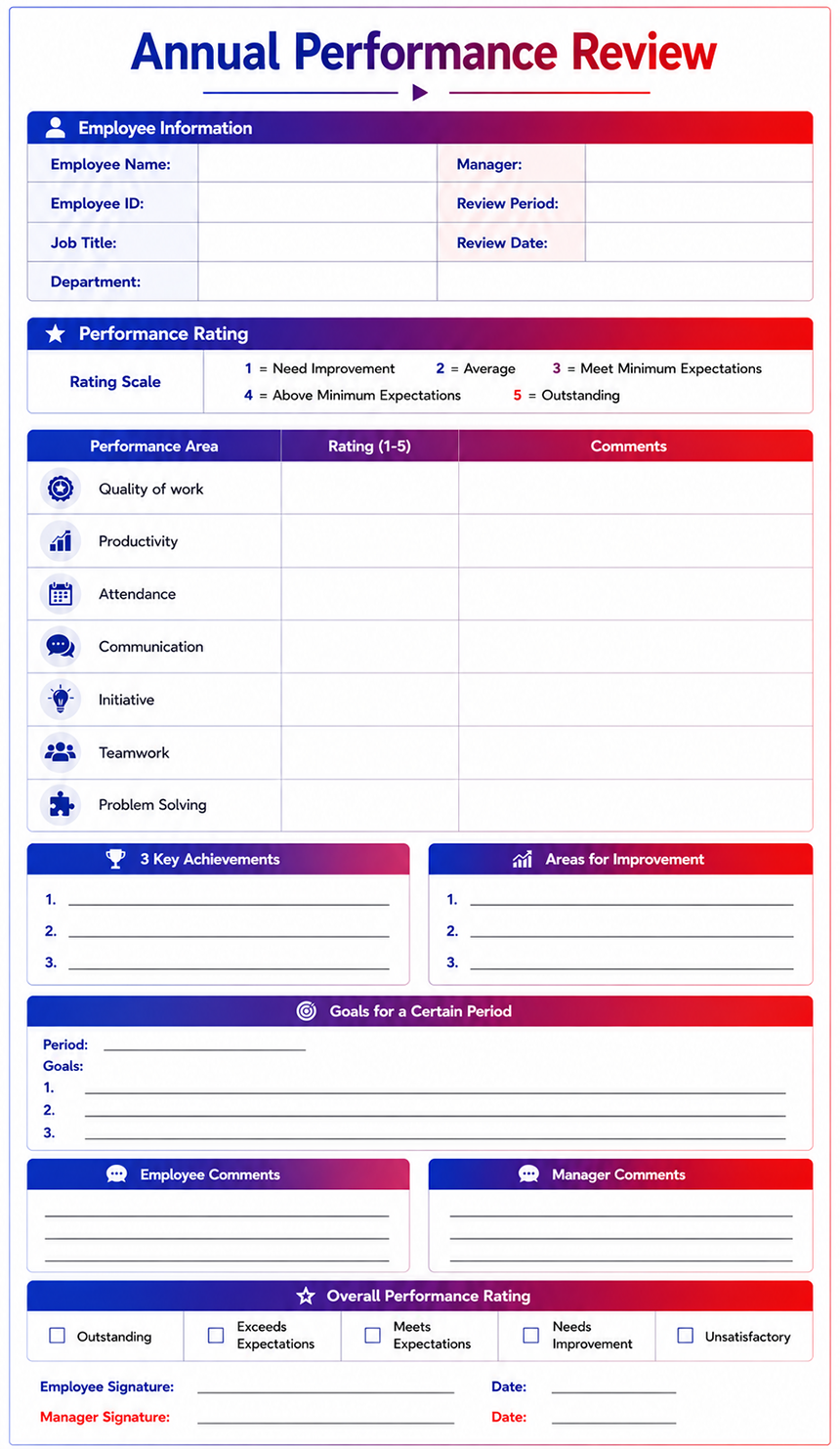
Template 1: Annual Performance Review Template
Best For: Evaluating performance across the year based on achievements, growth, and progress. It is widely used for appraisals, promotions, career development, and long-term planning.
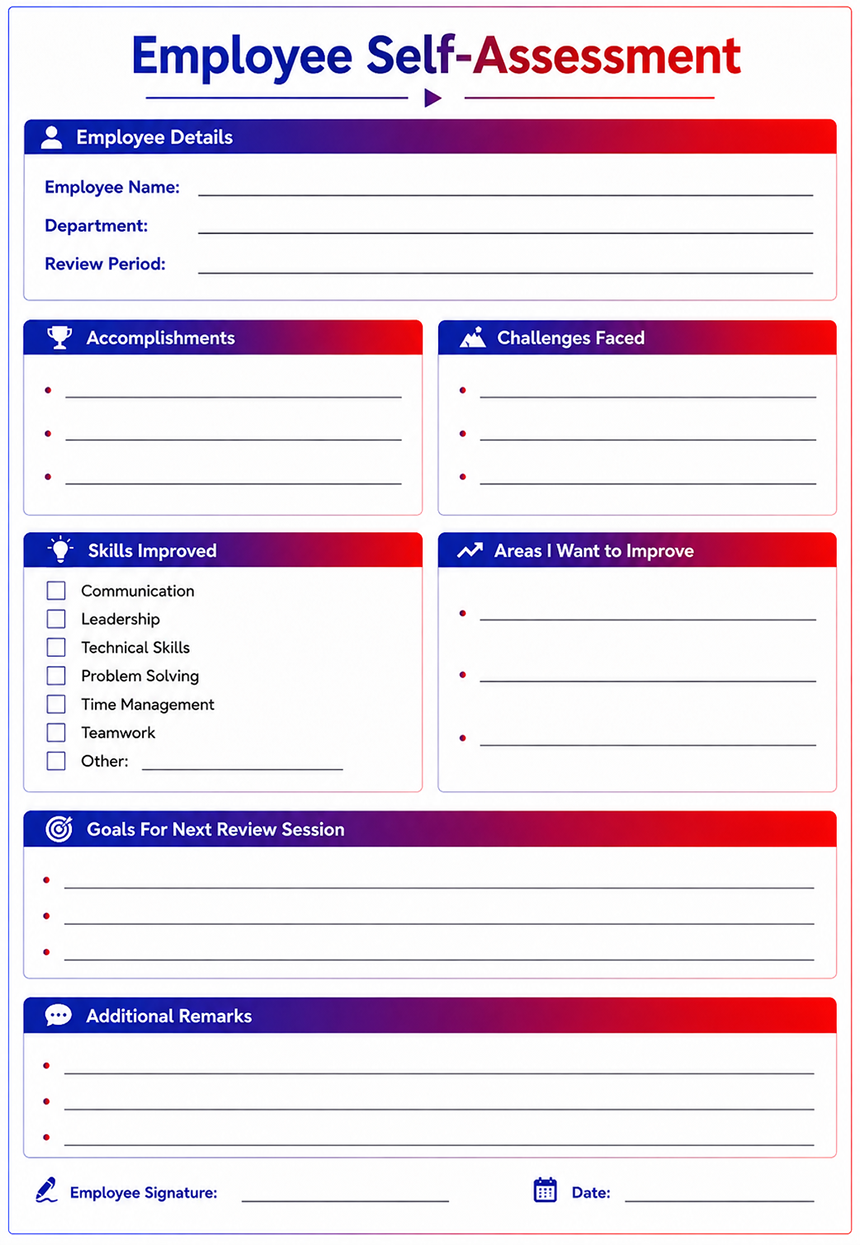
Template 2: Employee Self-Assessment Template
Best For: It is an encouraging process to help employees understand their own strengths and weaknesses, challenges, and professional development over a specific period. This promotes self-reflection and meaningful discussions with leaders.
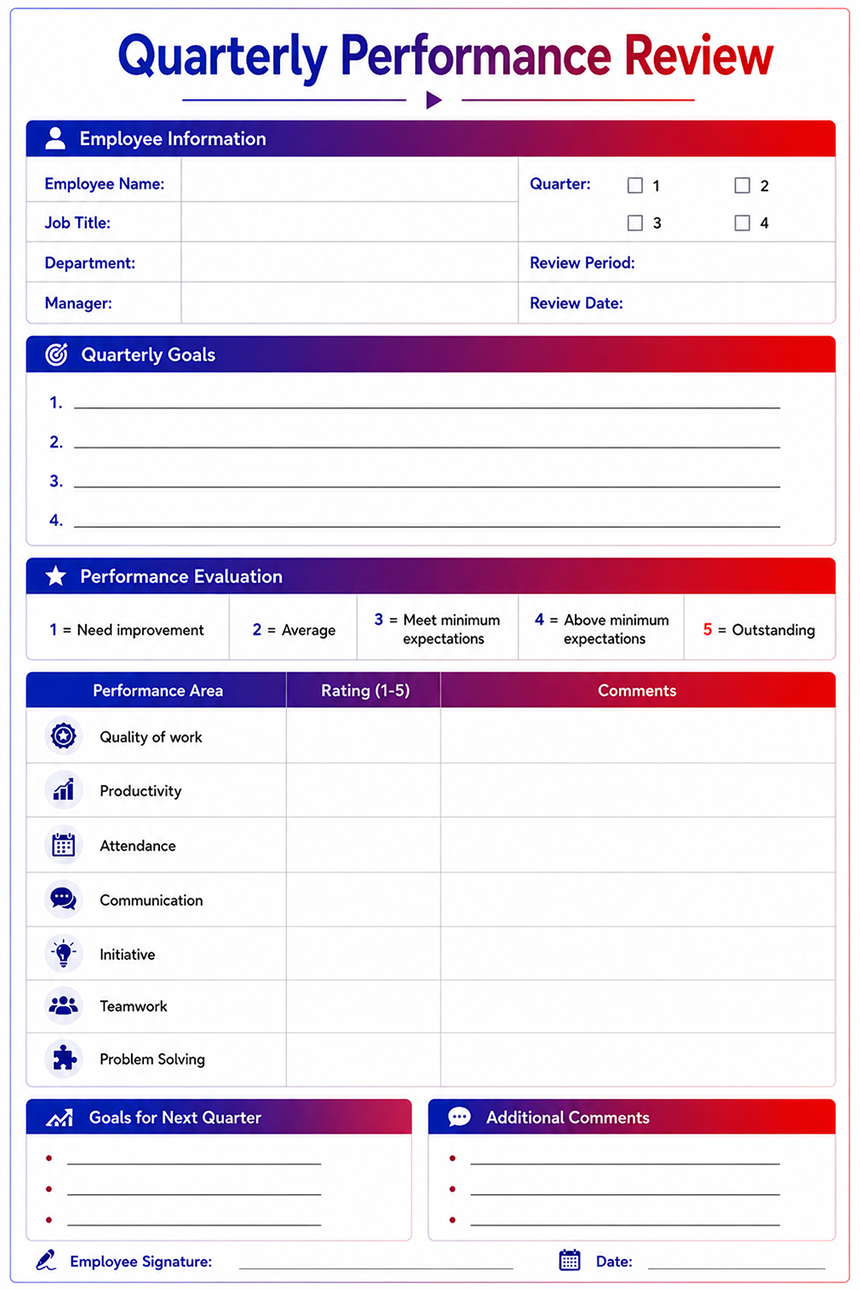
Template 3: Quarterly Performance Review Template
Best for: Monitoring the progress of an individual every three months. This review helps managers provide timely feedback, recognize accomplishments, and address issues before they have a long-term impact.
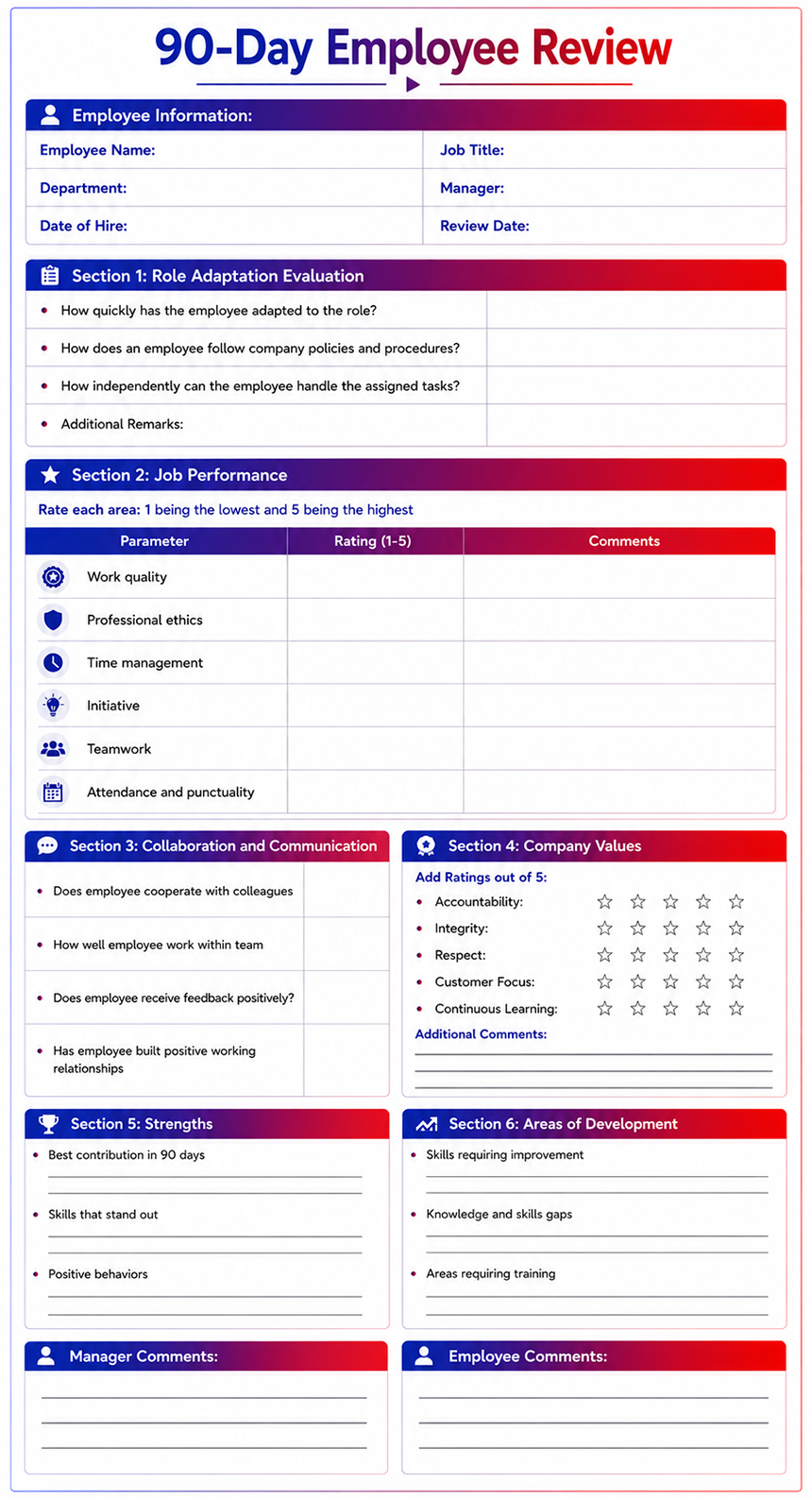
Template 4: 90-Day Employee Review Template
Best For: It is commonly used to evaluate new hires in the first three months. This template is best for checking onboarding success, cultural fit, and initiatives.
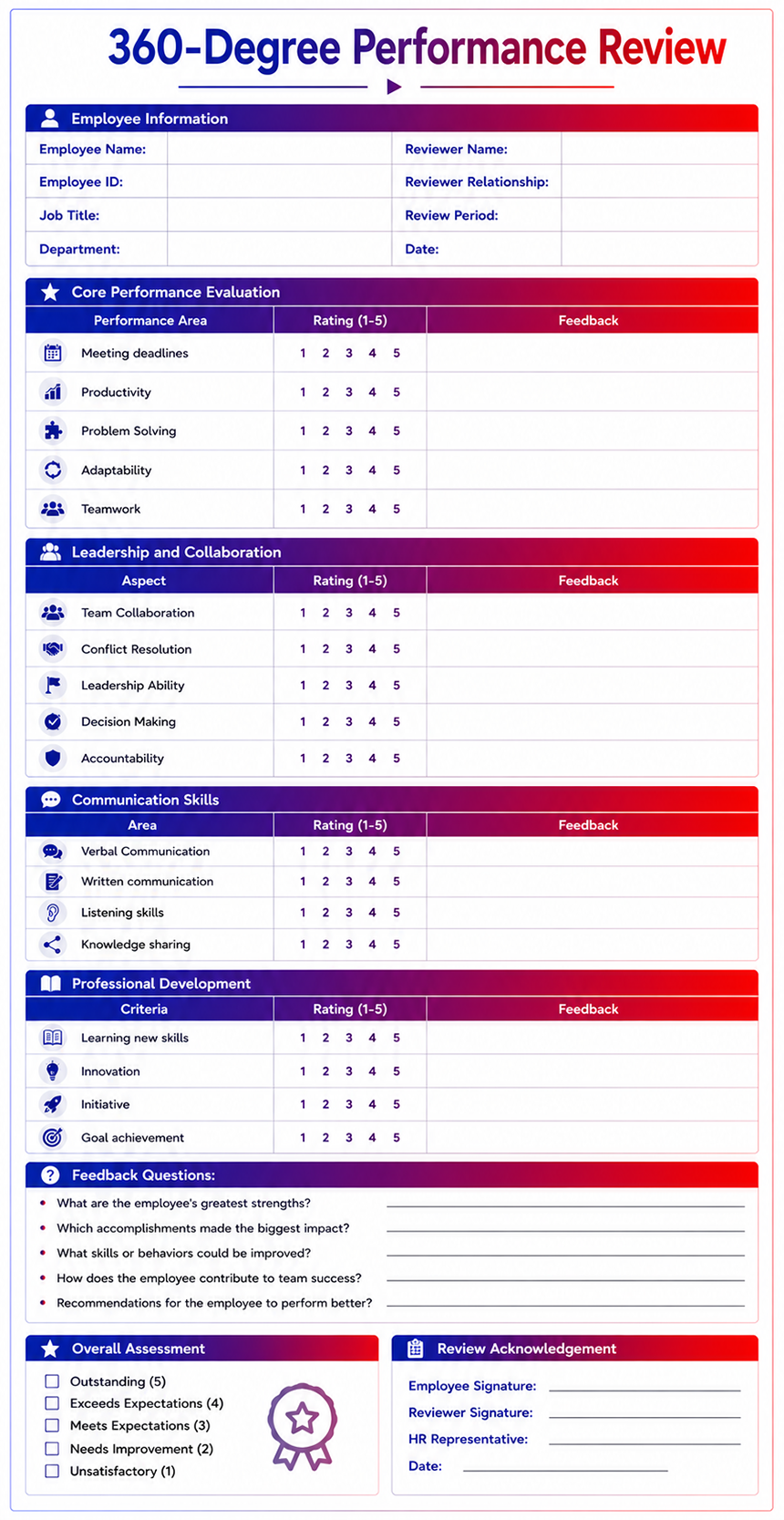
Template 5: 360-Degree Performance Review Template
Best For: It offers an overall view of an employee’s performance using feedback from all related people, such as managers, peers, direct reports, and sometimes clients. This is a well-rounded assessment pattern for growth and development.
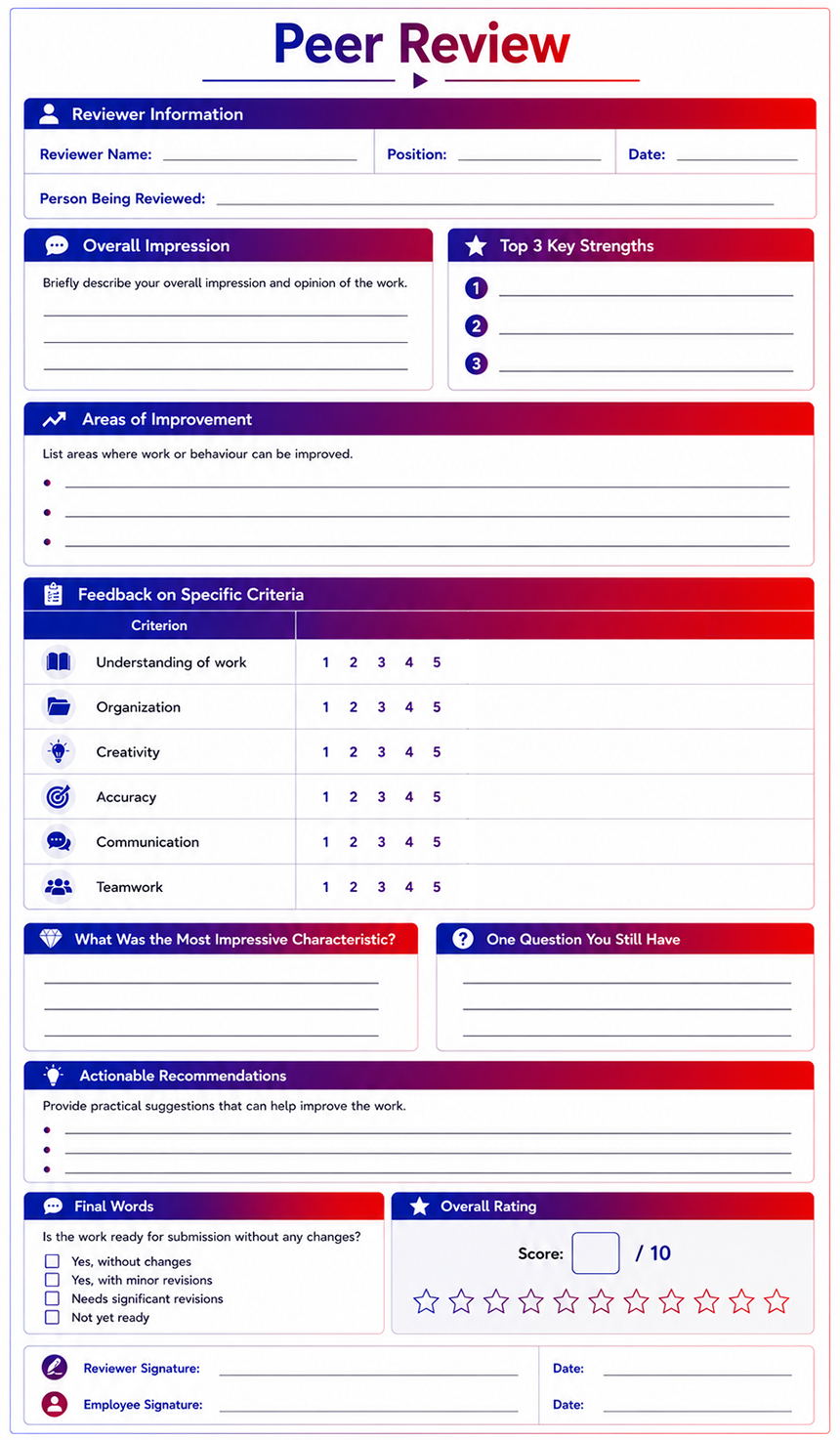
Template 6: Peer Review Template
Best For: This template is best for constructive feedback from colleagues who work closely with the employee regularly. They provide insights on teamwork, communication, and collaboration.
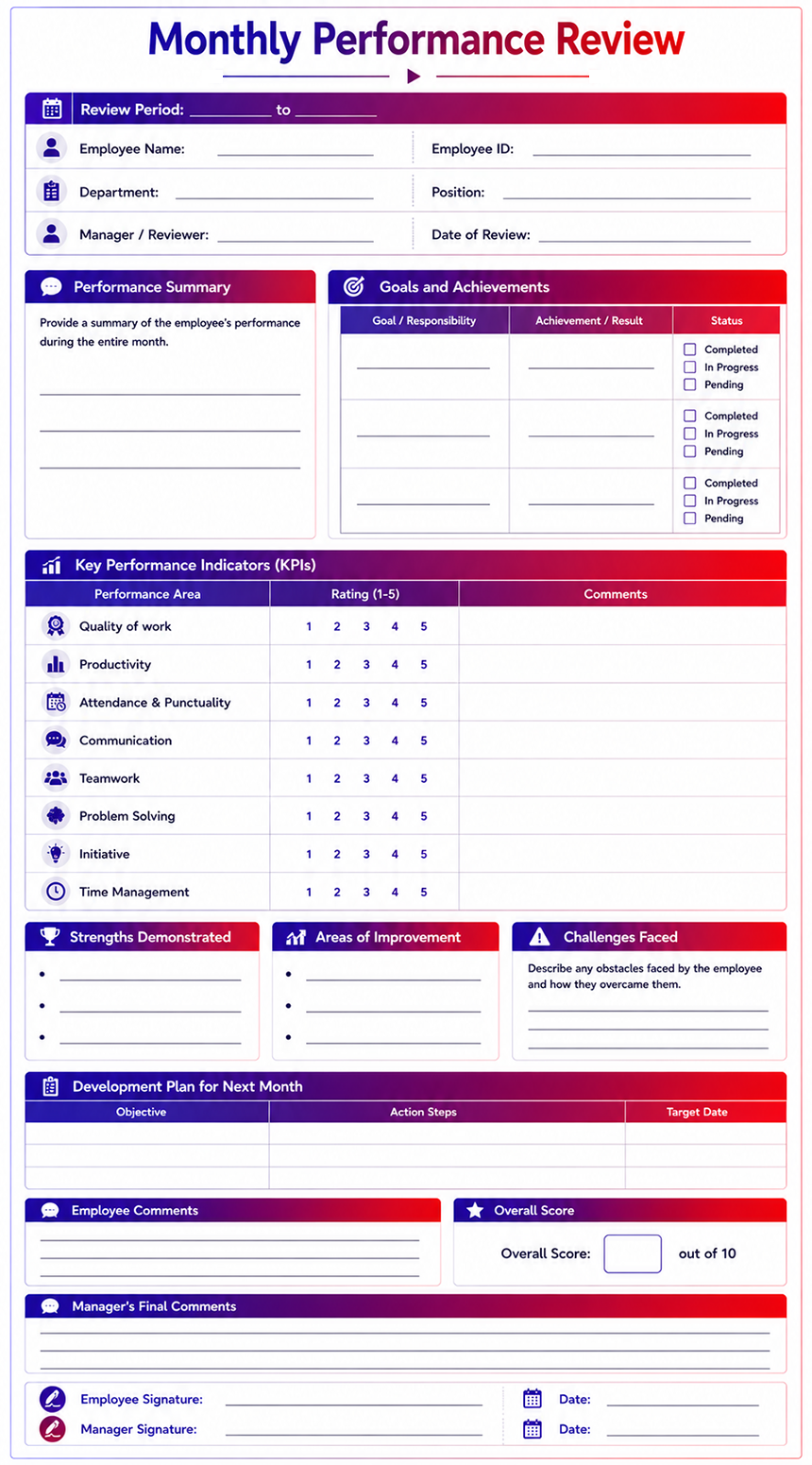
Template 7: Monthly Performance Review
Best For: Tracking regular short-term goals, productivity, and ongoing performance. Monthly reviews help provide continuous feedback, ensure accountability, and make required adjustments readily.
Key Elements of The Performance Review Template
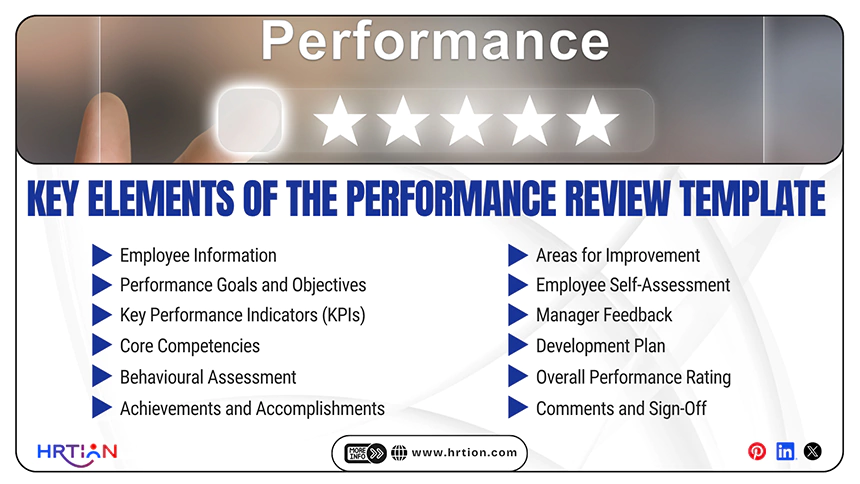
As you must have noticed, every template consists of these elements, one way or another. If you are creating a customized performance review format, add the 12 components listed below to make it wholesome and effective
- Employee Information
Basic details like employee name, job title, department, manager, review period, and review date are included in this section. This provides much-needed context for the evaluation and also keeps performance records accurate.
- Performance Goals and Objectives
Outlining the clear goals and responsibilities is emphasized in every review template. It is necessary to evaluate progress made by the employee towards these pre-determined objectives and measure just how effective the employee is at meeting these expectations.
- Key Performance Indicators (KPIs)
OKRs or KPIs are measurable metrics that are utilized by an organization to evaluate job performance. Usual KPIs are productivity, quality of work, attendance, customer satisfaction, project completion rates, and sales targets.
- Core Competencies
Core competencies are an assessment of the knowledge, skills, and abilities that are needed for success in the role. Communication, teamwork, leadership, adaptability, accountability, and problem-solving are some of the common competencies.
- Behavioural Assessment
This section involves workplace behaviors and professional conduct, focusing on attributes like collaboration, integrity, adherence to company rules and policies, professionalism, reliability, and general respect for others.
- Achievements and Accomplishments
Key accomplishments and achievements of the employee during the review period are discussed in this section. Successful projects, milestones, innovations, contributions, and other achievements that positively favored the organization are highlighted.
- Areas for Improvement
This section explores skills, performance areas, and behaviors that can be developed further. Constructive feedback serves as a good method of helping employees understand where improvements are required and how they can enhance their performance.
- Employee Self-Assessment
The self-assessment promotes self-awareness and allows the employee to reflect on their own performance and identify their strengths, challenges, career goals, and achievements. This also encourages open communication during the review.
- Manager Feedback
Managers provide an overall evaluation of the employee’s performance and recognize strengths, offer constructive recommendations, and discuss improvement opportunities.
- Development Plan
To improve performance and support career growth, development plans are created and implemented. These can frequently involve training programs, mentoring, certifications, skill development activities, or new responsibilities with defined timelines.
- Overall Performance Rating
This section gives a summary of the employee’s overall performance using a standardized and detailed rating scale, such as Outstanding, Exceeds Expectations, Meets Expectations, Needs Improvement, or Unsatisfactory. This keeps the evaluation outcome concise and to the point.
- Comments and Sign-Off
The final section includes additional comments from both the employee and manager, along with signatures and review dates. This is used to confirm that the performance review has been properly discussed and acknowledged formally by all parties.
How to Use a Performance Review Template
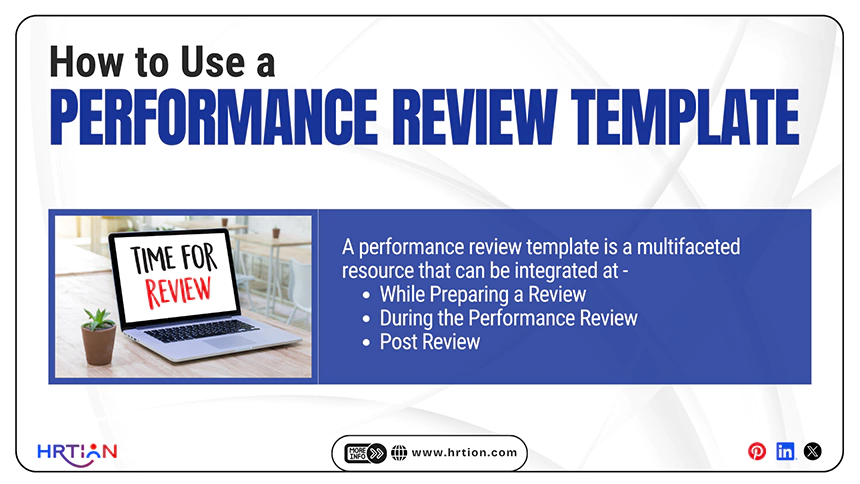
A performance review template is a multifaceted resource that can be integrated at different levels of the process. If you are unsure of its use, here are some suggestions.
- While Preparing a Review
Gathering relevant performance data, such as goals, project outcomes, KPIs, attendance records, and previous feedback, is necessary before the review. Review employee achievements, identify areas for discussion, and keep the evaluation fair and evidence-based.
- During the Performance Review
Utilize the template and address the performance, accomplishments, and improvement areas of the employee. Provide constructive feedback, allow employees to share their perspectives, and set realistic goals and development plans.
- Post Review
Document the discussions, agreed goals, and action items. Regularly follow up to track progress, support the employee’s continuous development and performance improvement, and provide feedback.
HRtion for Most Accurate Performance Review
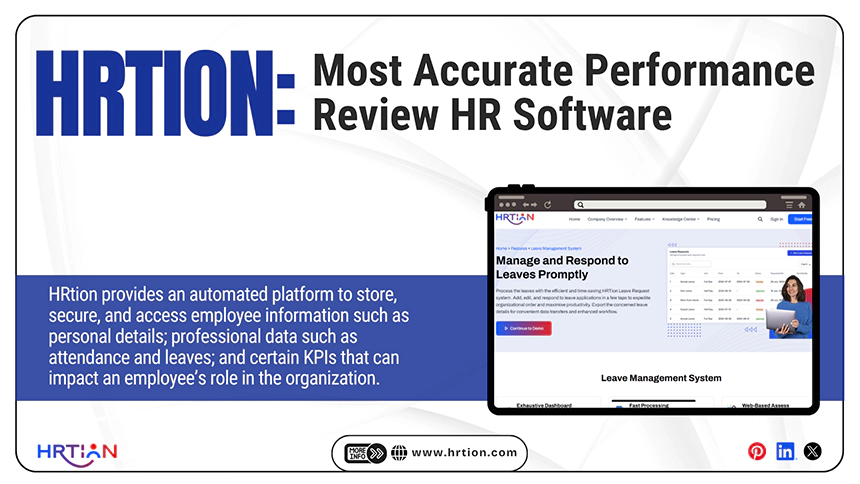
A well-designed performance review template offers a structured approach to employee evaluation. It also ensures fairness, consistency, and professional growth. But the template can not work in isolation or with the scarcity of employee data. This is when HRtion comes into play.
HRtion provides an automated platform to store, secure, and access employee information such as personal details; professional data such as attendance and leaves; and certain KPIs that can impact an employee’s role in the organization.
FAQs
What is a performance review template?
A performance review template is a structured format that is used to evaluate the performance, achievement, skills, and areas for improvement of an employee.
Why are performance review templates important?
The templates ensure smoothness, consistency, reduction in bias, and better growth planning by providing valuable insights that can help in promotions, compensation, and training.
What should be included in a performance review template?
A template must consist of metrics like employee information, goals and objectives, key competencies, areas of improvement, self-assessment, manager feedback, and development plans.
How often should performance reviews be conducted?
It depends on the organization. But most review cycles are monthly, quarterly, biannual, annual, and 90-day reviews.
Sources:

Bhavesh is a Guest Writer at HRTion with an academic background in HR. He did an HR management course in 2025. Before transitioning to HR content writer, he worked as an Academic Content Writer at Trident Management for over 6 years. His expertise in recruitment processes & strategies helps him write detailed and clear content that is not only informative but also accessible for everyone.