
- What is an Employee Handbook?
- Importance of an Employee Handbook
- Difference Between Employee Handbook vs. Company Policy Manual
- What Should Be Included in an Employee Handbook: Important Components
- What to Avoid Adding to an Employee Handbook?
- How to Write an Employee Handbook: Step-By-Step
- Readymade Template for Employee Handbook
- Best Practices to Maintain an Employee Handbook
- HRtion: To Simplify Employee Handbook Management
- Conclusion
- FAQs
Why do countries have constitutions? To establish rules, govern actions, and impose policies, right? This is exactly what an employee handbook does within the organization.
An employee handbook is a formal document that outlines an organization’s policies, employee expectations, workplace practices, company benefits, and procedures.
Note: Though every employee handbook follows a standard set of rules, the legal requirements vary by country, state, industry, workforce size/types, and work category.
This guide explains everything required to create, understand, or update an employee handbook.
What is an Employee Handbook?
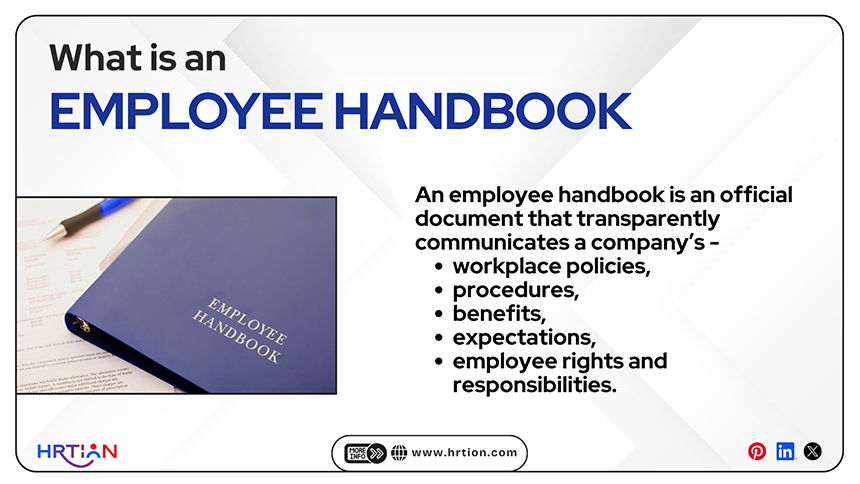
An employee handbook is an official document that transparently communicates a company’s workplace policies, procedures, benefits, expectations, and employee rights and responsibilities. In simple terms, a handbook is a practical guide for employees (and even employers) to refer to throughout their employment, from joining to offboarding.
A handbook can be available as a printed booklet, a digital document, an intranet page, or an HRMS segment.
It usually includes policies regarding:
- Working hours and break timing
- Vacation policies
- Legal guidelines
- Leave and attendance policies
- Behavioral expectations
- Code of conduct
- Benefits and compensations
- Rules related to remote work and company assets
- Resignation and offboarding process
- Acknowledgement form
According to SHRM, an effective employee handbook must be written concisely, making it understandable, legally appropriate, and a mirror of the company’s actual practices.
Most importantly, the handbook for employees should not be copied from another organization. Another SHRM guide reveals that “no two handbooks should be the same because policies must reflect the organization’s real culture, operations, and legal requirements.”
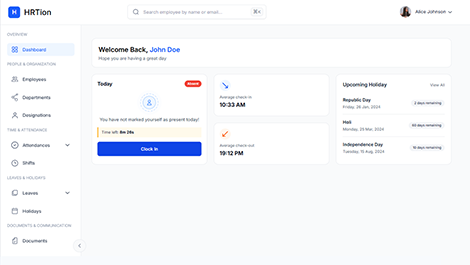
Manage the payroll, attendance, shift roles, and more in an all-encompassing HR suite. Your ultimate HR toolkit is just a click away.
Importance of an Employee Handbook
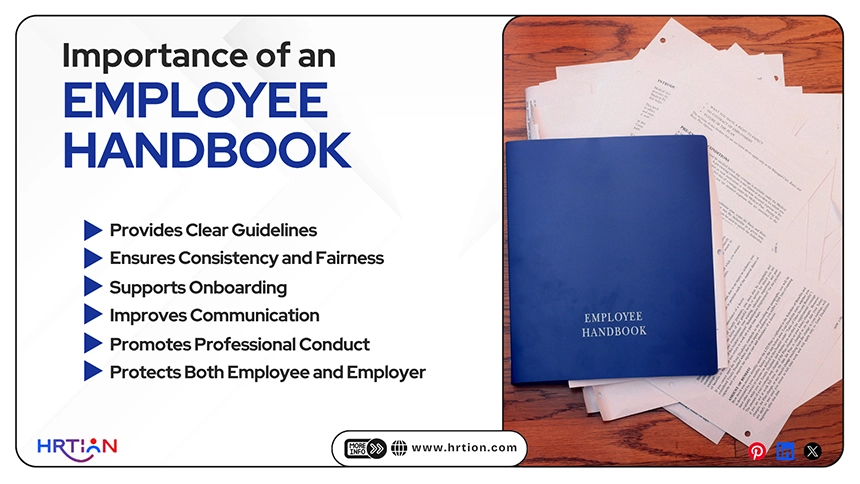
An employee handbook creates an understanding of workplace rules and expectations. So, instead of relying on ad hoc decisions, which can be erroneous, using a centralized document can improve balance and hierarchy.
A well-written handbook for employees is crucial for the following reasons:
- Provides Clear Guidelines: It explains workplace rules, policies, working hours, leave procedures, code of conduct, and other important policies, helping employees to understand what is expected.
- Ensures Consistency and Fairness: A handbook establishes common standards for all employees, promoting fairness in the workplace.
- Supports Onboarding: All new employees can use the handbook to become familiar with the organizational hierarchy, culture, policies, benefits, and procedures. It makes the transition easier.
- Improves Communication: By providing important information in writing, an employee handbook reduces confusion and helps employees find answers to common workplace questions.
- Promotes Professional Conduct: The handbook sets expectations regarding behavior, ethics, attendance, confidentiality, harassment, and discrimination, and promotes health, positive, and respectful culture.
- Protects Both Employee and Employer: Documented policies can clear misunderstandings and provide references whenever a dispute or issue arises. It helps employees understand rights and responsibilities.
Overall, an employee handbook acts as a reference for both employees and management. It encourages clarity, professionalism, communication, and fairness and helps employees stay organized, well-behaved, and productive.
Difference Between Employee Handbook vs. Company Policy Manual
Although both serve as guides, the employee handbook and company policy manual serve different purposes
| Employee Handbook | Company Policy Manual |
| Primarily useful for employees | Used by HR, managers, and employees |
| Explains workplace expectations along with policies | Provides detailed operational policies and procedures |
| Written in a simple and employee-friendly style | Written in formal, detailed, and technical language |
| Elaborates on culture and conduct, leave, attendance, benefits, and expectations | Detailed overview of procedures, compliance rules, and administrative processes |
| Usually shorter in length | Considerably longer and more complex |
| Reflects updated policies and laws | Requires frequent technical updates |
What Should Be Included in an Employee Handbook: Important Components
A 2020 survey by Brightmine (earlier called XpertHR) found that “66% of 619 tested employers considered getting employees to read their employee handbook quite challenging, and maintaining compliance with state law is another major challenge, cited by 62% of business owners.”
So, these challenges can only be overcome by segregating the important components of the employee handbook.
An employee handbook must provide a detailed overview of policies, benefits, workplace standards, and procedures. Not only should it be easy to understand, but it should also be regularly updated and consistent with labor laws.
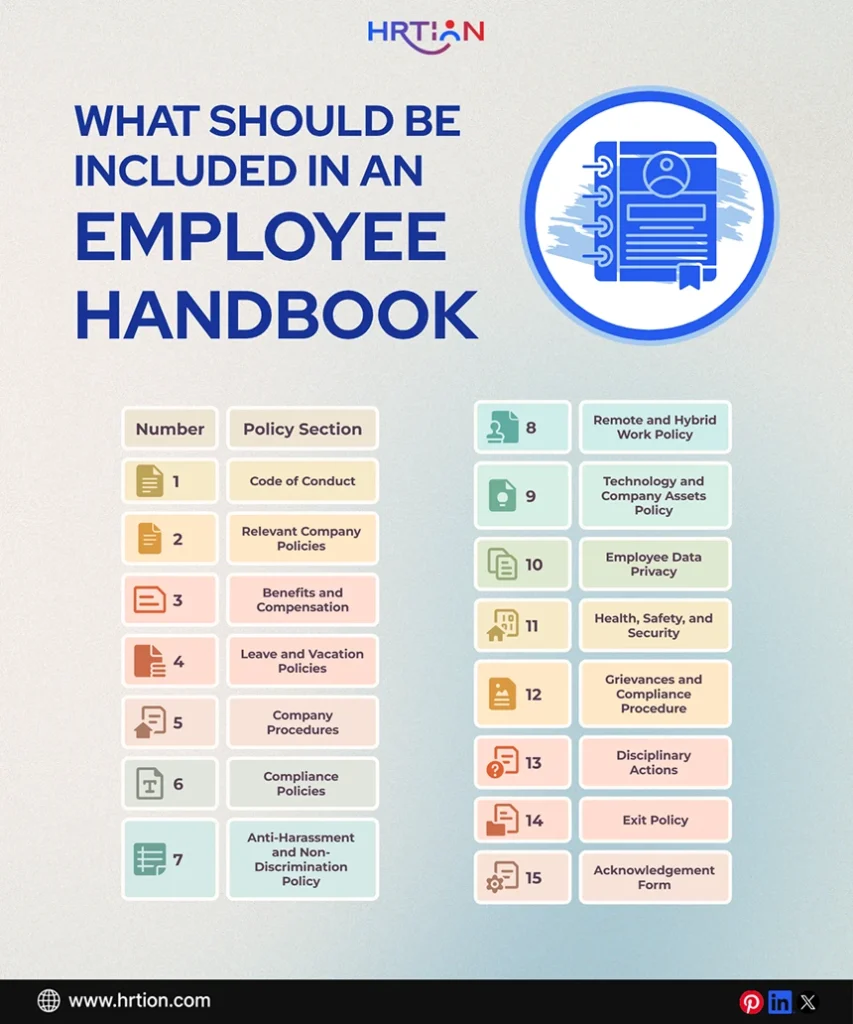
Here are the important key components of an employee handbook:
1. Code of Conduct
A code of conduct implies a standard of behavior expected from an employee. It explains how employees should interact with and treat colleagues, customers, managers, suppliers, and other associated parties. It is important to build a safe and professional working environment; this section must cover:
- Dress code: This totally depends on your business type. Whether you want smart-casual or formal business wear is a subjective choice. The most important factor is fairly handling and respecting all cultures, religions, and individual considerations.
- Cybersecurity: Employees must protect company property such as systems, devices, passwords, and confidential data from breaches or unauthorized access. Therefore, add the necessary guidelines about protecting the crucial information.
- Social media and internet usage: This section must cover how the company’s internet is meant to be used. Also, add directions regarding responsible use of social media, such as avoiding posting confidential or sensitive company information without authorization. Also, personal activities must not interfere with work responsibilities.
- Employee relationship: Guidelines for maintaining professional and respectful relationships with colleagues, seniors, managers, and stakeholders.
- Employment of relatives: Describe the employment rules related to hiring relatives and supervision by relatives. Ensure rules prevent favoritism due to nepotism and conflict of interest.
- Conflicts of interest: The process of identifying, disclosing, and managing personal or financial interests that can create a conflict with the company’s interests.
2. Relevant Company Policies
The handbook must provide complete insights into the organization’s major policies. These policies must be relevant to the workforce, such as the following:
- Attendance and working hours
- Recruitment and employment practices
- Performance management
- Promotion and internal mobility
- Conflict of interest
- Dress code
- Business travel
- Expense reimbursement
- Equal opportunities
- Confidentiality
- Whistleblowing
3. Benefits and Compensation
Employees should be given a clear understanding of the compensation structure regarding benefits. The handbook can describe the approach to the following:
- Salary and wages
- Payroll schedules
- Overtime
- Bonuses
- Incentives
- Performance-related pay
- Insurance and medical benefits
- Provident fund and statutory benefits
- Allowances
- Employee discounts
- Wellness programs
- Learning and development benefits
4. Leave and Vacation Policies
A handbook must explain the types of leave available for all employees and the procedures for applying for leave. It can include:
- Annual or earned leaves
- Sick leave
- Casual leave
- Maternity leave
- Paternity or parental leave
- Bereavement leave
- Public holidays
- Leave without pay
- Medical leave
- Special or emergency leave
The policy must define how employees apply for leave, who approves it, and how long it takes. It should also explain carry-forwarding practices and how unused leave can be handled.
5. Company Procedures
The handbook should explain important procedures that employees need to learn during their employment. These procedures are important to reduce uncertainty and promote consistency for similar situations.
Some examples are:
- Joining and onboarding procedures
- Attendance and time reporting
- Leave application
- Expense claims
- Business travel
- Performance reviews
- Requesting equipment
- Reporting workplace incidents
- Updating personal information
- Resignation procedures
6. Compliance Policies
The compliance policies outline the company’s take and commitment to conduct business ethically, responsibly, and in accordance with the laws, regulations, internal policies, and market standards.
It may consist of:
- Employee responsibility to comply with applicable laws and company policies.
- Following ethical measures
- Prevention of fraud, bribery, corruption, and unethical practices
- Conflict of interest requirements
- Confidentiality of company information
- Obligation to report unethical conduct
- Consequences of non-compliance or policy violations
7. Anti-Harassment and Non-Discrimination Policy
This section must reflect the company’s commitment to maintaining a respectful, inclusive, and discrimination-free workspace for employees of all backgrounds. It must state the company’s diversity hiring policies to ensure an all-inclusive workforce.
The points to include:
- Equal opportunities and non-discrimination principles
- Prohibition of harassment, bullying, discrimination, intimidation, or retaliation.
- Examples of inappropriate behavior
- Types of harassment covered under the policy
- Procedure for reporting complaints
- Investigation and company-resolution process
- Confidentiality and protection against retaliation
- Disciplinary or corrective action for violations.
8. Remote and Hybrid Work Policy
It is used to define the expectations and responsibilities of employees working from home, remotely, or under a hybrid arrangement. The main goal of this policy is to improve productivity, collaboration, communication, and business growth.
These policies consist of:
- Eligibility and approval process for remote or hybrid work
- Working hours and availability expectations
- Attendance, meetings, and communication process
- Performance and productivity expectations
- Requirements for a suitable work environment
- Use and protection of company equipment
- Data privacy and information-security rules
- Rules for working from an unapproved location
- Circumstances under which an arrangement can be modified or withdrawn.
9. Technology and Company Assets Policy
This is important to establish guidelines for the appropriate use, protection, and management of the company’s technology, equipment, systems, and other assets.
Here are the details to enter:
- Acceptable use of laptops, mobile devices, email, the internet, software, and company systems.
- Employee responsibility for company property.
- Password and access control
- Cybersecurity and information-security practices
- Restriction on unauthorized software, applications, or devices
- Use of communication platforms provided by the company
- Reporting lost, stolen, damaged, or compromised assets.
- Return of company property
- Consequences of misuse or unauthorized use of assets
10. Employee Data Privacy
Details of how the company collects, uses, stores, processes, and retains the employee data or personal information. It must include employee responsibilities regarding the protection of confidential data, too.
- Types of employee information collected
- Purpose and manner of processing employee data
- Storage, access, and protection of information
- Employee responsibilities for securing personal data
- Access to employee records, and applicable privacy rights
- Data retention and secure disposal practices
- Reposting of data breaches and privacy incidents
11. Health, Safety, and Security
Mention how the company provides a safe, healthy, and secure workplace and define how employees can help maintain workplace safety.
Write guidelines regarding:
- Workplace health and safety standard
- Employee responsibility for maintaining a safe environment
- Emergency and evacuation procedures
- Fire and other emergency safety guidelines
- Reporting of accidents, injuries, hazards, and unsafe conditions
- Workplace security and access-control requirements
- Prevention and reporting of workplace violence or threats
- Safe use of equipment and workplace facilities
12. Grievances and Compliance Procedure
Employees must understand the process of raising concerns, grievances, policy violations, and compliance-related issues and ensure that concerns are handled fairly and properly.
Adding these points will help:
- Rights to raise a grievance or concern
- Channels to use for reporting or submitting complaints
- Designated person or department for handling complaints
- Procedures for submitting and documenting grievances in the right manner.
- Review and investigation process
- Timeline for providing resolution
- Confidentiality and protection against retaliation
- Escalation or appeal acceleration process
- Communication of outcomes or corrective processes
- Record-keeping of procedures and complaints
13. Disciplinary Actions
The important part of the employee handbook is providing information regarding actions the company may take when an employee violates company policies, employment terms, or applicable laws.
- Clear examples of misconduct and policy violations
- Process of reviewing and investigating alleged misconduct
- Opportunity for the employee to provide an explanation
- Types of disciplinary measures that may be imposed
- Progressive disciplinary action
- Circumstances that can cause serious or immediate action
- Documentation of proceedings
- Appeal or review process
- Consequences of severe or repeated violations
14. Exit Policy
The exit policy offers a properly structured process for employee separation and ensures the smooth transfer of roles, responsibilities, and completion of employment or separation requirements.
To make this process clear, add:
- Resignation and notice-period requirements
- Process for termination and other forms of separations
- Handover of duties, projects, documents, and responsibilities
- Return of company assets
- Withdrawal of the system, email, and facilities
- Clearance and no-dues process
- Final salary, benefits, reimbursements, and other settlements
- Exit interview process
- Issuance of employment separation documents
- Obligations of employees regarding confidentiality, intellectual property, and company information.
15. Acknowledgement Form
The Acknowledgement Form is required to confirm that the employee has properly reviewed and understood the employee handbook and is aware of the written material. He/she complies with the company’s policies and procedures.
Here is a sample of an Employee handbook acknowledgement form:
| EMPLOYEE HANDBOOK ACKNOWLEDGEMENT FORM I acknowledge that I have received access to the company’s Employee Handbook and understand that it contains important policies, procedures, guidelines, and standards applicable to my employment. I Confirm That: ☐ I have received and read the Employee Handbook. ☐ I understand and agree to follow the Company’s policies and procedures. ☐ I understand that I can contact HR if I have any questions or need clarification. ☐ I understand that the Company may update its policies from time to time. ☐ I understand that failure to follow Company policies may result in appropriate action. Employee Details Employee Name: __________________________________ Employee ID: _____________________________________ Designation: ______________________________________ Department: ______________________________________ Date of Joining: ___________________________________ Employee Declaration I confirm that I have read and understood the Employee Handbook and agree to comply with the policies and requirements applicable to my employment. Employee Signature: _______________________________ Date: _____________________________________________ |
What to Avoid Adding to an Employee Handbook?
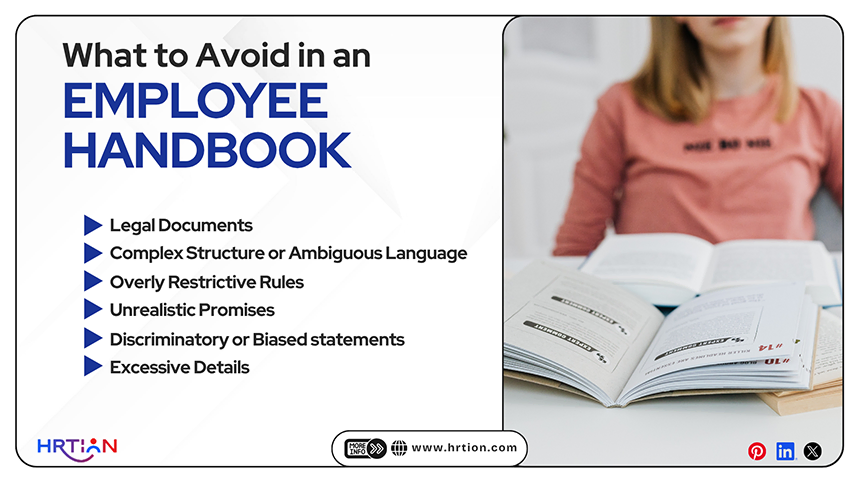
An effective Employee Handbook must be employee-friendly, and thus content that can create confusion, legal risk, or difficulty in reading must be avoided. Never add the following things while creating an employee handbook.
- Legal Documents
The handbook must not replace legal documents like contracts, agreements, or other formal records. Therefore, the handbook should not contain any legally binding terms without appropriate documentation.
- Complex Structure or Ambiguous Language
Policies should be presented in a clear and easy-to-understand manner. Complicated wording, excessive legal jargon, or unclear statements can make the handbook difficult for employees to comprehend.
- Overly Restrictive Rules
Workplace rules must be flexible and reasonable enough to meet the expectations of the modern workforce. Thus, avoid adding unnecessary restrictions that create an extremely rigid work environment and may not suit different or complex workplace situations.
- Unrealistic Promises
Only write the statements that are true and possible. All statements related to benefits, career growth, job security, or workplace initiatives should be realistic and plausible in nature. The employee handbook must not contain expectations that the company is unable to meet.
- Discriminatory or Biased Statements
Policies or any communication platform should support fairness, inclusion, and equal opportunities for people of all kinds. Language that can be discriminatory, biased, or unfair can bring negative attention and attract legal conflicts.
- Excessive Details
Too many details can confuse employees. Therefore, add only essential policies, expectations, and key procedures. Any detail or process that changes frequently can be maintained in a different document other than the employee handbook.
How to Write an Employee Handbook: Step-By-Step
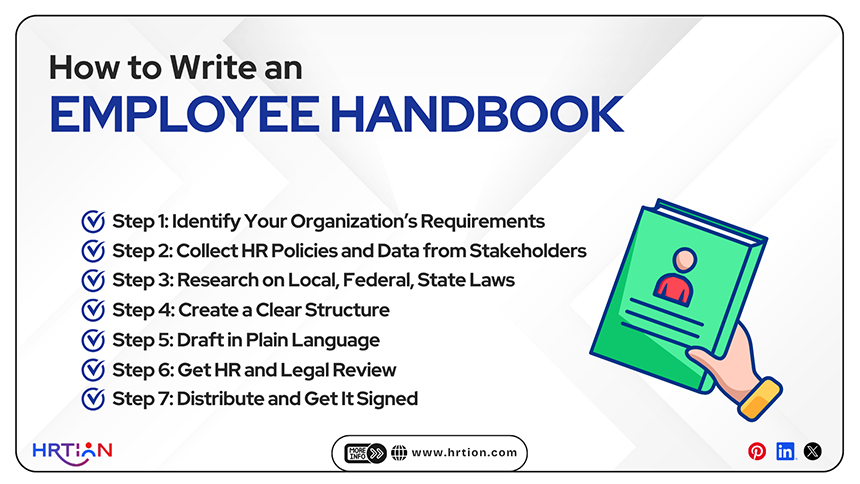
Writing an employee handbook is not about putting company rules and policies into one document, but it reflects the company’s culture, process, approach, and vision. It must be reviewed and verified thoroughly by HR and legal professionals.
Step 1: Identify Your Organization’s Requirements
The organization first analyzes what they are trying to achieve by creating an employee handbook. The data regarding the number of employees, industry, locations, employee categories, remote/hybrid work arrangement, working hours, leave structure, benefits, and applicable employment laws is important to create a customized document for a specific workforce.
Step 2: Collect HR Policies and Data from Stakeholders
Gather existing HR policies, procedures, employee benefits data, and workplace practices from relevant stakeholders such as HR, management, department heads, and responsible team leads.
Accurate information is crucial to creating a handbook that reflects actual operational policies.
Step 3: Research on Local, Federal, and State Laws
Check the employment laws and regulations that are applicable in the region where the organization is situated. This may include national, state, provincial, and local law requirements applicable to specific employee categories.
The employee should be aligned with current legal requirements and updated from time to time with changes in laws.
Step 4: Create a Clear Structure
Organize the handbook into clear and logical sections so that employees can easily find and understand the required information. First, add the general information and then gradually write the complex workplace policies, employee benefits, conduct, compliance, and other procedures.
Use clear headings, subheadings, bullet points, and consistent structure and formatting to make the handbook easy to navigate.
Step 5: Draft in Plain Language
The next step is to form a handbook in simple, professional, and employee-friendly language. Policies should clearly explain the rules, practices, and laws the company follows.
Use shorter paragraphs, clear instructions, and practical examples to make the handbook more helpful. Avoid adding ambiguous statements, complex language, unnecessary details, or technical jargon.
Step 6: Get HR and Legal Review
Before publishing the handbook, make sure to have it reviewed by the concerned departments, such as HR and legal teams. Where HR verifies company policies and practices, the legal department identifies issues related to compliance and applicable laws.
Any changes must be made before making the document public. Even in the survey published on hrdailyadvisor.hci.org, “521 employers reported that 58% of them finalized their employee handbook after getting it reviewed by a lawyer. This practice saved them from future legal conflicts.”
Step 7: Distribute and Get It Signed
Once the employee handbook is reviewed and finalized, the handbook should be made accessible to all employees through the HR portal, intranet, email, or other communication platforms. Employees should be given time to read and understand the policies.
The handbook must end with an acknowledgement section to ensure and confirm that they have received, read, and understood the handbook and agree to comply with organizational rules.
Readymade Template for Employee Handbook
No one size fits all, but the template provided below can act as a structured starting point. The template can be customized according to the organization’s industry, workforce, locations, and applicable laws.
- Welcome and Introduction
- Welcome message
- About the company
- Mission, vision, and values
- Employment policies
- Employment classification
- Probation
- Working arrangements
- Working Hours and Attendance
- Work schedules
- Attendance
- Timekeeping
- Overtime
- Leave and Holidays
- Leave types
- Leave application
- Holidays
- Compensation and Benefits
- Payroll
- Benefits
- Incentives
- Workplace Conduct
- Code of conduct
- Ethics
- Dress code
- Conflict of interest
- Workplace Respect and Anti-Harassment
- Anti-harassment policy
- Complaint process
- Non-retaliation
- Remote and Hybrid Work
- Eligibility
- Work from home rules
- Communication expectations
- Technology and Data Security
- IT resources
- Email and internet
- Passwords
- Social Media
- Data Privacy
- Performance and Career Development
- Performance reviews
- KPIs
- Promotions
- Learning and developments
- Health and Safety
- Workplace safety
- Emergency procedures
- Incident reporting
- Grievance and Disciplinary Procedures
- Formal complaint process
- Disciplinary actions
- Approach to the appeal
- Resignation and Separation
- Notice period
- Exit formalities
- Full and final settlement process
- Employee Acknowledgement
- Policy acceptance form
- Employee signature
- HR contact details
Best Practices to Maintain an Employee Handbook
Creating an employee handbook is one thing, but keeping it updated is what keeps the wheels moving. HR teams must create a system to keep the document accurate and accessible.
- Conduct an annual review of the handbook, making sure that all important legal and organizational changes take place. If required, read some of the successful employee handbook examples to take inspiration from.
- Keep policies consistent with actual practices. Do not include policies that managers do not follow or believe in. Outdated or unnecessary rules can create confusion and affect employee trust.
- Policies must be easy for employees to understand and should avoid adding complex legal terminology.
- Every handbook should include version control details such as version number, effective date, revision date, policy owner, and approval authority.
- Do not make the changes suddenly or upload a new version. Notify all employees about the important changes and explain the need for them.
- Use an electronic management system to maintain the records of employee acknowledgement of handbook distribution.
- A digital handbook should be accessible through all important portals such as HRMS, the employee portal, or the intranet. This will help employees access the latest version whenever needed.
HRtion: To Simplify Employee Handbook Management
HRtion can simplify the process of creating, managing, distributing, and maintaining an Employee Handbook. It acts as a centralized platform to keep all documents and policies accessible and organized.
- Allows storing the Employee Handbook and related policies in one location.
- Employees and HR teams can access the latest version of the handbook anytime.
- Reduces the need for printing copies, as Hrtion enables digital distribution.
- HR professionals can share the handbook and collect digital acknowledgements, making record-keeping easier.
- Whenever a change takes place, HR can inform employees through the portal.
Conclusion
An employee handbook offers an integrated source of information about workplace policies, benefits, rules, procedures, and culture. It is essential for both employees and HR teams to ensure consistent communication, smoother onboarding and exit, improved employee relations, and better policy management.
The most important part is updating the handbook regularly, as it must evolve with the organization, workforce, technology, and legal requirements.
FAQs
What is an employee handbook?
An employee handbook is a document and reference guide for employees that helps explain an organization’s workplace policies, rules, procedures, benefits, expectations, and employee responsibilities in a consistent manner.
Is an employee handbook legally required?
Though there is no single blanket requirement that a business employer must have one specific document labeled as an employee handbook, employers can still be subject to various statutory requirements regarding conditions, wages, social security, workplace safety, and other matters.
What should an employee handbook include?
Some common sections in an employee handbook include company information, employment policies, working hours, attendance, compensation and benefits, code of conduct, anti-harassment policies, leave, data privacy, grievance procedures, technology usage, and performance management.
How often should an employee handbook be updated?
An employee handbook should receive a formal review at least once a year and whenever any significant changes in company policies, employment laws, benefits, technology, or working arrangements occur.
What is the difference between an employee handbook and an HR policy manual?
An employee handbook is generally made as an employee-friendly reference guide that contains key workplace policies and expectations. On the other hand, an HR policy manual is often a much more detailed document that provides more complete and detailed information about administrative procedures, implementation instructions, and compliance information intended primarily for HR and managers.
Can an employee handbook be digital?
Yes. An employee handbook can be distributed in a digital format using employee portals, onboarding platforms, HRMS, or other secure digital systems. Digital handbooks are also generally easier to update and track employee acknowledgements.

Sunita Kumari is a Freelance Contributor Writer at HRTion, writing accurate, reliable, and informative content. She completed her Bachelor's from Rajdhani College of the University of Delhi. She has been a Human Resources Recruiter for almost 2 years, including over 1 year with Battersea Web Expert. Drawing on her recruitment and HR processes experience, she writes clear and practical payroll-related guides that help employees and job candidates better understand HR procedures and workplace practices.