
- How Many Hours is Part time in a Week?
- How Should Employers Define Part-time Hours?
- Part-Time vs. Full-Time Employees
- Advantages and Disadvantages of Part-Time Employees
- Requirements for Hiring Part-Time Employees
- Common Part-Time Shift Schedules
- Examples of Part-Time Work Schedules by Industry
- Best Practices for Managing Part-Time Employees
- Conclusion
- FAQs
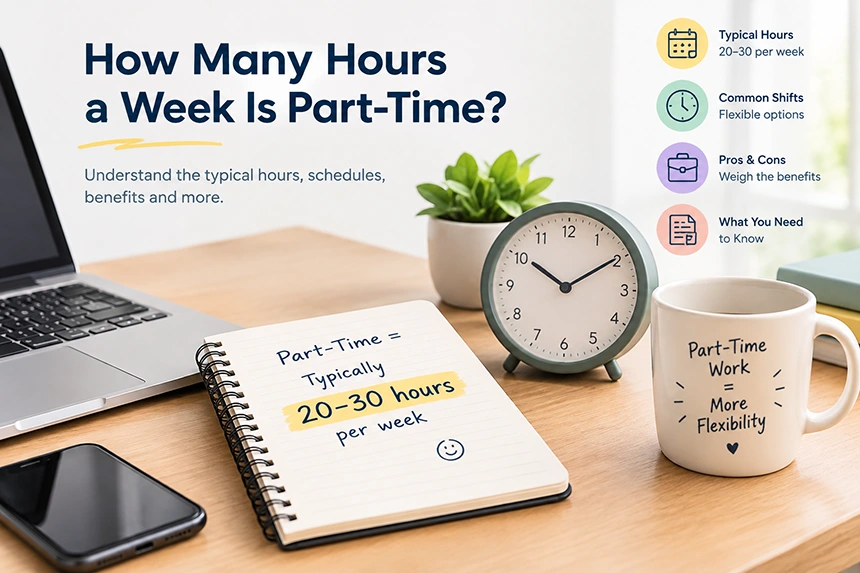
Part-time employment is becoming commonly popular among current workforce because it provides greater flexibility. It is ideal for students balancing work and education, parents managing family responsibilities, and businesses requiring additional staffing at certain intervals.
But one question that confuses many is: how many hours is part-time?
The answer depends on the employer. However, the US Fair Labor Standards Act (FLSA) does not establish a universal definition of part-time employment.
Understanding how many hours is part time helps create fair schedules, manage payroll, and comply with labor laws. Here is the complete guide to help knowing how part-time works and how it is different from full-time employment.
How Many Hours is Part time in a Week?
In the United States, part-time employees usually work fewer than 30-35 hours per week, depending on the employer’s policy. However, no federal rule sets a standard for the number of hours that qualifies as part-time.
The US Bureau of Labor Statistics (BLS) uses a threshold of fewer than 35 usual hours per week to classify workers as part-time for statistical purposes. This definition helps the agency analyze employment trends, but it is not a legal requirement that employers must follow.
Here is a comparison of common weekly schedules:
| Hours per week | Typical interpretation |
| 10–15 hours | Short-hours part-time schedule |
| 20 hours | Common part-time schedule |
| 25 hours | Part-time under many employer policies |
| 30 hours | May be part-time under company policy, but relevant to ACA rules |
| 32 hours | Depends on the employer’s definition and applicable rules |
| 35 hours | May be full-time or part-time, depending on the policy |
| 40 hours | Common full-time schedule, but not a universal legal definition |
How Should Employers Define Part-time Hours?
Employers must establish a clear definition in their employer handbook, offer letter, or a written employment policy. The policy should explain what the expected weekly hours are, whether schedules can vary, how additional shifts are assigned, and how benefit eligibility is determined.
Businesses should also review applicable state and local laws rather than relying on a single nationwide threshold.
Part-Time vs. Full-Time Employees
The main difference between part-time and full-time employees is the number of hours they are scheduled to work every week. However, employment status can also affect scheduling expectations, benefits, and company policies.
| Factor | Part-Time Employees | Full-Time Employees |
| Weekly hours | Mostly fewer than 30-35 hours | Often 35-40 hours |
| Schedule | May work shorter or fewer shifts | May work a regular, longer schedule |
| Pay structure | Hourly or salaried, depending on the role and applicable laws | Hourly or salaried, depending on the role and applicable laws |
| Overtime | May qualify when legal thresholds are met | May qualify when legal thresholds are met |
| Health insurance | Depends on the employer, plan, and applicable laws | If qualified when legal thresholds are met |
| Paid Leave | Depends on applicable laws and employer policy | Based on applicable laws and employer policy |
| Flexibility | Often greater, but not guaranteed | May have more fixed working hours |
Note for Employers: The takeaway is to clearly distinguish job classification, actual hours worked, and legal eligibility.
Advantages and Disadvantages of Part-Time Employees
Part-time employees can help businesses respond to changing workloads while giving managers better control over employee schedules.
Advantages of Part-Time Employment
- Greater Scheduling Flexibility
Part-time schedules let you cover busy periods, evenings, weekends, and seasonal demand without overloading any employee. Thus, people find it easier to combine work with education, caregiving, and other responsibilities.
- Better Coverage During Peak Business Hours
Businesses like retail stores, restaurants, healthcare facilities, and customer service teams experience regular fluctuations in demand. Thus, hiring part-time employees will provide adequate coverage during rush hours without over-staffing quieter periods.
- Access to Broader Talent Pool
Many committed candidates cannot commit to a traditional full-time schedule. Part-time positions can attract students, experienced professionals seeking reduced hours, retirees, and people returning to work.
- Potentially Lower Costs
Employers can align paid working hours with operational needs. However, savings are not automatic: recruitment, training, payroll, and legally required benefits, or leave, can still create costs.
- Opportunities to Evaluate Workforce Needs
Part-time hiring can help businesses handle seasonal demand or test a new position before expanding staffing. But part-time should not be used to avoid wages, overtime, or other legal obligations; it is an unethical practice.
Disadvantages of Part-time Employment
- Less Consistent Employee Availability
Employees who work limited hours may not be available every time they are needed, especially during busy periods. Therefore, employers need to coordinate multiple part-time schedules to maintain proper workflow.
- Higher Coordination and Training Demands
A larger part-time workforce can require onboarding, communication, shift or strategic workforce planning, and supervision, especially when people work on different days.
- Potentially Limited Benefits
Some employer-sponsored benefits may be restricted only to full-time employees. However, employers must comply with applicable legal requirements, and part-time employment doesn’t remove the benefit obligations.
- Employee Retention Challenges
Workers may seek other jobs if their schedule keeps on changing, their hours are unpredictable, and they may not meet their financial needs. Thus, organizations need to follow best employee retention strategies in such cases.
- Risk of Compliance Errors
If part-time employees work more hours than expected, managers may fail to fulfill the overtime obligations or fail to reassess benefit eligibility. Reliable timekeeping and schedule reviews can reduce these risks.
Requirements for Hiring Part-Time Employees
Hiring part-time employees in the United States includes more than deciding how many hours someone should work.
The Fair Labor Standards Act (FLSA) applies to covered part-time employees the same as to covered full-time employees. It offers standards for minimum wages, overtime pay, recordkeeping, and youth employment.
Employers must follow the given factors when creating a part-time policy:
- Set a clear weekly hour range: Establishing a standard number of working hours is the primary need to define a part-time role. Furthermore, the classification must comply with applicable laws.
- Distinguish part-time from full-time employment: Clearly document the difference between these two categories to minimize confusion about work schedules, responsibilities, compensation, and benefits.
- Account for scheduling flexibility: Specify whether hours are fixed, variable, or dependent on business demand. Employees should understand how schedules are assigned and how much notice they can expect when shift changes.
- Review benefits and legal requirements: Avoid assuming that part-time status automatically excludes statutory benefits and overtime protections. Eligibility may depend on the local laws, hours worked, length of service, or other criteria.
- Communicate expectations in writing: Clearly include weekly hours, workdays, scheduling arrangements, overtime procedures, and any relevant benefit eligibility rules in the employee handbook or agreement.
- Review policies regularly: Reassess part-time classifications as business needs, employee schedules, and labor regulations change.
Every employer must establish a proper part-time policy that is transparent, practical, and legally compliant.
Common Part-Time Shift Schedules
Part-time work schedules vary by industry, business demand, employee availability, and the nature of the job. Some employees work a few hours every day, while others complete longer shifts on selected days of the week.
Here are the common part-time scheduling arrangements employers can consider:
| Schedule type | Example | Total weekly hours |
| Short daily shifts | 3 hours × 5 days | 15 |
| Four-day schedule | 5 hours × 4 days | 20 |
| Three-day schedule | 6 hours × 3 days | 18 |
| Weekend schedule | 8 hours Saturday + 8 hours Sunday | 16 |
| Evening shifts | 4 hours × 5 evenings | 20 |
| Flexible schedule | 4, 6, 5, and 5 hours across four days | 20 |
| Extended part-time schedule | 6 hours × 5 days | 30 |
The schedules given above are basic examples; the actual shift lengths and working hours may depend on applicable state and local laws.
Examples of Part-Time Work Schedules by Industry
Different industries use part-time employment to meet customer demand, cover specific operating hours, and maintain flexibility. Here are some of the industry-related examples:
1. Retail and Customer Service
Retail stores often need additional workers during evenings, weekends, holidays, and seasonal periods.
Example: A sales associate works a four- to five-hour shift from Tuesday to Friday, totalling 20 hours per week. Another employee may work two eight-hour weekend shifts to help manage higher customer traffic.
2. Restaurant and Hospitality
Restaurants, hotels, and cafes use part-time employees to cover shifts during breakfast, lunch, dinner, and events.
Example: A restaurant server works four-hour shifts on Thursday, Friday, Saturday, and Sunday, totalling 16 hours per week.
3. Healthcare and Nursing
Clinics, hospitals, and care facilities may offer part-time positions for nursing assistants, administrative staff, medical technicians, and other healthcare workers.
Example: A clinic receptionist works three six-hour shifts per week, totalling 18 hours.
4. Education and Tutoring
Schools, tutoring centers, and educational businesses may employ part-time tutors, classroom assistants, substitute teachers, and administrative staff.
Example: A tutor conducts two-hour sessions from Monday to Friday, working 10 hours per week.
5. Office Administration and Human Resources
Businesses may hire part-time administrative assistants, bookkeepers, recruiters, or HR coordinators when they do not require a full-time role.
Example: An HR assistant works four hours each morning from Monday to Friday, totaling 20 hours per week.
Best Practices for Managing Part-Time Employees
Managing part-time employees effectively requires clear expectations, reliable communication, accurate timekeeping, and fair scheduling practices. Here are a few effective practices to create a better employee experience and stay compliant.
1. Establish a clear part-time employment policy
Define the company’s criteria for part-time status, expected weekly hours, scheduling procedures, availability requirements, and benefits eligibility.
2. Create Schedules in Advance
Whenever possible, publish schedules early enough for employees to plan transportation, childcare, education, or other commitments. Give employees a clear way to report scheduling conflicts and request shift swaps.
3. Use Time and Attendance Software
Digital timekeeping tools like HRtion can record clock-in and clock-out times, calculate weekly totals, flag overtime risks, and simplify payroll preparation.
4. Provide Regular Training and Communication
Part-time employees should receive timely training, safety information, performance expectations, and role-specific guidance needed to perform their job effectively. Do not assume employees working fewer hours need less essential information
5. Offer Fair Access to Opportunities
Where feasible, communicate available shifts, provide training opportunities, and offer advancement paths transparently and fairly.
6. Review Schedules and Employee Feedback
Ask employees whether their schedules are manageable and monitor patterns such as shift swaps, unexpected absences, and unfilled shifts. Use this information to adjust staffing requirements and improve schedules.
7. Keep Accurate Employment Records
Maintain all required information, such as payroll and time records, including actual hours worked, applicable pay rates, overtime earnings, and wages paid. The U.S. Department of Labor provides a complete guide through the FLSA recordkeeping fact sheet.
Conclusion
How many hours is part time? Part-time employment in the United States does not have a universal weekly-hour limit. Many employers use schedules below 30 or 35 hours per week, while the Bureau of Labor Statistics states fewer than 35 hours for statistical purposes. However, FLSA doesn’t define any part-time employment rule.
For employers, the key to running a successful part-time workforce is to set workable schedules, track actual hours, and comply with wage, overtime, recordkeeping, and applicable benefit requirements.
FAQs
How many hours is considered part time in the US?
There is no universal federal definition. Many employers use fewer than 30 or 35 hours per week, while BLS classifies workers working less than 35 hours as part-time employers for statistical purposes.
Is 20 hours a week considered part-time?
Yes, 20 hours per week is commonly treated as part-time. However, employee benefits and legal status depend on applicable laws, company policies, and benefit plans.
Are 30 work hours per week part-time or full-time?
It depends on the context. An employer may classify a 30-hour position as part-time, but 30 hours per week or 130 hours per month is an ACA threshold used to determine full-time status for certain employers’ health coverage requirements.
Do part-time employees qualify for overtime pay?
Yes, part-time employees covered by the FLSA who are non-exempt qualify for overtime pay at no less than 1.5 times their regular rate for hours worked over 40 in a workweek.
What is a typical part-time work schedule?
Common schedules include 15 hours over five short shifts, 24 hours over four or five days, or 24 hours over three eight-hour shifts.

Sunita Kumari is a Freelance Contributor Writer at HRTion, writing accurate, reliable, and informative content. She completed her Bachelor's from Rajdhani College of the University of Delhi. She has been a Human Resources Recruiter for almost 2 years, including over 1 year with Battersea Web Expert. Drawing on her recruitment and HR processes experience, she writes clear and practical payroll-related guides that help employees and job candidates better understand HR procedures and workplace practices.