- What is Strategic Workforce Planning?
- Importance of Strategic Workforce Planning
- Framework or Key Components of Strategic Workforce Planning
- Strategic Workforce Planning Process : 8 Key Steps
- Examples of Strategic Workforce Planning
- Strategic Workforce Planning Tools and Technology
- Key Metrics for Measuring Workforce Planning Success
- Best Practices for Effective Workforce Planning
- Strategic Workforce Planning Checklist
- HRtion: Reliable Companion in Strategic Workforce Planning
- FAQs
Businesses are changing dynamically, and so are the skills, roles, and talent acquisition practices. Organizations are no longer just hiring employees to fill vacancies; instead, they are finding people who can support long-term business goals.
Anticipating future workforce needs, identifying skill gaps, and preparing employees for changing workforce demands are collectively called strategic workforce planning.
Every business must understand its current workforce needs and create a plan that can help it have the right skills at the right time.
This guide explores what is strategic workforce planning, its key components, how to create a SWP, the tools and metrics required, and best practices for successful planning.
What is Strategic Workforce Planning?
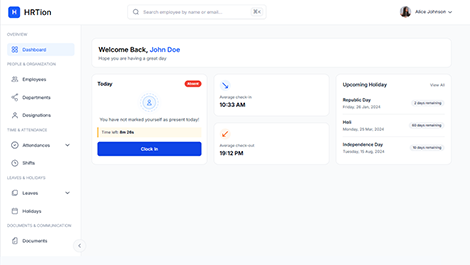
Manage the payroll, attendance, shift roles, and more in an all-encompassing HR suite. Your ultimate HR toolkit is just a click away.
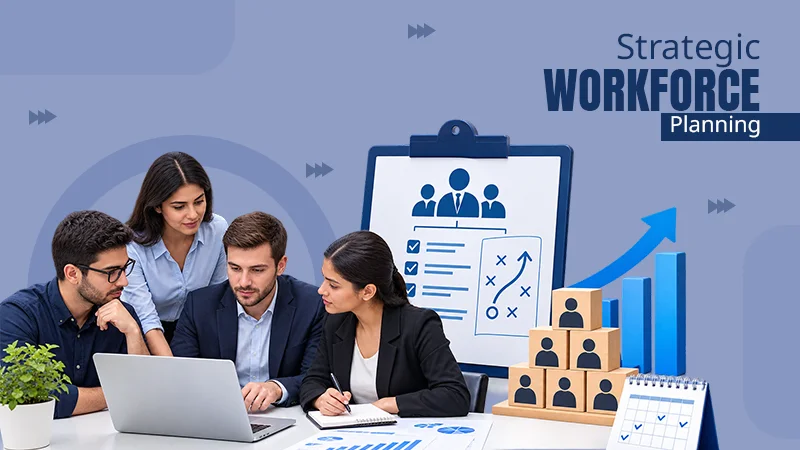
Strategic Workforce Planning (SWP) is the process of analyzing an organization’s current workforce needs and developing a plan based on business goals, market conditions, technology, and expected changes in the job and skills market.
Unlike regular or traditional workforce planning, which mainly focuses on short-term staffing needs, strategic workforce planning takes a longer-term view into consideration.
SWP answers some of the following questions:
- How many employees are required in the company in the near future?
- What skills does the company require the most?
- Which roles are likely to grow or decline?
- Where are the current workforce gaps?
- Can existing employees be trained for the future roles?
- Which positions can be filled through internal hiring?
- How can workforce costs be managed while supporting business growth?
So, by aligning the workforce capabilities with business strategy, SWP enables companies to prepare for the upcoming talent requirements, manage risks, optimize resources, and build a workforce capable of supporting growth over time.
Importance of Strategic Workforce Planning
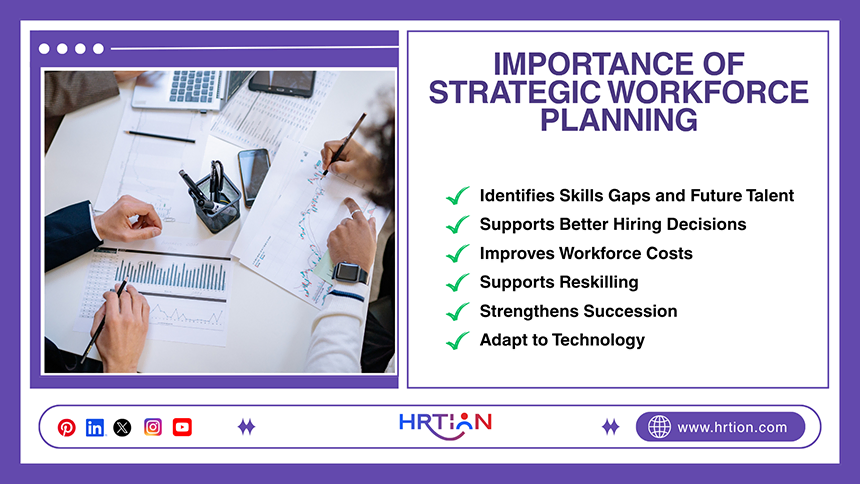
According to the World Economic Forum report 2025, “39% of workers’ existing skill sets are expected to be transformed or become outdated between 2025 and 2030.”
This highlights why companies need to plan for skills and adapt strategic workforce planning to stay future-ready.
1. Helps Companies Prepare for Future Talent Needs
Workforce planning allows HR teams and business leaders to determine the number and type of employees they may need as the business grows or changes.
For example, entering a new market requires sales employees and managers, customer service representatives, or employees with local market knowledge.
2. Identifies Skills Gaps
One of the major benefits of strategic workforce planning is figuring out the difference between the skills an organization requires today and in the future.
Organizations can use this information to decide whether they should hire new employees, provide training, reskill existing workers, or redesign the job pattern.
3. Supports Better Hiring Decisions
Workforce planning helps companies avoid urgent hiring simply because the department demands additional employees.
Instead, it enables making hiring decisions based on projected business requirements, workload, skills requirements, employee turnover, and future growth.
4. Improves Workforce Costs
Every company needs a balance in the number of employees. Too many employees can create unnecessary labor costs, whereas too few employees can create excessive workloads and productivity issues.
Strategic workforce planning helps organizations create the right proportion between workforce capacity and expected business demand.
5. Supports Reskilling and Upskilling
SWP allows identifying employees whose current skills can be developed or polished for future roles
The recent WEF report states that “85% of surveyed employers expect to prioritize workforce upskilling between 2025 and 2030.”
6. Strengthens Succession Planning
Workforce planning is crucial for identifying critical positions and employees who have potential leadership or other special capabilities.
This reduces the dependence on last-minute external hiring when an important employee leaves.
7. Helps Companies Adapt to Technology
New technology like automation, artificial intelligence, and other digital advancements can change job responsibilities and skill requirements.
The WEF found that “60% of employers expect broadening digital access to transform their businesses by 2030, while 86% expect AI and information processing technologies to be transformative.”
Framework or Key Components of Strategic Workforce Planning
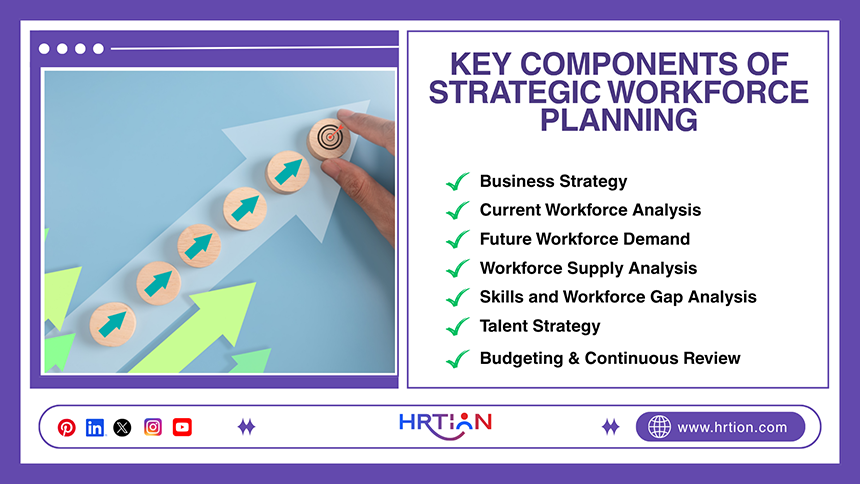
A strategic workforce planning framework consists of several components that connect current and future workforce requirements. Here are the key components of the framework:
1. Business Strategy
Workforce planning should begin with strategy and objectives.
HR teams need to understand the expected growth, new products, expansion plans, technology investments, restructuring, and other strategic priorities.
2. Current Workforce Analysis
This includes considering the existing workforce in terms of employee numbers, roles, skills, experience, performance, age profile, location, and critical positions.
With this analysis, companies can understand their current strengths and areas requiring improvement.
3. Future Workforce Demand
Organizations can identify the type and quality of talent they need in the future. This includes estimating the future staffing levels, critical skills, leadership requirements, and emerging roles, depending on business growth, technological changes, and other related factors.
4. Workforce Supply Analysis
Workforce supply analysis examines whether the required talent is available internally or should be hired externally. It considers different factors like employee turnover, retirements, promotions, internal mobility, talent availability, and market conditions.
5. Skills and Workforce Gap Analysis
The organization compares current and projected workforce supply with the future requirements. This is a meaningful approach to evaluate the need for employee strength, capabilities, leadership, and critical roles. Both current and potential gaps should be considered.
6. Talent Strategy
After identifying the gaps, the company can determine how to address those. Some common ways are
- Hiring
- Upskilling
- Reskilling
- Internal mobility
- Succession planning
- Outsourcing
- Automation
- Temporary or contract workers
7. Workforce Budgeting
Workforce plans must consider monetary matters like compensation, recruitment costs, training budgets, benefits, technology investments, and other related expenses.
8. Continuous Review
Clear governance and regular review help ensure that workforce planning remains effective for longer periods. It also helps adjust workforce strategies as business needs and conditions change.
Strategic Workforce Planning Process : 8 Key Steps
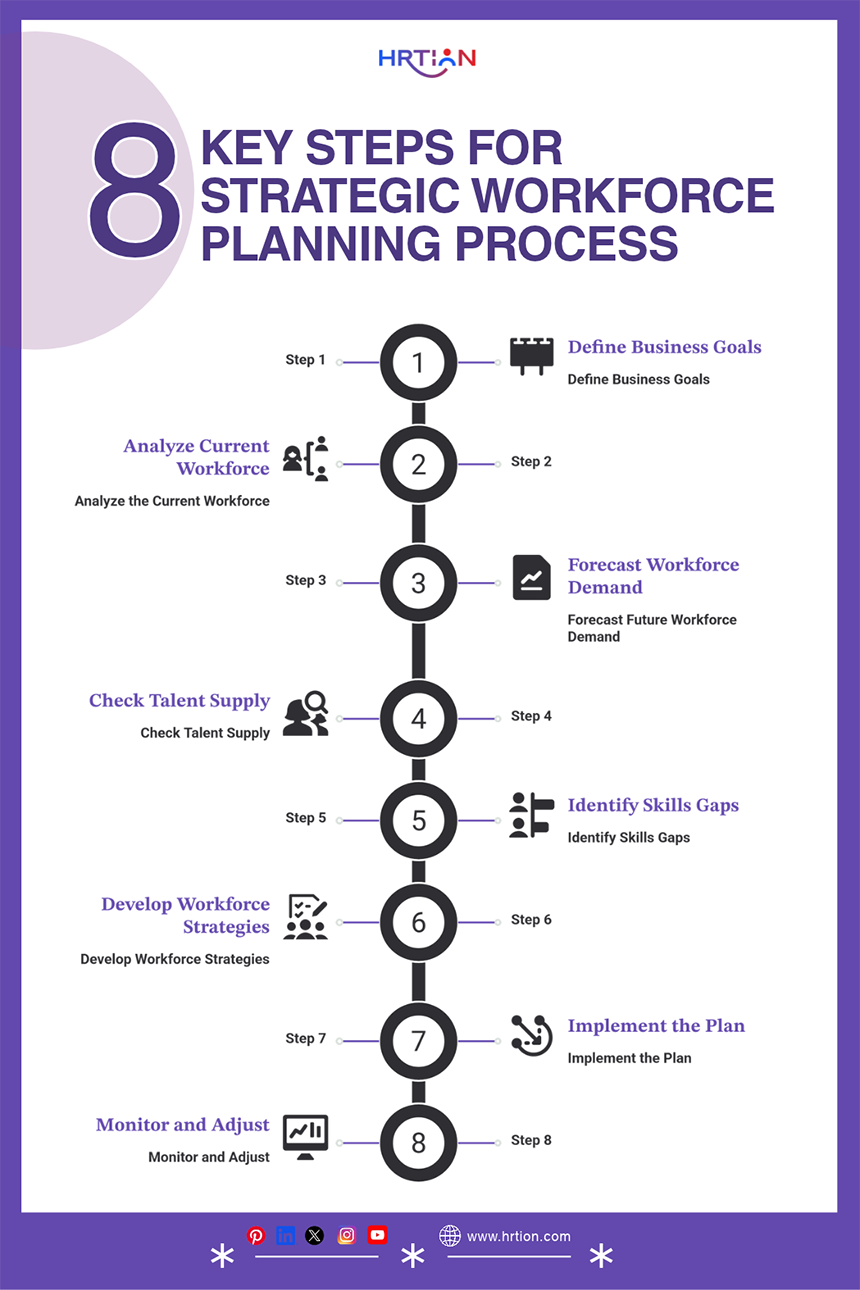
A strategic workforce planning process consists of several stages. Here are the steps involved:
Step 1: Define Business Goals
Start by analyzing where your organization wants to go.
Business leaders and HR teams should identify goals such as growth, ROI, expansion, digital transformation, cost reduction, new product development, or entering a new market.
Step 2: Analyze the Current Workforce
Collect workforce-related data that plays an important role in understanding the current talent positions.
Some essential data includes headcount, skills, turnover, performance, compensation, critical roles, and employee demographics.
Step 3: Forecast Future Workforce Demand
Estimate the number of employees and skills that are needed in the company in the next one, three, or five years.
This will help develop strategies for rapid growth, moderate growth, and slower business conditions.
Step 4: Check Talent Supply
Check whether current employees and the external labor market can provide the required talent.
This step is quite essential for managing internal promotions, employee turnover, retirements, talent availability, and recruitment challenges.
Step 5: Identify Skills Gaps
Compare the future demand with the current as well as expected workforce supply.
The result can reveal shortages in employee numbers, demanded skills, leadership capabilities, or critical roles.
Step 6: Develop Workforce Strategies
Create strategies to close the identified gaps.
For example, an organization might require cybersecurity specialists while optimizing the skills of existing IT employees.
Step 7: Implement the Plan
Assign responsibilities, budgets, timelines, and measurable outcomes.
Workforce planning should become part of regular HR and business planning instead of being a one-time thing.
Step 8: Monitor and Adjust
Workforce requirements can change over time. Thus, a company must review data and plans regularly to keep pace with labor market conditions.
Examples of Strategic Workforce Planning
Some common examples of strategic workforce planning in the current market are the following:
1. Adopting New Technology
Introducing new technologies can change the skills employees need to perform their roles efficiently. Organizations can use strategic workforce planning to identify which employees need training, what new skills are required, and how to incorporate technology into already existing roles.
2. Managing Employee Retirement
When experienced employees are approaching retirement, companies need to be prepared for the loss of their knowledge and expertise.
Workforce planning helps identify potential replacements, develop future leaders, and establish robust knowledge-transfer programs so that critical responsibilities can continue smoothly.
3. Seasonal Workforce Planning
Some businesses experience a sudden surge in demand during a particular period. A few examples of this are retail stores that require more employees during festive and holiday seasons.
This is when SWP helps businesses arrange temporary and part-time employees in advance.
4. Reducing Employee Turnover
High employee turnover can create staffing shortages and increase recruitment and training costs. Organizations can use workforce planning to identify positions with high turnover, understand future staffing requirements, and introduce improvement measures like career development, training, and better employee benefits.
Strategic Workforce Planning Tools and Technology
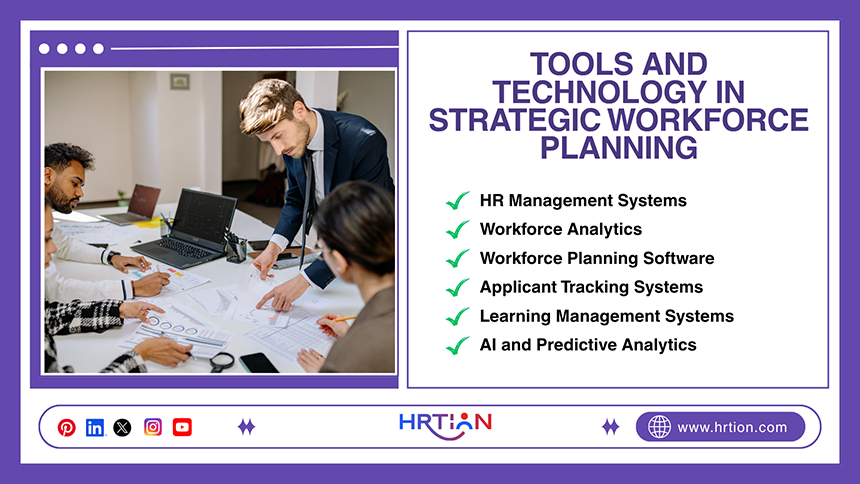
A few useful tools and technologies can help make strategic workforce planning easier and more effective.
1. Human Resources Management Systems
An HRMS or HCM platform can centralize employee information such as job roles, skills, attendance, compensation, performance, and organizational structure.
2. Workforce Analytics
Workforce analytics tools help the HR team analyze employee trends and identify patterns in areas such as
- Turnover
- Absenteeism
- Hiring
- Workforce costs
- Skills
- Productivity
- Employee demographics
3. Workforce Planning Software
Dedicated workforce planning platforms can support headcount forecasting, scenario planning, budgeting, and workforce analysis.
4. Applicant Tracking Systems
An Applicant Tracking System can help organizations manage the recruitment process and identify whether external hiring can fix the workforce gaps.
5. Learning Management Systems
An LMS can support reskilling and upskilling candidates and help the company deliver and track employee training programs.
6. AI and Predictive Analytics
AI-powered analytics can help identify workforce trends and support scenario planning. However, the organization must review data quality, privacy, transparency, and potential bias when using AI.
Key Metrics for Measuring Workforce Planning Success
To measure the success of SWP, there are a few KPIs and PPIs that can be extremely useful. Here are the metrics that the company must track regularly:
| Metric | How Is It Helpful |
| Headcount forecast accuracy | How the actual headcount matches workforce forecast trends |
| Time to fill | How long it takes to fill open positions |
| Employee turnover rate | The percentage of employees leaving the organization |
| Critical-role vacancy rate | Unfilled positions that are important to business operations |
| Skills gap closure rate | Progress in addressing identified skills shortages |
| Internal mobility rate | How frequently employees move into new internal roles |
| Succession readiness | Availability of potential successors for critical roles |
| Training completion rate | Employee participation in planned development programs |
| Cost per hire | Average cost of recruiting a new employee |
| Workforce cost as a percentage of revenue | Relationship between workforce spending and business revenue |
| Employee productivity | Output or business results relative to workforce capacity |
Best Practices for Effective Workforce Planning
Here are a few workforce planning techniques that can ensure the success and effectiveness of strategic workforce planning and achieve long-term organizational growth.
- HR should work closely with business leaders to understand the future organizational priorities.
- It is essential to focus on skills and not just headcount. Knowing that the company needs 100 additional employees is not useful without knowing which skills are needed.
- Create different workforce scenarios based on possible conditions. This makes the plan more feasible when the assumptions become certainties.
- Try to combine hiring with internal development. It is not always necessary to solve the workforce gaps through external hiring. Existing employees may be trained to fill the new positions.
- Use reliable workforce data for meaningful workforce forecasting. Accurate data on employee skills, turnover, and cost data can help make more accurate decisions.
- Involve business leaders in strategic workforce planning. HR, finance, operations, and senior leadership must be included in the process.
- Prepare your workforce for future skills. Organizations should consider how emerging technologies can affect their roles and skills requirements and prepare accordingly.
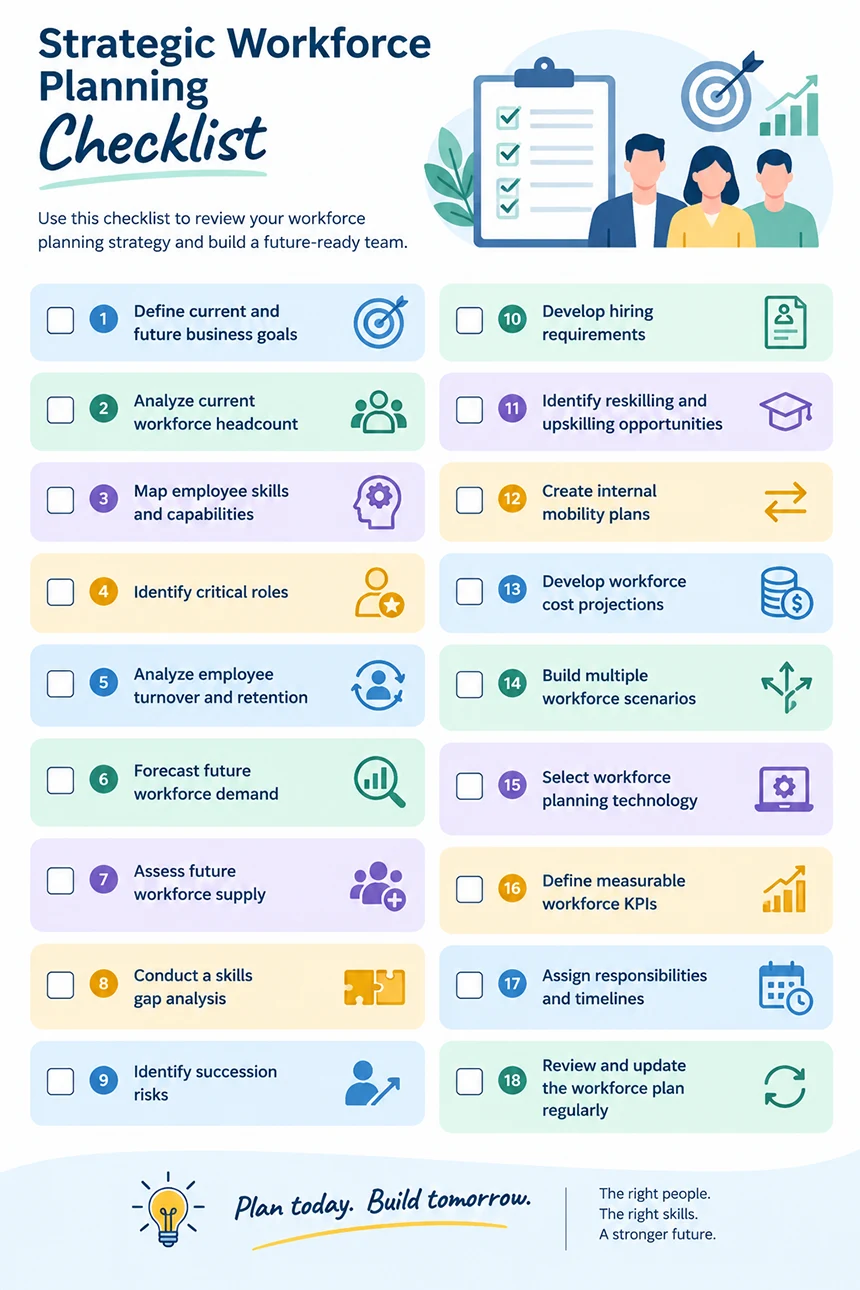
Strategic Workforce Planning Checklist
HRtion: Reliable Companion in Strategic Workforce Planning
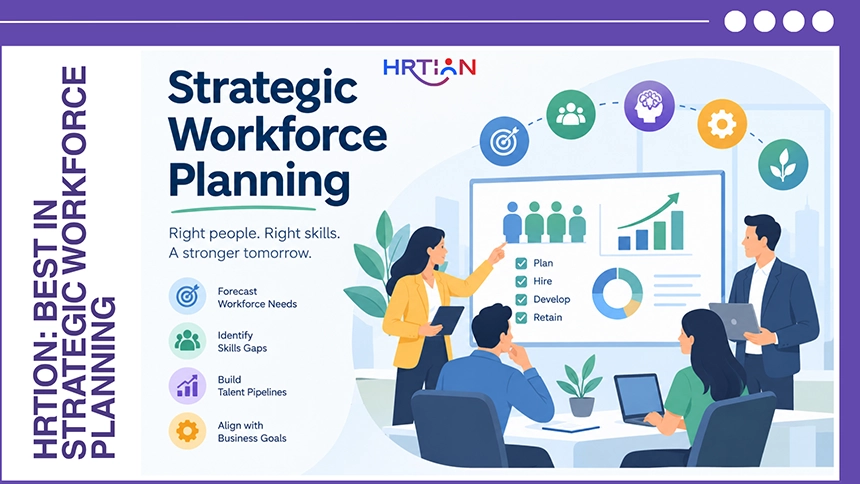
Strategic workforce planning becomes easier when HR teams have access to correct employee data, real-time insights, and workforce analytics. HRtion supports companies by offering a centralized platform to access all workforce information and make more informed decisions.
HRTion can help organizations maintain accurate employee records, track attendance, manage leave, streamline payroll processes, and track other important information.
The robust tool can complement different workforce planning strategies such as:
- Workforce data management
- Attendance and workforce tracking
- Leave management
- Payroll management
- Employee self-service
- HR automation
- Employee analytics
FAQs
What is strategic workforce planning?
Strategic workforce planning can be defined as the process of predicting and forecasting an organization’s future workforce requirements and ensuring there are plans and strategies in place to achieve business goals with the right number of employees.
What are the main components of strategic workforce planning?
The main components involve business strategy alignment, workforce supply analysis, skills gap analysis, current workforce analysis, workforce demand forecasting, talent planning, succession planning, workforce budgeting, and ongoing monitoring.
Why is strategic workforce planning important?
Strategic workforce planning allows organizations to anticipate future talent needs, control workforce costs, improve their hiring decisions and methods, support employee development, identify skill gaps, and prepare for any changes in technology and business conditions.
What is the difference between workforce planning and strategic workforce planning?
Traditionally, workforce planning used to be focused on short-term staffing and headcount requirements. This has since been improved and turned into strategic workforce planning, which takes a much broader, longer-term approach by connecting workforce requirements with future skills, business strategy, technology, and market changes.
How often should strategic workforce planning be done?
Businesses should prioritize and conduct a detailed workforce planning exercise at least annually, making sure to review important workforce assumptions more frequently when business conditions or workforce requirements change.

Bhavesh is a Guest Writer at HRTion with an academic background in HR. He did an HR management course in 2025. Before transitioning to HR content writer, he worked as an Academic Content Writer at Trident Management for over 6 years. His expertise in recruitment processes & strategies helps him write detailed and clear content that is not only informative but also accessible for everyone.