

- What is a Registered Employment Agreement (REA)
- Key Legal Features of a Registered Employment Agreement
- Benefits of a Registered Employment Agreement (REA)
- What Does a Registered Employment Agreement Include?
- Eligibility Requirements for a Registered Employment Agreement
- Documents Required For Registering an Employment Agreement
- Forms of Registered Employment Agreements
- Registered Agreement vs. Enterprise Agreement vs. CBA vs. Employment Contract
- How Collective Bargaining Agreements Work in the United States
- Mistakes to Avoid while Forming Registered Employment Agreements
- Best Practices for Forming Registered Employment Agreements
- Conclusion
- FAQs
A Registered Employment Agreement (REA) is a legal agreement between employers and trade unions. It sets minimum pay and other working conditions for certain groups of workers. This agreement is registered under the labor court, making it legally binding for employers and workers.
The main purpose of REA is to establish a protected environment to ensure fair wages, reasonable working conditions, and clear employment rules and standards.
This guide explains the features, benefits, requirements, legal implications, mistakes to avoid, and best practices for forming an REA for your company.
What is a Registered Employment Agreement (REA)
A Registered Employee Agreement is a legal agreement that sets rules like minimum wage and conditions applicable to employers in a specific industry or type of job. The agreement is officially approved by the labor court and registered to make it effective. Once registered, every employer and employee covered by it needs to adhere to the rules religiously.
The difference between a regular employment contract and REA is significant. A regular employment contract applies only to one employer and one employee. REA applies to everyone working in the industry or occupation covered by the agreement.
REA was first introduced under the Industrial Relations Act to ensure that all employees receive fair and consistent working conditions. It covers basic things, like the following:
- Minimum pay
- Working hours
- Overtime rates
- Annual leave
- Sick leave
- Other benefits and workplace conditions
Quick Facts about REA
| Feature | Details |
| Purpose | Standardize employment conditions |
| Legally binding | Yes |
| Applicable | Specific industries or occupations |
| Registration required | Yes |
| Individual negotiations | Limited |
| Coverage | Wages, leave, overtime, hours, dispute resolution |
Note: The term “registered employment agreement” is used differently depending on the country. In Ireland, it refers specifically to the REA framework described below. In Australia, the closer equivalent is an Enterprise Agreement approved by the Fair Work Commission. In the United States, the nearest equivalents are Collective Bargaining Agreements (CBAs) and Project Labor Agreements. This guide covers all of these, with a focus on how each operates.
Key Legal Features of a Registered Employment Agreement
The Registered Employment Agreement (REA) contains several distinguishing factors, making it different from other employment contracts. Check the below-given legal aspects of REA.
- Legally Enforceable
This employment contract is legally binding, as every covered employer must comply with the rules and provisions. If not followed, the failure can lead to legal action, financial penalties, and other labor disputes.
- Industry-Wide Coverage
Unlike individual contracts, REAs are applied to the entire industry instead of just one organization. For example, if REA covers construction workers, every eligible employer in that industry needs to comply with the agreed employment conditions.
- Minimum Employment Standards
The REA establishes minimum rules and standards for:
- Basic pay
- Working hour
- Overtime compensation
- Paid leave
- Sick leave
- Rest periods
- Holiday entitlements
Employers under REA can offer better conditions but cannot provide less than the minimum requirements mentioned in agreements.
- Registration Under Labor Authorities
The agreement can only be legally enforced when approved and registered by the appropriate employment authority. This registration is crucial for transparency and legality.
- Employee Protection
Employees covered under REA can enjoy better and more favorable workplace protections because employers cannot reduce wages and remove agreed-upon benefits.
- Fair Competition Among Employers
Without standardized employment conditions, the competition can lead employers to lower wages or reduce employee benefits. This will exploit employees and harm them professionally.
An REA sets a level requiring all employers to meet the same standards.
- Fair and Collective Negotiations
REAs are mainly negotiated between:
- Employer organizations
- Trade unions
- Worker representative
This collective process ensures that both employers and employees agree on the same interests.
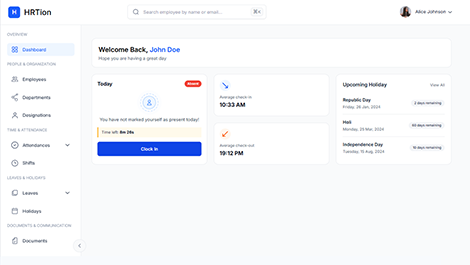
Manage the payroll, attendance, shift roles, and more in an all-encompassing HR suite. Your ultimate HR toolkit is just a click away.
Benefits of a Registered Employment Agreement (REA)
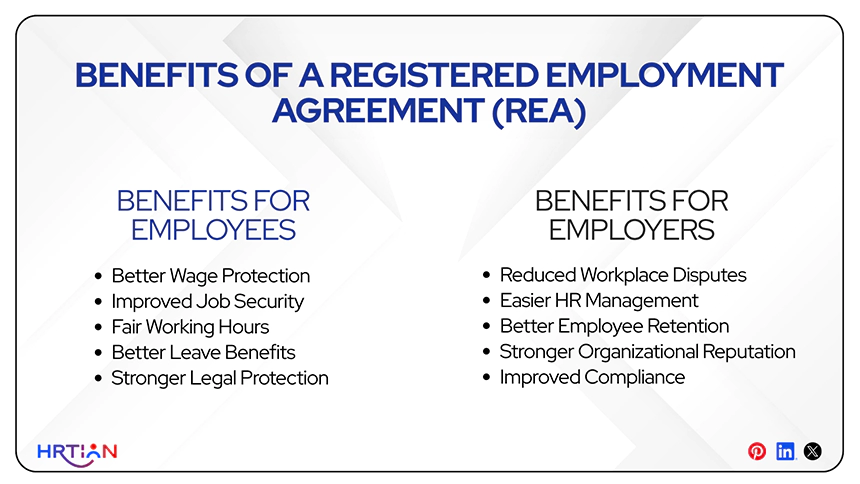
A registered employment agreement provides advantages for both employees and employers, and even the variables in the economy.
Benefits for Employees
- Better Wage Protection
Employees receive guaranteed minimum wages under REA because of the collective negotiations rather than a single employee deciding it.
- Improved Job Security
It defines employment terms clearly and reduces the uncertainty regarding compensation, working hours, and termination.
- Fair Working Hours
Most REAs specify the following to ensure employees work in better conditions.
- Maximum working hours
- Break periods
- Overtime compensation
- Weekly rest days
This helps promote work-life balance and reduce excessive working hours.
- Better Leave Benefits
Employees often receive defined and well-structured entitlements for:
- Annual leave
- Public holidays
- Sick leave
- Family leave
- Maternity or parental leave
- Stronger Legal Protection
If an employer doesn’t follow or violates the agreement, employees generally have legal remedies to resort to. This is handled through labor authorities and employment tribunals.
Benefits for Employers
- Reduced Workplace Disputes
With REA, everything is documented to control the misunderstandings between employers and employees. The recent research of Society for Human Resource Management (SHRM) reveals that clearly documented work policies contribute to improved employee relations and fewer HR dispute.
- Easier HR Management
With standardized employment terms, these factors become easier and more efficient.
- Payroll processing
- Leave management
- Compliance monitoring
- Employee onboarding
- Better Employee Retention
Employees who clearly understand their rights and compensation are usually more satisfied and likely to stay longer.
- Stronger Organizational Reputation
Organizations that follow fair employment practices often attract higher-quality candidates and build greater trust among employees.
- Improved Compliance
With standardized agreements, employers can maintain legal compliance with applicable labor laws, reducing the risk of costly legal disputes. Employers can further reduce compliance risk by following established payroll compliance best practices alongside REA requirements.
What Does a Registered Employment Agreement Include?
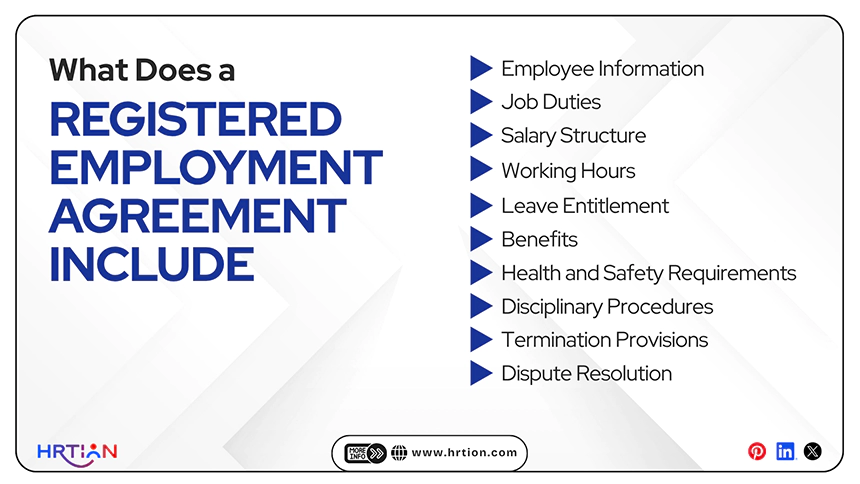
Though every agreement varies by industry, there are a few major components that remain static in every agreement. Some common ones are
- Employee Information
The agreement contains all necessary identification details, such as:
- Employee name
- Employer details
- Job title
- Department
- Employment status
- Job Duties
The next important element that must be defined in an REA is job duties of the group of employees it is designed for:
- Responsibilities
- Performance execution
- Reporting structure
- Workplace location
- Salary Structure
Compensation is a crucial element for a well-defined REA. This ensures transparency in wages. The salary details that must be included in the agreements are:
- Base salary
- Hourly wage
- Overtime rates
- Bonuses
- Payment date or frequency
- Working Hours
Fair working conditions are one of the major goals of an REA; thus, it must contain details like
- Weekly working hours
- Shift schedules
- Rest breaks
- Overtime eligibility
- Weekend work provisions
- Leave Entitlement
What employers are promising to the people working in their industry is necessary to mention while drafting the employee agreement.
- Annual leave
- Paid holidays
- Sick leave
- Bereavement leave
- Family leave
- Parental leave
- Benefits
Common employee benefits consist of:
- Health insurance
- Pension contribution
- Travel allowance
- Meal allowance
- Training opportunities
- Wellness programs
- Health and Safety Requirements
Employers are bound to provide secure working conditions. This is why they must enter these details:
- Safe working conditions
- Protective equipment
- Safety training
- Emergency procedures
These provisions reduce workplace accidents and promote employee well-being.
- Disciplinary Procedures
Having clear disciplinary procedures ensures fairness and transparency. The agreement outlines how employers will handle the following:
- Misconduct
- Performance concerns
- Investigations
- Appeals
- Corrective actions
- Termination Provisions
The Registered Employment Agreements must specify the conditions of employment termination. It must elaborate:
- Notice periods
- Grounds for termination
- Final wage payments
- Severance obligations
- Return of company property
- Dispute Resolution
The resolution mechanism helps resolve disputes efficiently while reducing the need for complex litigation. So, to deal with disagreements, REA must establish the following:
- Internal grievance processes
- Mediation
- Arbitration
- Labor tribunal referrals
Eligibility Requirements for a Registered Employment Agreement
A Registered Employment Agreement (REA) is designed through negotiations between representatives of employee and employer groups. They together establish minimum employment standards for a particular industry, occupation, or group of workers.
Before making the REA legally binding, the terms of the agreement cover all employers and employees within the industries or occupations covered by the agreement, regardless of their presence in the negotiations.
Here are the eligibility terms for a Registered Employment Agreement
- Employer and Employee Representation: The agreement must be drafted and negotiated in the presence of representatives of employers and employees, such as trade unions.
- Industry-wide coverage: the agreement must relate to a specific occupation, industry, or group of workers sharing similar working conditions.
- Mutual agreement: Both employer and employee representatives must agree on the employment terms before making the registration.
- Legal registration: The completed agreement must be reviewed and registered under an appropriate labor authority to become legally binding.
- Compliance with employment law: The agreement cannot provide terms that do not align with the minimum standards set by applicable employment laws.
Documents Required For Registering an Employment Agreement
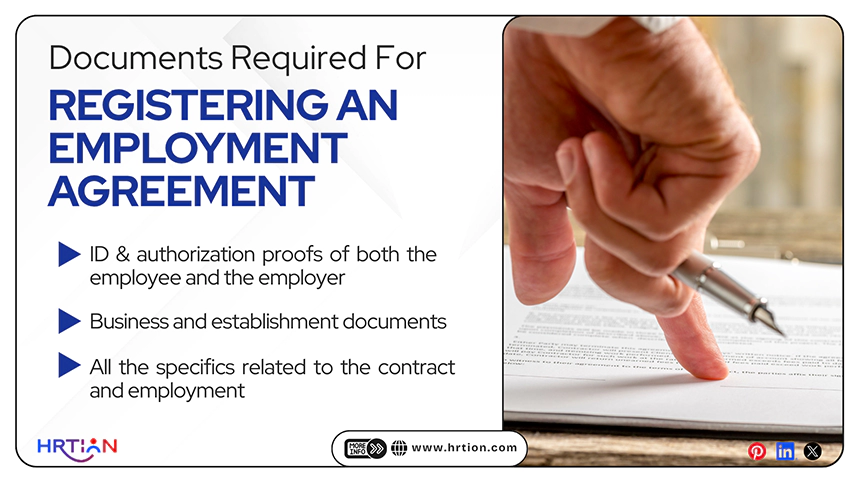
Though the exact documentation varies on the basis of jurisdiction and industry type, a registered employment agreement commonly requires these documents.
- Identification & authorization proofs of both the employee and the employer.
- Business and establishment documents that clearly present a registered business address
- All the specifics related to the contract and employment, such as job title, compensation structure (basic pay), working hours, probation, and confidentiality obligations.
Forms of Registered Employment Agreements
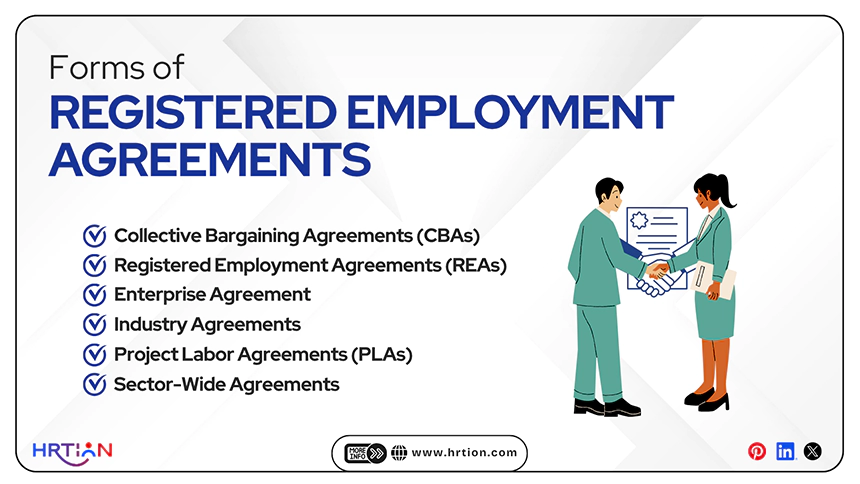
There are different frameworks for registered employment agreements for different countries, but the goal remains the same: creating binding employment standards to ensure optimum working conditions for workers.
These are common forms of Registered Employment Agreements used worldwide.
- Collective Bargaining Agreements (CBAs): This is the most common form of agreement used in the United States. It defines wages, benefits, working hours, and other employment conditions. The National Labor Relations Board (NLRB) oversees union representation and bargaining rights.
- Registered Employment Agreements (REAs): Mainly used in Ireland, REAs focus on minimum pay rates and employment conditions for workers in specific industries. Once approved and registered, they apply to all employers and employees covered by the agreement.
- Enterprise Agreement: Used in Australia, these agreements are negotiated at the workplace level between employers and employees. The Fair Work Commission approves it.
- Industry Agreements: These agreements set the common employment standards for all employers and employees within a particular trade or industry, ensuring consistency across the sector.
- Project Labor Agreements (PLAs): These contracts are mainly used in large construction projects, mainly public infrastructure projects in the United States. PLAs set employment terms and apply during a specific project only.
- Sector-Wide Agreements: These agreements establish minimum wages and working conditions across all economic sectors instead of a single company. This reduces the difference in employment standards.
Among all these, Collective Bargaining Agreements (CBAs) are used in the United States. It provides legally negotiated employment terms for all workers represented by certified labor unions.
Registered Agreement vs. Enterprise Agreement vs. CBA vs. Employment Contract
| Type | Country | Approving/Registering Body | Scope | Legally Binding |
| Registered Employment Agreement (REA) | Ireland | Labour Court / Workplace Relations Commission | Specific industry or occupation | Yes (subject to 2015 framework) |
| Sectoral Employment Order (SEO) | Ireland | Labour Court | Specific sector | Yes |
| Enterprise Agreement | Australia | Fair Work Commission | Single workplace/employer | Yes |
| Award | Australia | Fair Work Commission | Industry-wide, sets minimum baseline | Yes |
| Collective Bargaining Agreement (CBA) | United States | Negotiated with NLRB oversight | Union-represented workforce | Yes |
| Project Labor Agreement (PLA) | United States | Negotiated per project | Single construction project | Yes |
| Individual Employment Contract | Any | Not registered with a labor authority | Single employer–employee relationship | Yes |
How Collective Bargaining Agreements Work in the United States
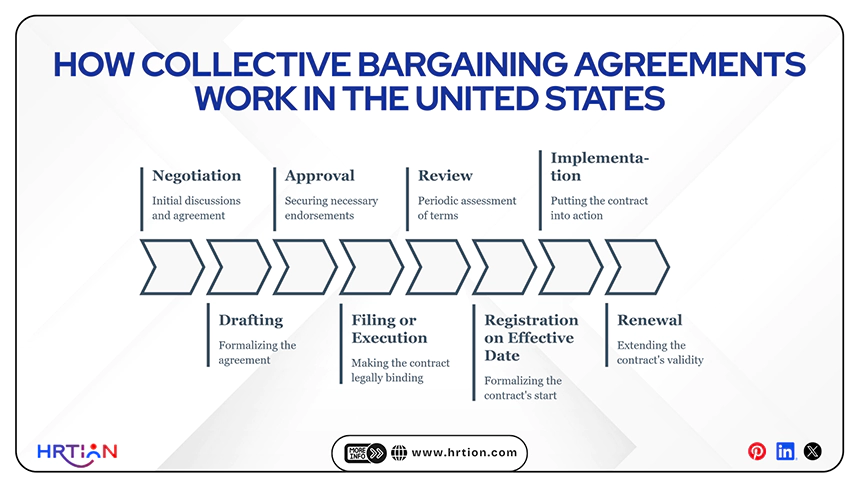
- Negotiation: First, employers, unions, and worker representatives must make the required negotiations with mutual understanding.
- Drafting: Once both employee and employer representatives agree on common grounds, the agreement is written in a formal contract format.
- Approval: Then, both parties review and approve the mentioned points. It is subject to a ratification vote by union members.
- Filing or Execution: After the negotiations are completed, the agreed terms are recorded in the Collective Bargaining Agreement (CBA). The agreement becomes legally binding on the employer and all employees within the bargaining unit.
- Review: Where the agreement is applied, the relevant authorities ensure its compliance with legal and employment standards.
- Registration on Effective Date: The agreement then becomes officially binding to ensure that all eligible employees receive the rights and benefits mentioned under the agreement.
- Implementation: The employers apply the contract to the covered employees.
- Renewal: The agreement is reviewed, amended, and negotiated with new terms before renewing, replacing, or extending the agreement.
Mistakes to Avoid while Forming Registered Employment Agreements
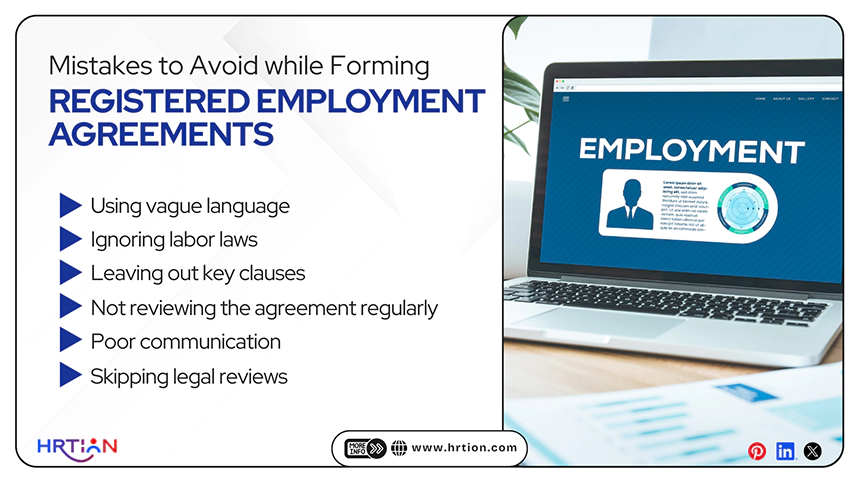
When drafting a registered employment agreement, avoid the mistakes given below. Doing so will control disputes and ensure legal compliance.
Using vague language: Clearly define the wages, working hours, benefits, and responsibilities. Use simple language that can be understood by employees of all sorts.
Ignoring labor laws: Ensure that the agreement complies with the applicable employment laws and regulations.
Leaving out key clauses: Include all essential terms such as pay, leave, termination, dispute resolution, and workplace policies.
Not reviewing the agreement regularly: Review and update the agreement at regular intervals. Add all the changes related to laws, industry standards, or business needs.
Poor communication: All employees must understand the agreement clearly. If not understood clearly, it can create disputes and disagreements in later stages.
Skipping legal reviews: Get the agreement reviewed by an employment law expert to identify and fix potential issues.
Best Practices for Forming Registered Employment Agreements

By following the best practices given below, employers can create fair, effective, and legally compliant employment agreements.
- Use simple language so all parties can understand the terms and conditions properly.
- Ensure the involvement of employers and employee representatives during the drafting process.
- Clearly define the terms such as wages, working hours, benefits, and leave policies.
- Ensuring legal compliance is important to ensure alignment with current employment laws.
- Establish a defined process to handle dispute resolution. This will help resolve workplace conflicts efficiently.
- Maintain transparency in the communication while drafting or updating the agreement.
These practices work best as part of a broader, well-defined HR strategy rather than in isolation.
Conclusion
Although Registered Employment Agreements are primarily used in Irish employment law, they are not common in the United States. For US employers, implementing clear employment contracts and following the federal and state labor laws helps protect both businesses and employees.
FAQs
What is a Registered Employment Agreement (REA)?
A Registered Employment Agreement (REA) is a legally binding agreement that sets minimum employment terms and conditions for employees in specific industries and occupations.
Is a Registered Employment Agreement used in the United States?
No, Registered Employment Agreements are primarily a part of Irish labor law. In the United States, employment relationships are generally governed by employment contracts, collective bargaining agreements, and federal and state labor laws.
What does a Registered Employee Agreement typically include?
An REA includes provisions related to wages, working hours, overtime, leave entitlements, employee benefits, health and safety requirements, disciplinary procedures, termination terms, and dispute resolution.
How to make a registered employment agreement?
Add details like wages, job duties, working hours, leaves, employee benefits, and other employment-related terms.
How long does it take to register an employment agreement?
The timeline varies according to jurisdiction, industry type, and business complexity.
Is a Registered Employment Agreement legally binding?
Yes, once approved and registered with the relevant labor authority, an REA (or its equivalent, such as a Sectoral Employment Order in Ireland) is legally binding on all covered employers and employees, regardless of whether they took part in negotiating it.
How do I know if my employment is covered by a Registered Employment Agreement?
Coverage depends on your industry, occupation, and location. Check with your national labor authority (e.g., the Workplace Relations Commission in Ireland or the Fair Work Commission in Australia) or ask your employer or union representative whether a registered agreement applies to your sector.
Sources:

Bhavesh is a Guest Writer at HRTion with an academic background in HR. He did an HR management course in 2025. Before transitioning to HR content writer, he worked as an Academic Content Writer at Trident Management for over 6 years. His expertise in recruitment processes & strategies helps him write detailed and clear content that is not only informative but also accessible for everyone.