
- What is the Full Form of LWD in HR?
- What is the Definition of LWD?
- How is LWD determined: Factors Involved
- How to Calculate LWD
- LWD in Resignation vs Relieving
- Importance of LWD
- Formalities to Complete on LWD
- How to Write LWD mail: Employee vs HR
- Best Practices for Successful Management of LWD
- Common Challenges in Managing LWD
- Final Take
- FAQs
Last Working Day (LWD) is the most important factor, especially when an employee decides to leave. It is the last or final day of an employee that marks their departure from the company and the end of their employment contract.
Some people may take it for granted, but it is crucial to plan the exit, complete handovers, calculate final pay, and ensure a smooth transition from one company to another.
Here you will learn what LWD means, how it’s calculated, and how the HR team can manage it effectively.
What is the Full Form of LWD in HR?
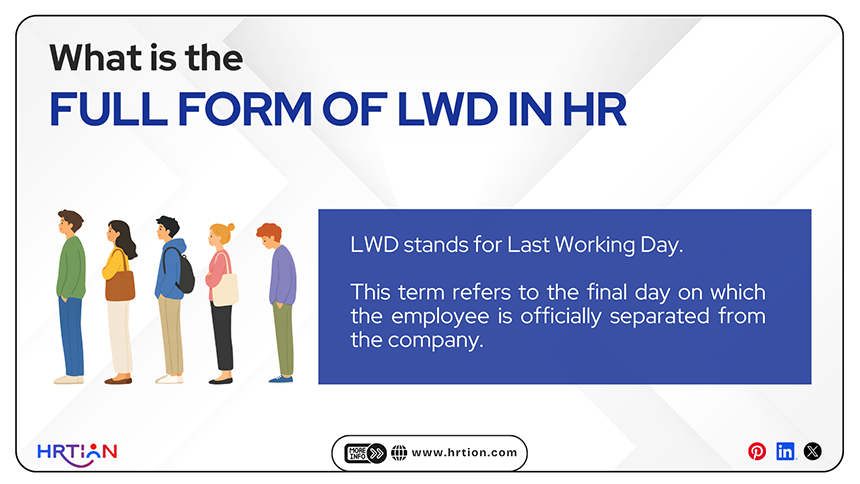
LWD stands for Last Working Day.
This term refers to the final day on which the employee is officially separated from the company, typically after completing the notice period or on an agreed date.
An employee is expected to complete and transfer all responsibilities before the LWD. Only the organization can change the LWD by waiving the notice period.
After the LWD, the employee is no longer on the company’s payroll and cannot use any employer resources for their benefits.
Also Read: Employee Onboarding Software Guide
Manage the payroll, attendance, shift roles, and more in an all-encompassing HR suite. Your ultimate HR toolkit is just a click away.
What is the Definition of LWD?
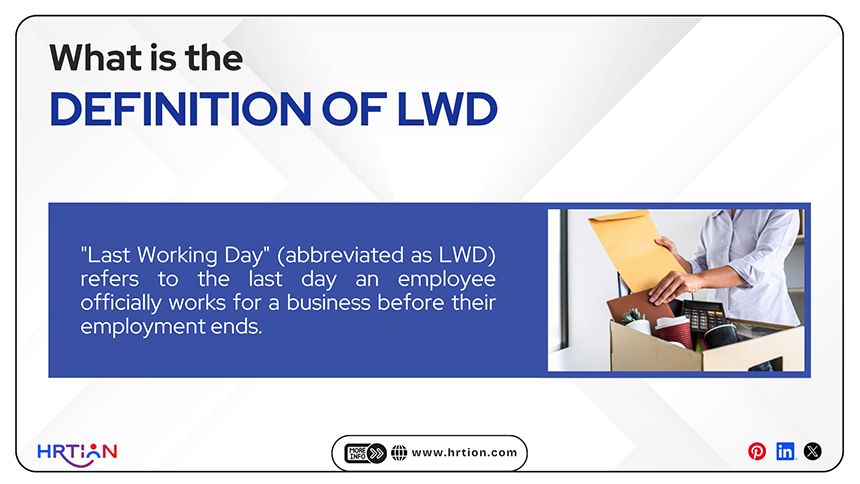
“Last Working Day” (abbreviated as LWD) refers to the last day an employee officially works for a business before their employment ends. The last day is often accompanied by the employee completing their assigned responsibilities, finishing their required handover process, and finally exiting the company.
LWD serves as a powerful milestone during the employee exit process, as it prepares both the employee and the employer for a smooth transition.
Before the LWD, the employees are expected to complete their pending tasks and goals, transfer knowledge, return any company assets, and complete their exit formalities.
A clear, concise, and detailed last working day avoids any confusion during the separation process, providing a formal timeline for the completion of all necessary tasks and activities related to an employee’s exit while still maintaining a professional relationship between the employee and the business.
How is LWD determined: Factors Involved
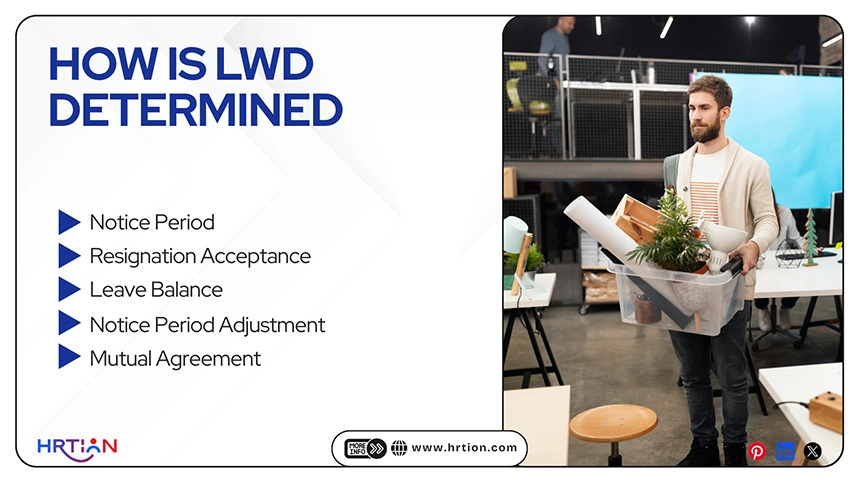
Several factors play a role in determining an employee’s Last Working Day (LWD), the most important of which is the notice period.
The LWD is calculated once an employee submits their resignation or the employer begins the separation process, and the terms of the employment contract and company policies play a major role in the calculation itself.
Some factors are provided below in detail:
- Notice Period
This is the standard notice period, which is mentioned in the employee agreement and is added to the resignation date to calculate the LWD.
- Resignation Acceptance
In certain organizations, the LWD is only finalized after the resignation is formally accepted by the employer.
- Leave Balance
Depending on the organization’s policy, any approved leaves taken during the notice period may affect the final working date.
- Notice Period Adjustment
The employer often exercises limited power regarding extending, shortening, or waiving the notice period entirely based on business requirements.
- Mutual Agreement
Certain cases often have both the employer and employee agreeing on a different last working day such that it suits both parties.
How to Calculate LWD
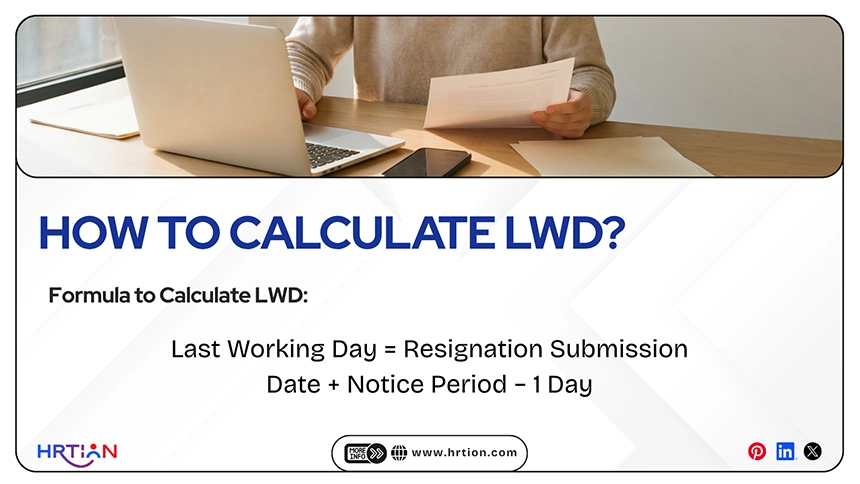
To calculate the Last Working Day or final relieving day of an employee before their employment officially ends. It is calculated with the employee’s resignation date and required notice period.
Formula to Calculate LWD:
Last Working Day = Resignation Submission Date + Notice Period − 1 Day
Note: By subtracting one day, the company starts the notice period from the day the notice is submitted. It can be excluded only if the company’s policies state that.
For example:
Resignation date: 5 August 2026
Notice period: 30 days
Calculation:
5 August 2026 + 30 days − 1 day = 3 September 2026
LWD in Resignation vs Relieving
Many employees confuse Last Working Day with the Relieving date. It can be the same in some cases; it is not always equal. Here are the core differences between the two
| Factor | Resignation | Relieving |
| Meaning | The employee submits a formal resignation lettter/mail to end the employment contract. | The employer releases the employee from their duties after completing the exit formalities. |
| LWD Definition | The last or final working day calculated using the resignation date and the notice period. | The date of separation is decided or approved by the employer on the basis of notice completion, handovers, and company policies. |
| Who Chooses It | Employee | Employer |
| Payroll is considered | Yes | Sometimes |
| Required documents | Resignation letter, resignation acceptance email/letter | Relieving letter, experience letter, full and final settlement documents |
| Purpose | Helps employee and employer to plan the departure with required formalities | Marks the end of employment officially and is recorded in the relieving letter. |
Importance of LWD
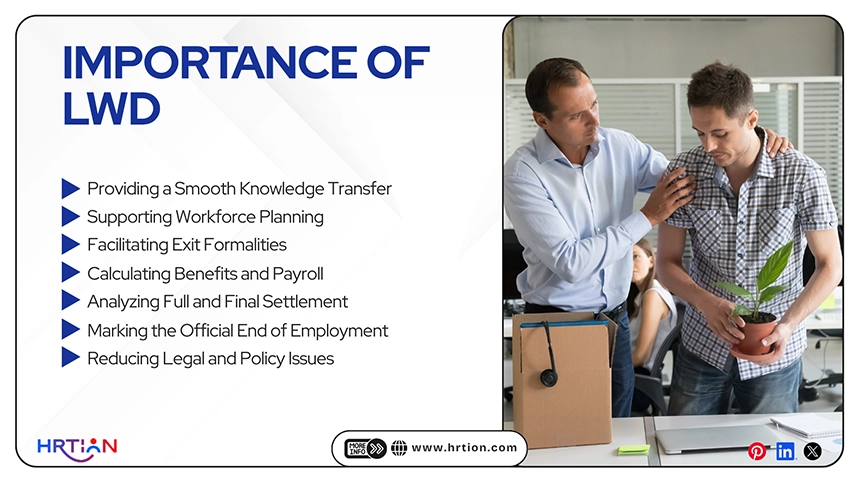
The Last Working Day serves as a significant official milestone in the employee onboarding process, detailing the official date on which an employee completes their final work and ends their employment with the organization. Some points highlighting its importance are provided below:
- Providing a Smooth Knowledge Transfer
The LWD gives employees sufficient time not only to hand over ongoing projects and minimize disruptions to the business, but also to share their valuable information and insights with their replacements or team members.
- Supporting Workforce Planning
For maintaining productivity levels, managers and HR teams often use the LWD to plan resource allocation, recruit replacements, and adjust project schedules to keep the transition clean and efficient.
- Facilitating Exit Formalities
The Last Working Day is also seen as a reference point when an employee returns company assets, their system access is revoked, exit interviews are conducted, and administrative tasks are finalized.
- Calculating Benefits and Payroll
The main basis of salary, leave encashment, bonuses, and other benefits is formed based on the employee’s LWD. The LWD also helps in pinpointing eligibility for benefits and the effective date of benefit termination.
- Analyzing Full and Final Settlement
Many organizations use the LWD for calculating and processing the employee’s full and final settlement, which includes unpaid salary, reimbursements, deductions, and any remaining outstanding payments.
- Marking the Official End of Employment
The LWD provides official documentation of the end of an employment relationship in the form of relieving letters and experience letters.
- Reducing Legal and Policy Issues
Proper documentation of the LWD helps businesses comply with employment contracts, notice period requirements, labor laws, and even internal HR policies. This reduces a lot of legal risk and disputes between the employee and the organization.
Formalities to Complete on LWD
The Last Working Day is considered to mark the completion of the employee’s tenure and association with the company. The below-stated formalities should be completed by both the employee and the employer.
Formalities for Employees
- Knowledge Transfer
It is important to hand over all the projects, responsibilities, passwords, documentation, and other work-related information to the manager or your replacement to ensure work continuity.
- Return Company Assets
Return all the assets and belongings to the company on the LWD, including:
- Laptop or computer
- Mobile phone
- Identity card or access badge
- Office keys
- Security tokens or identity-related devices
- Badges
- Company credit cards
- Headphone
- Any equipment or accessories
- Email ID accesses
- Complete Exit Clearance
Make sure you obtain clearance from all relevant departments before leaving. Contact these departments and complete formalities related to separation or exit:
- Human Resources
- Reporting Manager
- Information Technology
- Administration or Facilities
- Finance
- Security
- Participate in Exit Interview or Feedback Session
Attend the exit interview or feedback meetings to provide constructive feedback about your entire experience with the company, which can benefit both the employee and employers for ending terms on a positive note.
- Verify Final Payments and Documents
Make sure you thoroughly check the full and final settlements and confirm that you receive all the important documents, such as:
- Relieving letter
- Experience letter
- Full and Final payment (FNF)
- Tax-related documents
- Benefits or provident fund proofs.
- Update New Contact Information
Provide the HR with a working email address, phone number, and mailing address so that you can receive all the pending documents or settlements after you are gone.
Formalities for Employers
- Confirm the Last Working Day
Communicate with the employee and all related departments about the approved LWD to ensure that everyone follows the offboarding procedure and deadlines.
- Review Knowledge Transfer
Ensure that all the documents, projects, handovers, and pending responsibilities are transferred before the employee leaves.
- Collect Company Assets
Verify that company-owned assets are returned and record a receipt before completing the clearance process.
- Revoke All Accesses
Disable all the employee’s access to company resources after work is completed on the LWD. Take details of:
- Email accounts
- Business applications
- Internal Policies
- VPN Access
- Cloud Storage
- Building and security access
- Process FNF
Make sure to calculate and process Full and Final payments, reimbursements, deductions, leave encashment, and other financial obligations the company has towards employees.
- Issue Employee Documents
Prepare and provide all the documents that the employee needs, such as a relieving letter, experience letter, settlements, fund statements, and employment-related records.
- Update Internal Records
Once all formalities are cleared, update the HR, payroll, IT, and compliance records to reflect that the departure is completed and ensure all systems remain accurate and up to date for all related departments.
How to Write LWD mail: Employee vs HR

An LWD mail is the final closure email that formally communicates the final working day and contract termination. While employees send this email to inform their colleagues about their departure, HR sends the email to inform all relevant departments about the offboarding.
LWD Email By Employee
Employees can write this email on their approved LWD or when the resignation has been accepted. It must contain a professional, appreciative, and informative tone. Here is what is important to include:
- Confirmation of last working day
- A note of gratitude to the company, manager, and colleagues.
- Information about the responsibilities transfer and handover status.
- Contact details for future communication
- A polite closing
Example Structure:
| Subject: Confirmation of Last Working Day Dear (Manager or HR Name), Thanks for accepting my resignation. As discussed, my Last Working Day will be (date). I assure you I will complete all my pending tasks, hand over my responsibilities, and ensure a smooth transition before my departure. I sincerely thank you for your guidance and support during my tenure. I appreciate the opportunities provided by the organization. Regards, Employee Name, Position Contact Details |
LWD Email by HR
An LWD email by HR is sent to communicate with the employee, manager, and other related teams about the employee’s departure and facilitate the offboarding process. It must include the following:
- Employee details like name, designation, and department
- Confirmed Last Working Day
- Details of handover or replacement
- Information about exit formalities
- Appreciation for employees’ contributions
- Contact details for HR-related queries.
Example Structure:
| Subject: Confirmation of Last Working Day Dear (Employee’s Name), This is to confirm that your Last Working Day with (Company’s Name) will be (Date). Please complete all exit formalities, including project handover, asset submission, and clearance process, before you leave. Your FNF (full and final) settlements and employment documents will be processed after the completion of required formalities. We wholeheartedly thank you for your contribution and wish you success in your future endeavors. Regards, HR Department. Contact Information |
Best Practices for Successful Management of LWD

Managing the Last Working Day (LWD) required effective communication from both the employee’s and the employer’s ends. These are the best practices to ensure a smooth transition and positive offboarding.
| For Employers | For Employees |
| Communicate the approved LWD in writing to the employee and all associated departments. | Confirm the approved LWD with your manager and HR before making your departure. |
| Create an offboarding plan that must cover handovers, exit formalities, and final documentation. | Prepare your work, organize file for smoother access, and complete all pending tasks before leaving. |
| Keep HR, IT, finance, payroll, and managers informed throughout the offboarding process. | Return all the assets such as laptops, access cards, and any other company property. |
| Revoke access to company systems, applications, email accounts, and office facilities after the LWD. | Save or transfer the work-related files, and log out from company’s system or do as instructed by your manager. |
| Process the complete, full, and final payment on LWD or as stated in the company handbook. | Collect or confirm the timeline of receiving all payments. |
| Issue relevant documents such as a relieving letter, experience letter, and other applicable documents. | Review all your documents properly or raise any question you have before leaving. |
| Arrange a feedback session with the employee to ensure a positive and respectful exit. | Maintain professionalism, support transition, and leave on positive terms with your colleagues and the company. |
Common Challenges in Managing LWD
Even with clear policies, there are certain challenges that arise during the LWD process. Addressing those issues proactively helps ensure successful offboarding.
Challenge : Employees and employers may disagree on notice period or LWD, especially when it was unclearly mentioned in the contract. Sometimes, employees insist on leaving early due te different reasons, which can affect business continuity.
Solution: Thus, form clear notice period-related clauses in employee agreements and encourage employees to strictly follow them.
Challenge: Critical information may be lost or employee delays the handover, and that can result in incomplete knowledge transfer.
Solution: Use and form a proper handover process and assign backup owners or replacements as early as possible.
Challenge: The employee may leave without returning the assets like laptops, ID cards, and other equipment.
Solution: Maintain a proper asset checklist and share it with every related department. Furthermore, do not release exit documents until all assets are collected and receipts are generated for the same.
Challenge: Incorrect records of LWD can cause wrong payments and incorrect settlements.
Solution: Choose an integrated HR management tool like HRtion to link HR systems with payroll tools. This will result in accurate and timely fund settlements.
Challenge: Late issuance of relieving or experience letters can affect an employee’s future plans.
Solution: Automate the documentation process and offer a self-service portal to employees to obtain all documents related to departure.
Final Take
The Last Working Day is not just about the end of employment; it is a critical day in any employee’s tenure in a company. It can directly impact workflow, payroll, knowledge, and records; thus, managing it is more complex than it seems.
Therefore, implementing modern HR systems like HRtion can simplify LWD management by automating related tasks such as exit formalities, FNF settlements, payroll processing, and generating documents. It can save time while improving accuracy and employee experience simultaneously.
FAQs
What is the full form of LWD?
LWD stands for Last Working Day, which is an employee’s final official working day before leaving the company.
Are the Last Working Day and Relieving date the same?
Not necessarily. The LWD is the final working day on which the employee performs work, while the release date is the official date on which the company releases the employee. In many companies, both are held on the same date.
Can Last Working Day be changed?
Yes, LWD can be decided with a mutual agreement between employee and employers. If an employee requests early release, notice period extensions, or notice buyout, the employer can refer to the company policies to find a way out.
How to inform about the Last Working Day?
To inform LWD, both employees and employers can write an email and share it with all related managers and departments.
What documents are issued on the LWD?
After completing the exit formalities, the employee is subjected to receiving the following:
- Relieving letter
- Experience certificate
- Full and Final fund settlements
- Salary slips
- Tax documents

Sunita Kumari is a Freelance Contributor Writer at HRTion, writing accurate, reliable, and informative content. She completed her Bachelor's from Rajdhani College of the University of Delhi. She has been a Human Resources Recruiter for almost 2 years, including over 1 year with Battersea Web Expert. Drawing on her recruitment and HR processes experience, she writes clear and practical payroll-related guides that help employees and job candidates better understand HR procedures and workplace practices.