- What is HR Analytics?
- Importance of HR Analytics
- Types of HR Analytics
- Difference Between HR Reporting vs. HR Analytics
- What HR Data Should Your Company Collect
- How to Turn Data into Actionable Insights
- Key HR Metrics to Track
- Uses of HR Analytics in Different Areas
- Technology in HR Analytics
- Common Challenges with HR Analytics Management
- Best Practices for Effective HR Analytics Handling
- Conclusion
- FAQs
Businesses collect a huge variety of employee data every day. From recruitment, attendance, payroll reports, performance, and employee engagement to turnover, HR departments have access to most workforce information these days.
But only having information is not enough; the real value comes from understanding what that data means and turning it into actionable insights.
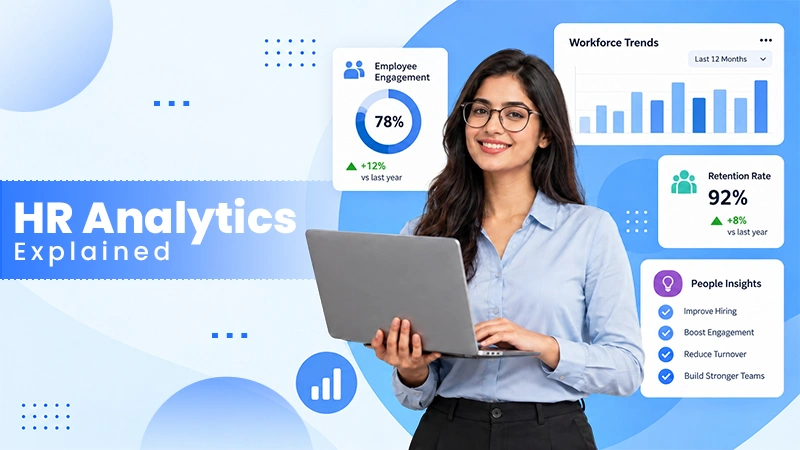
This is where HR analytics comes in. It is known by various aliases, including people analytics, workforce analytics, or talent analytics, but the purpose is the same: to solve business problems and help businesses make evidence-based decisions.
Here is what every organization must know about HR analytics and use it to encourage business growth.
What is HR Analytics?
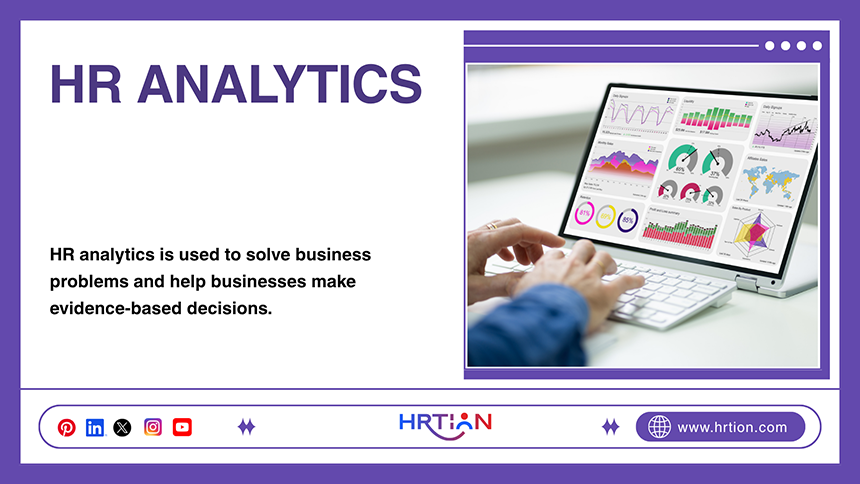
HR analytics is the systematic collection, analysis, and interpretation of workforce data to improve HR decision-making, workforce planning, and business growth. It is also known as human resources analytics or people analytics.
It is the process of collecting, analyzing, and interpreting employee-related data to support better decision-making within an organization. HR analytics uses data from areas such as recruitment, employee performance, attendance, compensation, engagement, turnover rate, and more to find patterns and trends.
This process helps an organization make informed, evidence-based decisions rather than relying on assumptions or intuition.
HR analytics is highly useful in identifying reasons behind high turnover rates, finding the best candidates, measuring employee performance, and predicting future workforce requirements.
In other words, HR analytics software helps organizations understand their employees through data. By turning HR analytics into actionable insights, companies can gain major benefits like improving employee satisfaction, reducing costs, increasing productivity, and developing more effective strategies.
Manage the payroll, attendance, shift roles, and more in an all-encompassing HR suite. Your ultimate HR toolkit is just a click away.
Importance of HR Analytics
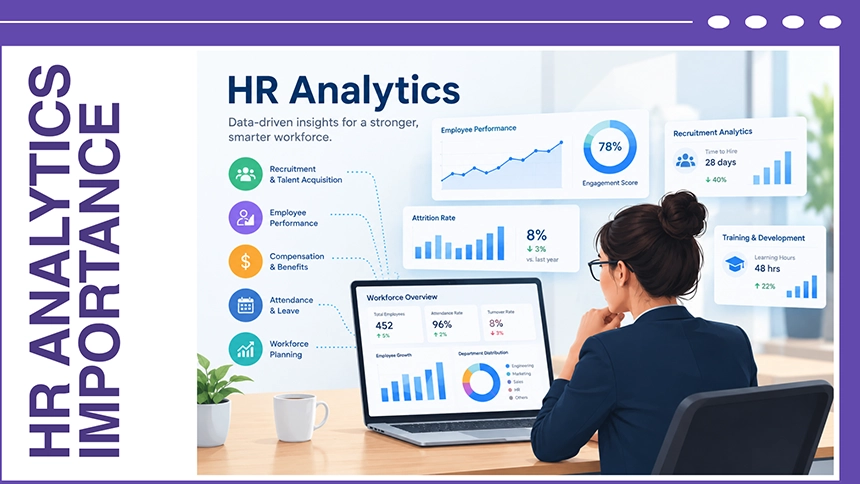
HR analytics helps organizations move from assumption-based HR management to informed decision-making for the workforce.
According to Gallup’s State of Global Workplace 2026, “only 20% of employees worldwide are engaged at work.”
These figures are clear examples of why organizations need better ways to analyze employee experiences instead of assuming they are satisfied.
With facts and data, company leaders can identify trends, solve HR problems, and support better decision-making.
Here is why HR analytics are highly important in the current dynamic market.
1. Data-Driven Decision Making
HR analytics dashboard provides HR leaders with the evidence to support their decisions rather than relying on assumptions and personal opinions.
By analyzing data on employee performance, attendance, salary, turnover, and engagement, organizations can better plan hiring, promotions, training, and workforce management.
2. Reduced Employee Turnover
Unexpected turnover can be expensive and disruptive, mainly for growing organizations. Analytics can help find reasons and patterns why employees are leaving.
For example, a company can find where the turnover is particularly high, such as employees who are leaving:
- Less than two years of tenure
- From a particular department
- With limited career progression
- Have lower compensation than market benchmarks
- Teams having consistently low engagement
3. Improved Recruitment
HR analytics can show the best recruitment channels to find the strongest candidates and the most effective methods of hiring.
Companies can use the data to analyze which job portals, recruitment agencies, employee referrals, social media, career pages, or interview methods result in employees who stay longer and perform well.
4. Better Workforce Planning
The analytics data help companies forecast future workforce requirements. It can help decide how many employees are needed, what skills are required, and which positions are going to be vacant due to various reasons like retirements, resignations, or business expansions.
This helps prepare in advance and avoid issues like employee shortages or unnecessary hiring.
5. Identifies Skills Gaps
With workforce skills changing every day, companies need to compare their current employee capabilities with future business requirements.
The World Economic Forum estimates that “39% of workers’ existing skill sets will be transformed or become outdated between 2025 and 2030.”
6. Increased Employee Engagement
Employee engagement is directly related to motivation, satisfaction, and commitment towards the organization.
HR analytics can analyze employee surveys, feedback, absenteeism, performance, and other indicators to understand employee engagement levels.
With these insights, organizations can plan different initiatives like recognition programs, flexible work environments, career development opportunities, and other employee welfare programs.
7. Helps Control HR Costs
Analytics can help regulate and control expenses related to employees. It is highly useful in identifying unnecessary recruitment, overtime, training, absenteeism, and employee turnover costs.
By understanding where money is being spent and measuring the results, organizations can plan the HR budget more efficiently.
Types of HR Analytics
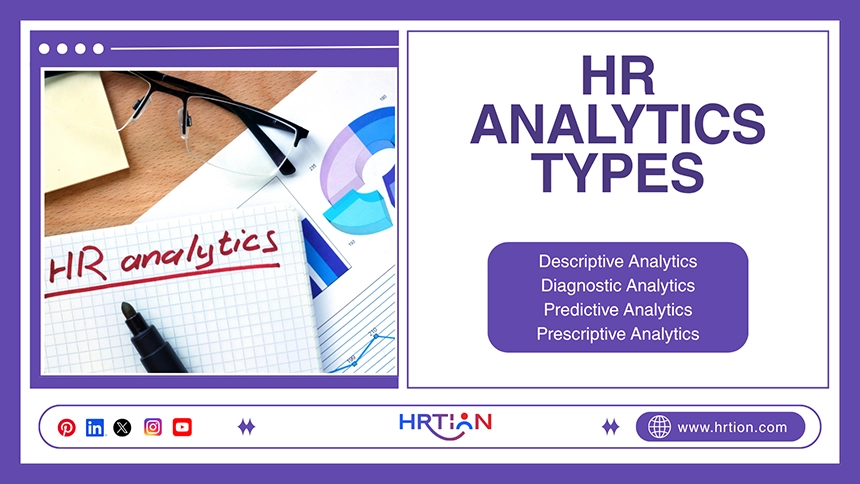
HR analytics can be classified into four different types of categories: Descriptive Analytics, Diagnostic Analytics, Predictive Analytics, and Prescriptive Analytics.
Summary of HR Analytics Types
| Type of HR Analytics | Main Question | Purpose |
| Descriptive Analytics | What happened? | Understand past HR data and trends. |
| Diagnostic Analytics | Why did it happen? | Identify causes of HR problems. |
| Predictive Analytics | What is likely to happen? | Forecast future HR trends and risks. |
| Prescriptive Analytics | What should we do? | Recommend appropriate HR actions. |
Here are the insights into the types of HR analytics.
1. Descriptive Analytics
Descriptive analytics focuses on understanding what actually happened. These analytics provide useful information, but they don’t explain the reason behind the event.
It uses historical data to summarize workforce activity. A few examples are:
- Employee headcount
- Turnover rate
- Employee demographic
- Absenteeism
- Hiring numbers
- Average tenure
- Training completion rates
- Employee engagement scores
For example, an organization can understand the turnover rate over the past few years and check if the number of people leaving has increased or decreased. HR managers can use this data to understand trends and prepare reports accordingly.
2. Diagnostic Analytics
Diagnostic analytics focuses on “Why did something happen?”
It examines the patterns of the data carefully. Thus, it helps HR leaders use diagnostic analytics to investigate possible causes behind a trend.
For example, if an organization observes a high employee turnover rate, diagnostic analytics can be used to assess factors like salary, job satisfaction, employee engagement, management policies, career opportunities, and working conditions.
If turnover is high in a particular group of employees, such as employees with less than two years of experience, HR can collect feedback and discover that they are leaving because of limited growth opportunities.
3. Predictive Analytics
Predictive Analytics mainly focuses on forecasting what is about to happen in the future. It uses historical and current data, statistics, and predictive models to identify future trends and potential risks.
These analytics can be used to predict employee turnover, future workforce requirements, employee performance, absenteeism, and recruitment needs. This helps an organization take preventive measures before the issues arise.
4. Prescriptive Analytics
Prescriptive analytics helps determine what actions should be taken based on the data and insights available. It uses information from descriptive, diagnostic, and predictive analytics to recommend useful actions.
For example, if predictive analysis indicates an increase in employee turnover, prescriptive analytics helps determine which actions to take, such as salary adjustments, training programs, flexible working arrangements, or career development opportunities.
Difference Between HR Reporting vs. HR Analytics
HR reporting and HR analytics both involve the use of employee data, but they serve different purposes.
HR reporting focuses on presenting historical data and showing what actually happened, while HR analytics analyzes that data to understand why the event happened, predict future outcomes, and support better decision-making.
| HR Reporting | HR Analytics |
| Shows what happened | Explains why it happened |
| Primarily uses historical data | Uses historical and current data to generate actionable insights |
| Focuses on metrics and summaries | Focuses on patterns, relationships, and predictions |
| Supports routine HR monitoring | Supports strategic decision-making |
| Example: Monthly absenteeism report | Example: Identifying factors such as high absenteeism. |
What HR Data Should Your Company Collect
For HR analytics to be effective, the company needs to collect accurate, relevant, and updated employee data. The type of data collected should help in different HR activities like recruitment, performance management, employee development, compensation, and retention.
1. Employee Demographic Data
Collecting basic information about employees such as age, gender, education level, work location, department, job role, and years of experience is the fundamental step.
This data helps HR understand the composition of the workforce and identify employee trends.
2. Recruitment and Hiring Data
Recruitment data includes information such as job applications, sources of candidates, interview results, time taken to fill positions, recruitment costs, offer acceptance rates, and new-hire performance.
Using this data, organizations can evaluate the effectiveness of current recruitment strategies and identify which hiring channels provide the best candidates for the company.
3. Attendance and Absenteeism Data
HR departments can collect data related to employee attendance, working hours, leave, absenteeism, overtime, and punctuality. This can help track attendance patterns and workforce availability.
4. Employee Performance Data
Performance data includes performance ratings, achievement of targets, productivity measures, quality of work, completed projects, and feedback from managers.
By using this information, HR can evaluate employee performance and identify high-performing employees as well as areas requiring improvement.
5. Compensation and Benefits Data
The organization can collect information about salaries, bonuses, incentives, benefits, allowances, and other forms of compensation.
Analyzing this data helps HR determine whether the compensation being offered is competitive, fair, and aligned with the responsibilities and performance.
6. Training and Development Data
Training data consists of information regarding the number of training programs attended, training hours, training costs, employee participation, assessment results, and changes in performance after training.
The data collected can be used to analyze whether the training programs are effective and identify areas where employees require additional skills or development.
7. Employee Engagement Data
Collecting employee feedback through surveys, engagement questionnaires, interviews, and feedback systems offers insights into employee motivation, job satisfaction, workplace culture, leadership, communication, and overall engagement.
Assessing employee sentiments helps HR identify potential problems causing low productivity or employee turnover.
How to Turn Data into Actionable Insights

Collecting HR data is not enough. An essential part of HR analytics is turning numbers into decisions. Here is the practical process to follow.
1. Identify Business Problem
The first step is to clearly identify the HR problem, or business question, that needs to be addressed. Instead of collecting data without a specific purpose, HR should identify what improvement the business requires.
2. Collect Relevant and Reliable Data
Once a problem is identified, HR should collect accurate and relevant data from the right sources. This may include employee surveys, performance records, attendance records, recruitment information, compensation data, and exit interviews.
The quality of data is important because it has to be accurate. Incomplete information can lead to incorrect conclusions and poor decisions.
3. Analyze the Data to Identify Patterns
After collecting the data, HR professionals must analyze trends, relationships, and unusual patterns. Data can be compared across departments, job roles, experience levels, time periods, and other relevant groups.
4. Find the Root Cause
Identifying a pattern is not enough without finding the exact reason why the pattern exists. For this, HR professionals can use diagnostic analysis and point out the underlying cause.
5. Convert Findings into Clear Insights
The result of analysis should be presented in a simple and understandable way. Instead of providing managers with large amounts of raw data, HR should explain what the data means and why it matters.
6. Recommend Specific Actions
The next step is to determine what should be done with the insights. Recommendations should be specific, realistic, and connected to the identified problem.
7. Set Measurable Goals
HR should establish measurable goals to determine whether the action taken is successful. The goals should be specific and time-bound.
Example of Turning HR Data into Action
Consider an organization experiencing high employee turnover.
Data Collected: The company finds that 25% of employees leave within their first year.
Analysis: Exit interviews and employee surveys show that many new employees feel the training provided is inadequate, and they have limited interactions with their managers.
Insight: Poor onboarding and insufficient managerial support are the major reasons for early employee turnover.
Action: The company introduces a structured onboarding program that includes assigning mentors to new employees and managers doing regular check-ins in the first six months.
Measurement: HR tracks first-year turnover and employee engagement over the following year to evaluate whether the changes are effective.
Key HR Metrics to Track
The right HR metrics, like KPIs and OKRs, are important to track. Some of the most useful indicators for HR analytics are:
| HR Metric | What It Measures | Basic Formula |
| Employee Turnover Rate | Employees leaving | Employees who left ÷ Average employees × 100 |
| Retention Rate | Employees retained | Employees remaining ÷ Employees at start × 100 |
| Absenteeism Rate | Time lost to absence | Absence days ÷ Available workdays × 100 |
| Time to Hire | Recruitment speed | Days from opening to accepted offer |
| Cost per Hire | Recruitment cost | Total recruitment cost ÷ Number of hires |
| Offer Acceptance Rate | Candidate acceptance | Accepted offers ÷ Total offers × 100 |
| Internal Promotion Rate | Career mobility | Internal promotions ÷ Average workforce × 100 |
| Training Completion Rate | Learning participation | Completed training ÷ Assigned training × 100 |
| Employee Engagement | Workforce connection | Based on survey methodology |
| Revenue per Employee | Workforce productivity | Revenue ÷ Average number of employees |
Uses of HR Analytics in Different Areas
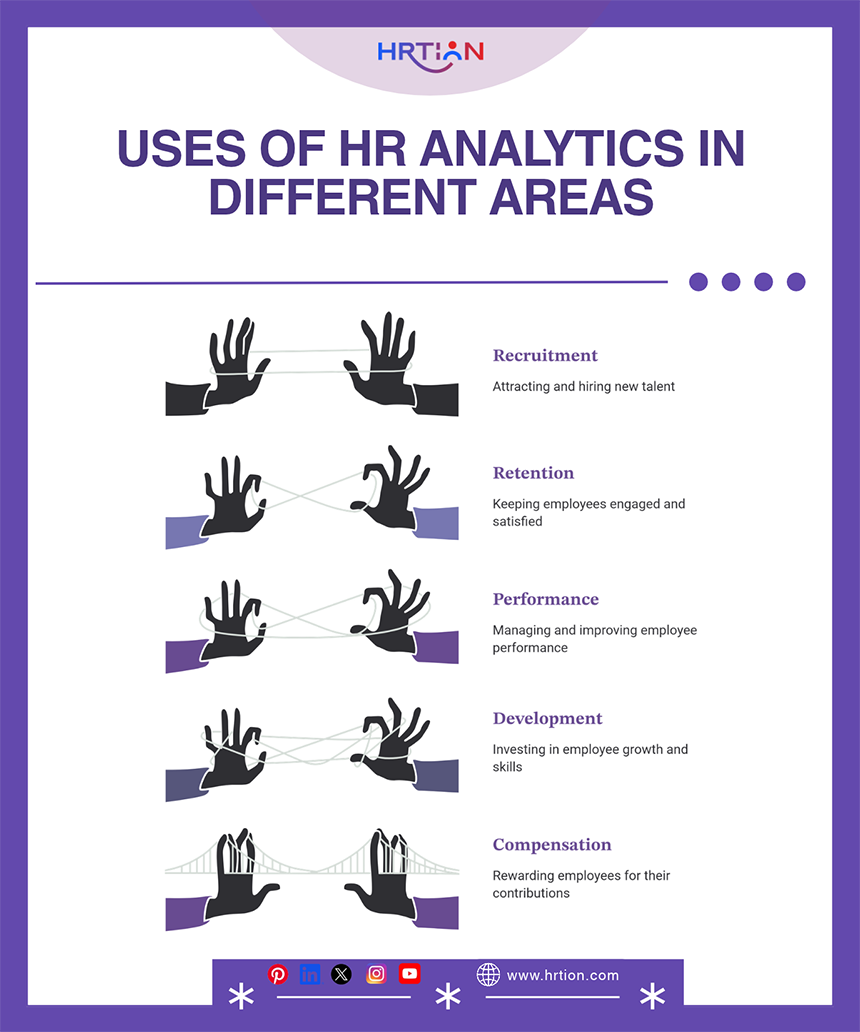
HR analytics can support almost every stage of the employee lifecycle. Here is how it can be used in different aspects of employee management.
1. Recruitment and Hiring
Recruitment analytics can identify which sources produce the best quality of candidates and which hiring stages are the toughest to deal with.
LinkedIn’s 2025 Future of Recruiting report found that “37% of organizations surveyed were actively integrating or experimenting with generative AI, while talent acquisition professionals using these tools reported an average 20% reduction in workload.”
The same research found that companies with the highest use of skill-based searches were 12% more likely to make a quality hire.
2. Employee Retention
HR analytics can help identify groups with elevated turnover risk. HR leaders can analyze tenure, compensation, engagement, promotion history, manager, and workload to find out which employees are at risk in the company and build better employee retention strategies.
The analysis will then help identify the conditions that may contribute to turnover.
3. Employee Performance Management
HR analytics helps organizations track and evaluate employee performance using information like ratings, productivity, achievement of targets, project outcomes, and feedback.
By analyzing this data, managers can identify high-performing employees, employees needing additional support, and factors affecting productivity. It also helps make performance evaluations more objective and data-driven.
4. Learning and Development
HR analytics can identify which skills the company has today and which skills it requires tomorrow.
This is quite important because WEF estimates that “170 million new jobs could be created globally by 2030 while 92 million jobs could be displaced by major labor-market trends, resulting in a net increase of 78 million jobs.”
For HR teams, it exhibits the importance of skill mapping, reskilling, and workforce planning.
5. Compensation and Benefits
Analytics can help organizations understand compensation patterns and pay gaps that some roles might have.
The HR team can compare compensation by using stats related to:
- Role
- Level
- Location
- Experience
- Performance
- Tenure
This will help identify unusual differences in compensation that may require further thought for employee retention.
Technology in HR Analytics
In current times, technology plays an important role in HR analytics by helping organizations collect, store, analyze, and interpret employee data efficiently. It enables HR professionals to make faster and more accurate decisions.
Modern HR technology may include:
- Human Resource Management Systems (HRMS)
- Human Capital Management (HCM) platforms
- Payroll software
- Attendance systems
- Applicant tracking systems
- Performance management platforms
- Learning management systems
- Employee engagement platforms
- Business intelligence tools
- AI-powered analytics tools
HRtion: Modern Solution for HR Needs
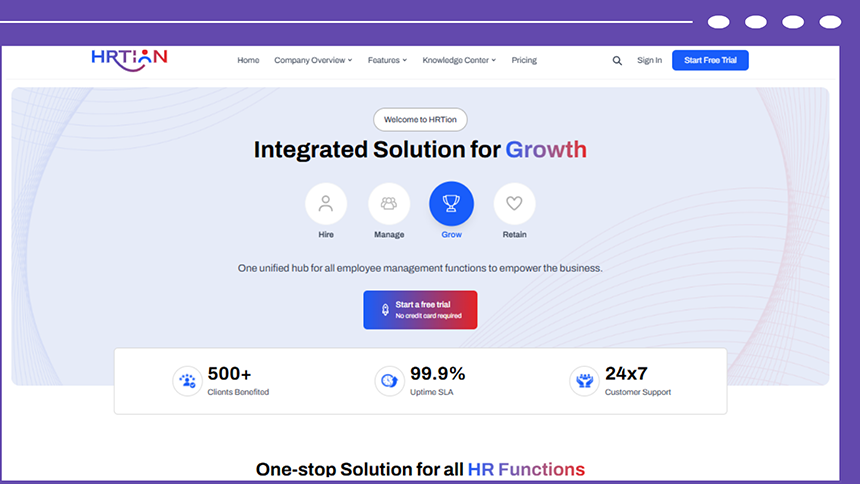
One platform that can help with successful HR analytics management is HRtion. It offers numerous features that facilitate data collection and workforce analysis.
This modern HR platform combines centralized HR data, employee dashboards, automation, and AI-driven insights to support faster and data-informed decisions.
Key features of HRtion are:
- Employee management
- Recruitment and hiring
- Payroll management
- Attendance management
- Performance management
- Training and development
- Self-service portal
Common Challenges with HR Analytics Management
HR analytics can deliver significant value, but there are a few challenges that may hinder the overall process. Addressing these issues is important to ensure that analytics offer accurate, secure, and useful, actionable HR insights.
- Poor Data Quality: If employee records are incomplete, inconsistent, duplicated, or outdated, results may be unreliable.
- Data Privacy and Security: HR analytics includes sensitive employee information, which must be protected from unauthorized access.
- Data Integration: Combining data from different GR systems and sources can be difficult.
- Employee resistance: Employees can be concerned about how their data is collected and used by the company.
- Bias in Data: Biased data can lead to unfair or inaccurate decisions by HR or leadership.
- High Implementation Cost: Advanced HR analytics tools may require significant investment in software, training, and infrastructure.
- Lack of Management Support: The analytics may not be effective without sufficient support from leaders and managers.
- Outdated Data: Outdated data can create data silos. Thus, regularly updating employee information is important to maintain accuracy.
- Lack of Analytical Skills: HR professionals may lack enough analytical skills to understand data, interpret metrics, and communicate insights.
- Too Many Metrics: Having too many metrics can create confusion. HR should use only the most closely related metrics.
Best Practices for Effective HR Analytics Handling
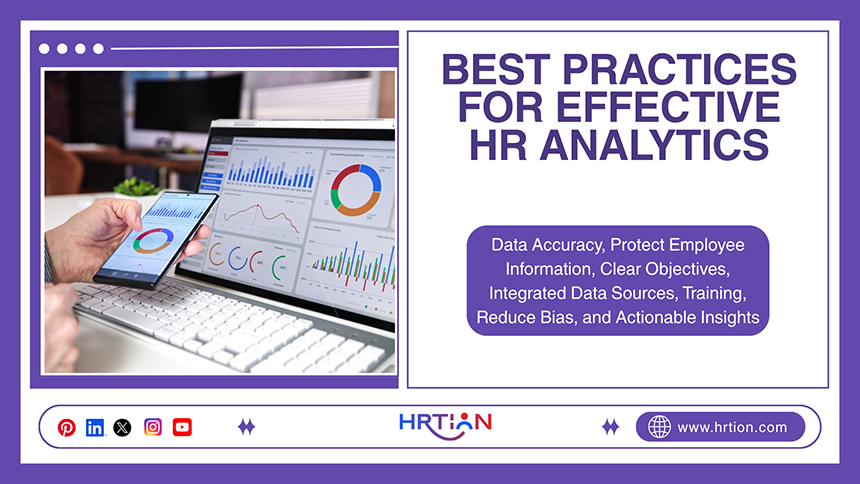
Effective HR analytics requires an organization to manage employee data carefully and use it responsibly. The following are best practices to achieve the best results.
- Focus on Data Accuracy: Keep employee data complete, accurate, and regularly updated to ensure data accuracy.
- Protect Employee Information: Use strong security measures and follow various protection measures when handling sensitive employee information.
- Set Clear Objectives: Define specific HR goals before collecting and analyzing data.
- Use Relevant HR Metrics: Instead of collecting random metrics, focus on key metrics that are important, such as employee turnover, attendance, performance, recruitment, and engagement.
- Integrate Data Sources: Combine information from different HR systems to create a complete view of the workforce.
- Train HR Employees: Provide training to the HR team so that they are able to understand data properly and use tools effectively.
- Reduce Bias: Regularly review data and analytical models used by the company to identify and minimize any sort of bias.
- Take Actions Based on Insights: Use analytics results to support practical HR decisions rather than just collecting data.
Conclusion
HR analytics is not just about generating monthly HR reports; it is a strategic process to understand what is happening inside an organization and within the workforce.
From recruitment to employee retention, HR analytics can help organizations make decisions across the entire employee lifecycle.
The smart way is not necessarily about collecting the most data; it is about turning reliable data into relevant insights and those insights into measurable actions.
FAQs
What is HR analytics?
HR analytics is the process of collecting, analyzing, and interpreting workforce data to improve HR decisions and business outcomes.
What are the four types of HR analytics?
The four common types of HR analytics are descriptive, diagnostic, predictive, and prescriptive analytics. Descriptive analytics explains what happened, diagnostic analytics tells why it happened, predictive analytics evaluates what may happen, and prescriptive analytics determines what action to take.
What is HR analytics used for?
HR analytics is used to collect, analyze, and interpret employee data. It can be used for recruitment, employee performance, attendance tracking, workforce planning, employee engagement, and reducing employee turnover.
What are the best HR analytics tools?
Some of the best HR analytics tools are HRMS, HR analytics and reporting tools, data visualization tools, recruitment analytics tools, performance management tools, employee engagement tools, predictive analytics tools, and payroll and attendance analytics tools.

Sunita Kumari is a Freelance Contributor Writer at HRTion, writing accurate, reliable, and informative content. She completed her Bachelor's from Rajdhani College of the University of Delhi. She has been a Human Resources Recruiter for almost 2 years, including over 1 year with Battersea Web Expert. Drawing on her recruitment and HR processes experience, she writes clear and practical payroll-related guides that help employees and job candidates better understand HR procedures and workplace practices.